
The consoles
Bandai sold three WonderSwan consoles in Japan between 1999 and 2003. They take the same cartridges, with one rule: a game made for colour needs a colour console.
Side by side
| WonderSwan | WonderSwan Color | SwanCrystal | |
|---|---|---|---|
| Released in Japan | 4 Mar 1999 | 9 Dec 2000 | 12 Jul 2002 |
| Price at launch | ¥4,800 | ¥6,800 | ¥7,800 |
| Model | SW-001 | WSC-001 | SCT-001 |
| Display | 2.49-inch reflective FSTN LCD, monochrome | 2.8-inch reflective FSTN LCD, colour | 2.8-inch reflective TFT LCD, colour |
| Resolution | 224 × 144 | 224 × 144 | 224 × 144 |
| Colours or shades | 8 shades of grey (chosen from 16) | 241 on screen from 4,096 | 241 on screen from 4,096 |
| Processor | 16-bit, NEC V30MZ core, 3.072 MHz | 16-bit, NEC V30MZ core, 3.072 MHz | 16-bit, NEC V30MZ core, 3.072 MHz |
| Memory | 16 KB (128 Kbit) | 64 KB (512 Kbit) | 64 KB |
| Sound | 4-channel digital; mono speaker, stereo through the headphone adapter | 4-channel digital; mono speaker, stereo through the headphone adapter | 4-channel digital; mono speaker, stereo through the headphone adapter |
| Power | 1 AA battery, or the rechargeable pack | 1 AA battery, or the rechargeable pack | 1 AA battery, or the rechargeable pack |
| Battery life | About 30 hours (AA alkaline) | About 20 hours (AA alkaline) | About 15 hours |
| Size | 74.3 × 121 × 24.3 mm with the AA cover; 17.5 mm thick with the pack | 74.3 × 128 × 24.3 mm with the AA cover; 17.5 mm thick with the pack | 77.5 × 127.7 × 17.5 mm, not counting the AA cover |
| Weight | About 93 g without battery | About 95 g without battery | About 98 g without battery |
| Connectors | Expansion port for the link cable or headphone adapter; no headphone jack | Expansion port for the link cable or headphone adapter; no headphone jack | Expansion port for the link cable or headphone adapter; no headphone jack |
| Cartridges played | WonderSwan; Color-only games show a warning | WonderSwan (in black and white) and WonderSwan Color | WonderSwan (in black and white) and WonderSwan Color |
WonderSwan
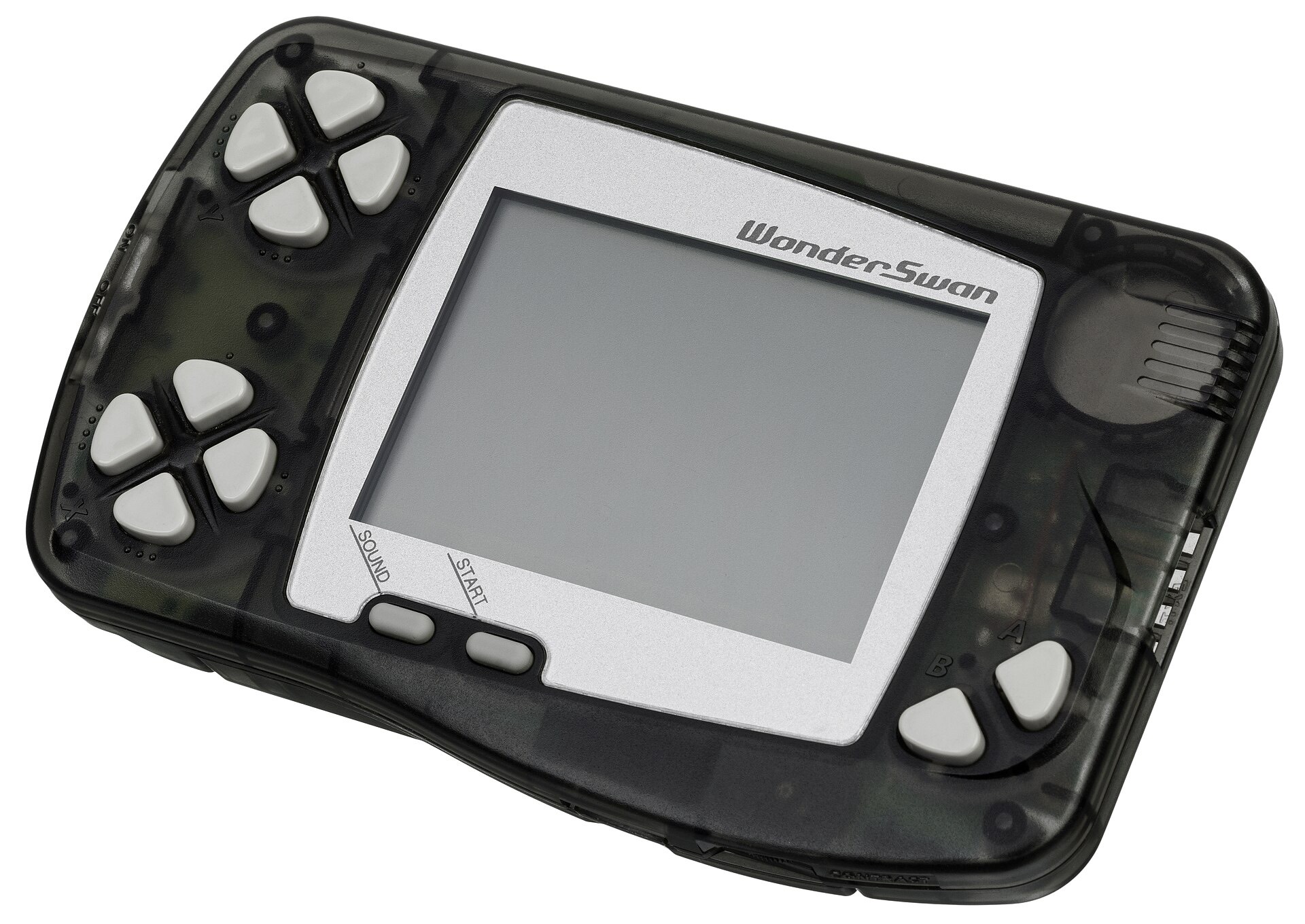

Bandai's first handheld, a small monochrome machine planned with Gunpei Yokoi's company Koto, built to be cheap, light and to run for a long time on one AA battery, and held either sideways or upright depending on the game.
Background
The WonderSwan was Bandai’s own handheld, but most of its planning and engineering came from Koto, the company Gunpei Yokoi founded after leaving Nintendo, where he had been behind the Game Boy. Yokoi died in 1997, before the machine was finished.
Bandai unveiled it at a press event on 8 October 1998, with a price of 4,800 yen and a release planned for March 1999, and put it in front of the public two days later at the autumn Tokyo Game Show in Makuhari. The pitch was a machine that was small, light and thin, aimed mainly at people aged 15 to 19. At the same event Bandai floated ideas for later: a pager unit, a link to a PC, and reading web pages through a PHS or mobile phone, all presented as things the hardware could do once it had first caught on as a game machine.
The Game Boy Color was already on sale and the Neo Geo Pocket Color arrived two weeks after the WonderSwan, yet Bandai kept a black-and-white screen on purpose. The usual explanation is cost and power: a low price and a long life on one battery were the selling points, and a colour panel would have worked against both.
Launch and sales
It went on sale in Japan on 4 March 1999 at 4,800 yen before tax. Four games came out with it: Yokoi’s puzzle game GUNPEY, Square’s Chocobo no Fushigi na Dungeon, Densha de GO! and Shin Nihon Pro Wrestling Toukon Retsuden.
About 600,000 consoles sold in the first two months and a million by the summer, when Bandai marked the milestone with three two-tone “Summer Version” colours. In the end there were 19 case colours, from the seven standard ones through bundle editions and prizes. No model in the family was ever sold outside Japan.
Figures for the whole line, all colour models included, came later. In May 2002 Bandai expected cumulative shipments of all three models to reach about 3.55 million by the end of March 2003, and by February 2003 more than 3 million had shipped. The WonderSwan and WonderSwan Color together sold 3.32 million. The monochrome model’s own total is not known.
Using it
There is no fixed direction pad. Instead the face has two groups of four buttons, X1 to X4 and Y1 to Y4, next to A and B. Turned sideways, the X group works as the pad; turned upright, the console is held like a phone and the Y group takes over, so games written for a tall screen fill the display properly. Bandai pitched this as a way to bring over arcade and other games without squeezing their screens. A row of small icons beside the picture shows power, low battery, the volume, a headphone sign, and whether the cartridge expects a sideways or upright grip.
It runs on a single AA cell, whose cover bulges out of the back; Bandai quoted up to about 30 hours of play on one battery. A nickel-metal hydride pack, sold separately, replaces the cover and makes the console about 7 mm slimmer; it lasts about 12 hours and charges in about an hour. The power switch slides on the left side. The sound button steps through loud, quiet and off, but the choice is forgotten at power-off, so the start-up chime plays every time. Holding START while switching on opens a screen for storing the owner’s name (up to 16 letters), birthday, sex and blood type, and the name then appears beside the Bandai logo at start-up; a few games use these details.
The speaker is a small piezo element and plays in mono. There is no headphone socket: headphones need an adapter that plugs into the expansion port, the same port the link cable uses, so the two cannot be used together.
Owners’ complaints are fairly consistent. The screen is dim, and moving pictures leave trails; a Game Watch writer reviewing the SwanCrystal in 2002 said the smearing had made action games hard work on both earlier models. Some find the button layout odd until they get used to it, and many dislike the start-up chime they cannot switch off. The cartridge connector has no cover, so dirt gets in and contacts fail; dead units can often be brought back by cleaning the battery and cartridge contacts.
How it differs
This is the first model. The screen is a 2.49-inch reflective monochrome panel with no light of its own, showing eight shades of grey. It is the smallest and lightest of the three, and the one that runs longest on a battery: about 30 hours on one AA cell, against about 20 for the WonderSwan Color and about 15 for the SwanCrystal. It is also the cheapest, at 4,800 yen against 6,800 and 7,800 at launch.
Games
It plays every cartridge made for the original WonderSwan. Cartridges made only for the WonderSwan Color do not run; the cartridge itself puts up a message saying it needs a WonderSwan Color. Some later games were made to work on both, running in black and white here and in colour on the newer models.
End of the line
Bandai followed it with the WonderSwan Color in December 2000. The colour models kept the same cartridges, expansion port and accessories, so everything bought for the original carried over. In February 2003 Bandai announced that WonderSwan hardware would be made only to order, which in effect ended the line, and at the same time said it would start publishing games for the Game Boy Advance. The online service for the Mobile WonderGate phone adapter closed at the end of 2004.
For the console’s 25th anniversary in March 2024, Bandai Namco Entertainment released stickers, keychains and other goods carrying the WonderSwan’s design and logo.
Sources: swan.channel.or.jp (archived) 1, swan.channel.or.jp (archived) 2, swan.channel.or.jp (archived) 3, swan.channel.or.jp (archived) 4, swan.channel.or.jp (archived) 5, swan.channel.or.jp (archived) 6, swan.channel.or.jp (archived) 7, pc.watch.impress.co.jp 1, ja.wikipedia.org, en.wikipedia.org, famitsu.com 1, famitsu.com 2, news.denfaminicogamer.jp, pc.watch.impress.co.jp 2, game.watch.impress.co.jp 1, game.watch.impress.co.jp 2, game.watch.impress.co.jp 3, bandai.co.jp, review.kakaku.com, chromagi.com
WonderSwan Color
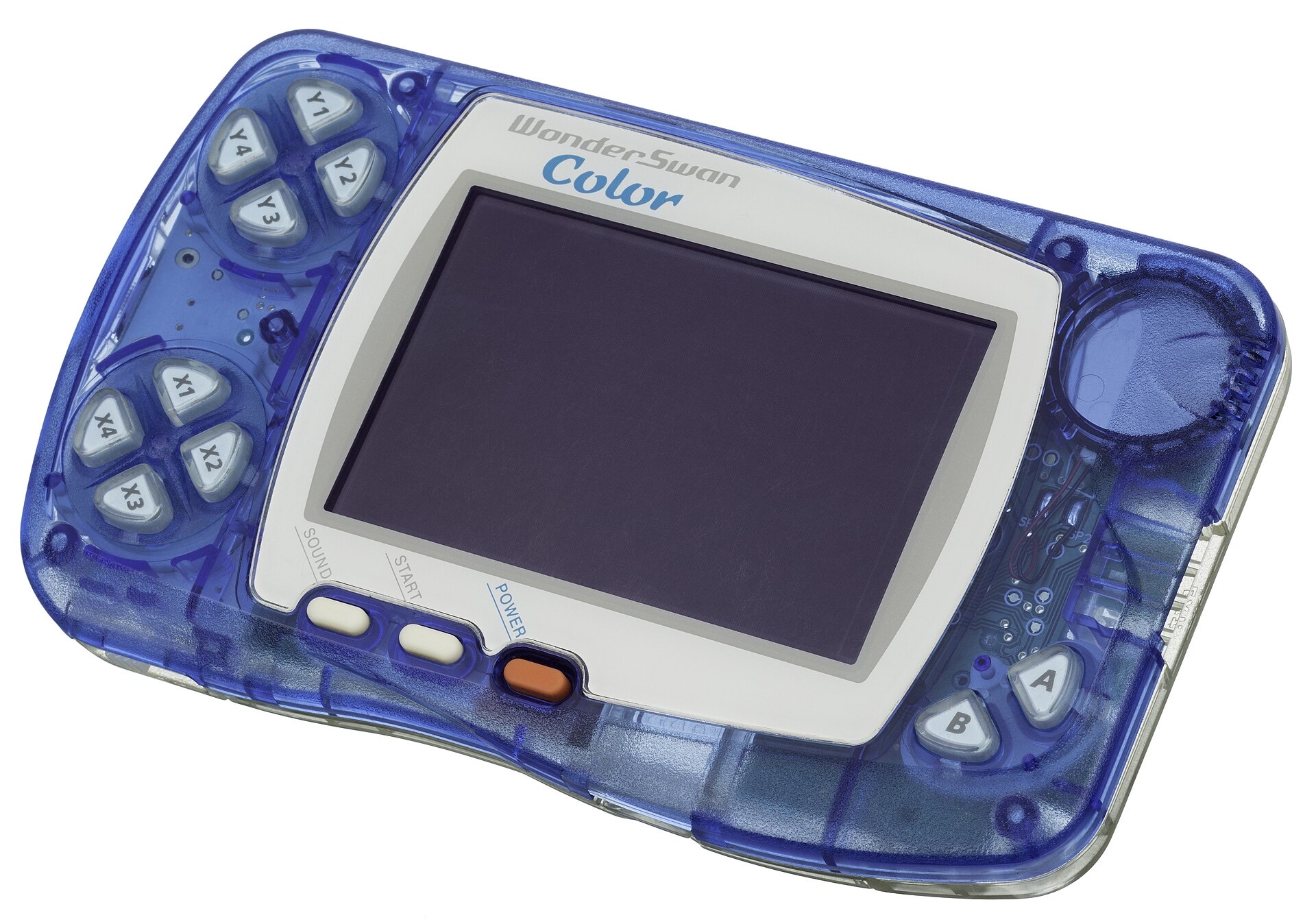

The colour successor to the WonderSwan: a slightly wider body with a larger 2.8-inch colour screen, four times the memory, and full support for the earlier cartridges and accessories, at the cost of shorter battery life.
Background
Bandai announced the WonderSwan Color on 30 August 2000, for release in early December at 6,800 yen. Its main addition was a colour screen, something the Game Boy Color and Neo Geo Pocket Color already offered, and it was designed so that everything already made for the WonderSwan kept working.
At the announcement Bandai explained who it was for and how it meant to sell. The target was people aged roughly 16 to 19 who did not usually play games but had money to spend and were curious; Bandai said about 80 per cent of Game Boy players were under 14, so it saw the two audiences as different. It also wanted to move from mask ROM cartridges to ones built on memory cards, because with mask ROMs a game that ran out of stock lost sales. About 20 publishers, among them Square, Namco and Sega Toys, had announced games, and Bandai planned four for launch day, about ten by the end of December and 32 colour games by March 2001.
Bandai also showed add-ons that never reached the shops. A memory-card reader with a USB connector was exhibited for summer 2001, and an MP3 player unit was shown as a prototype at the spring 2001 Tokyo Game Show, with neither its card format nor its price decided. The music adapter and a GPS project were later dropped because the console sold poorly.
Launch and sales
It went on sale in Japan on 9 December 2000 at 6,800 yen before tax. Queues formed at shops that opened in the morning. Square’s colour remake of Final Fantasy, the series’ first appearance on a handheld, came out the same day, sold on its own and in a limited bundle with a pearl white console, and Masaya Matsuura’s rhythm-action game Lime Rider Kerorican launched with it too. Five case colours were offered at launch: Pearl Blue, Pearl Pink, Crystal Black, Crystal Blue and Crystal Orange.
The first shipment of 300,000 consoles sold out within two days. Final Fantasy, Final Fantasy II, Chocobo no Fushigi na Dungeon, Super Robot Taisen Compact and GUNPEY were the five best-selling games across the line by March 2003.
From the summer of 2001 Bandai widened its aim beyond the late teens and twenties to the children who bought its character games, promoting head-to-head play over the link cable; by May 2002 it said the machine was popular with primary and middle school pupils. From 1 June 2002 the price fell to 4,800 yen.
Using it
The layout of the original is kept: the X and Y groups of four buttons beside A and B, and games that are played either sideways or upright. A few practical details changed. The power switch moved from a slider on the side to a push button under the screen. The contrast knob moved to the left side, and contrast can be set to high or low. The volume now has one more step, and the start-up volume can be stored on the settings screen, so the chime can be kept silent. A small slide catch locks the battery cover, and the old cover still fits. The buttons are clear plastic with printed labels.
With headphones attached through the adapter, a feature Bandai called Hyper Voice widens the stereo sound.
Two weaknesses come up again and again. The screen is a passive FSTN panel without a light; it is fairly dark unless the contrast is adjusted, and it smears when the picture scrolls. And the rubber contact under the push-button power switch wears with use, so that older consoles can become hard to switch off. Owners today sometimes replace the screen: a kit sold in Akihabara in 2021 swaps the panel for an IPS screen with a little soldering, and works only on this model, not on the SwanCrystal.
How it differs
The main change from the WonderSwan is the colour screen, which shows 241 colours at once from 4,096. The screen also grew from 2.49 to 2.8 inches, while the resolution stayed at 224 × 144. To fit it, the body became 7 mm wider and 2 g heavier. Working memory went from 128 Kbit to 512 Kbit, a transfer feature (DMA) was added to move data faster, and the largest cartridge size went up from 128 to 512 Mbit.
The cost of colour was battery life: about 20 hours on one AA cell, down from about 30, and the price went up from 4,800 to 6,800 yen. The SwanCrystal that followed kept all of this and changed only the kind of screen, along with a few details of the case.
Games
It plays every WonderSwan cartridge, in black and white, as well as cartridges made for the Color. All the earlier accessories, including the link cable and headphone adapter, fit it.
End of the line
Nintendo’s Game Boy Advance followed in 2001 and soon left it far behind in sales. Square had planned more games, including Final Fantasy III and Seiken Densetsu 2, but they were never released. When the SwanCrystal was announced in May 2002, Bandai cut the price of the Color to 4,800 yen and kept selling it alongside the new model, one for buyers who wanted a cheaper console and one for those who wanted a clearer screen. In February 2003 Bandai announced that its hardware would be made only to order and that it would start publishing for the Game Boy Advance.
For the Color’s 25th anniversary, Bandai Namco Entertainment announced commemorative goods in December 2024.
Sources: swan.channel.or.jp (archived) 1, swan.channel.or.jp (archived) 2, swan.channel.or.jp (archived) 3, pc.watch.impress.co.jp, game.watch.impress.co.jp 1, game.watch.impress.co.jp 2, av.watch.impress.co.jp, bandai.co.jp, game.watch.impress.co.jp 3, itmedia.co.jp, game.watch.impress.co.jp 4, weekly.ascii.jp, ja.wikipedia.org 1, ja.wikipedia.org 2, en.wikipedia.org, chromagi.com
SwanCrystal
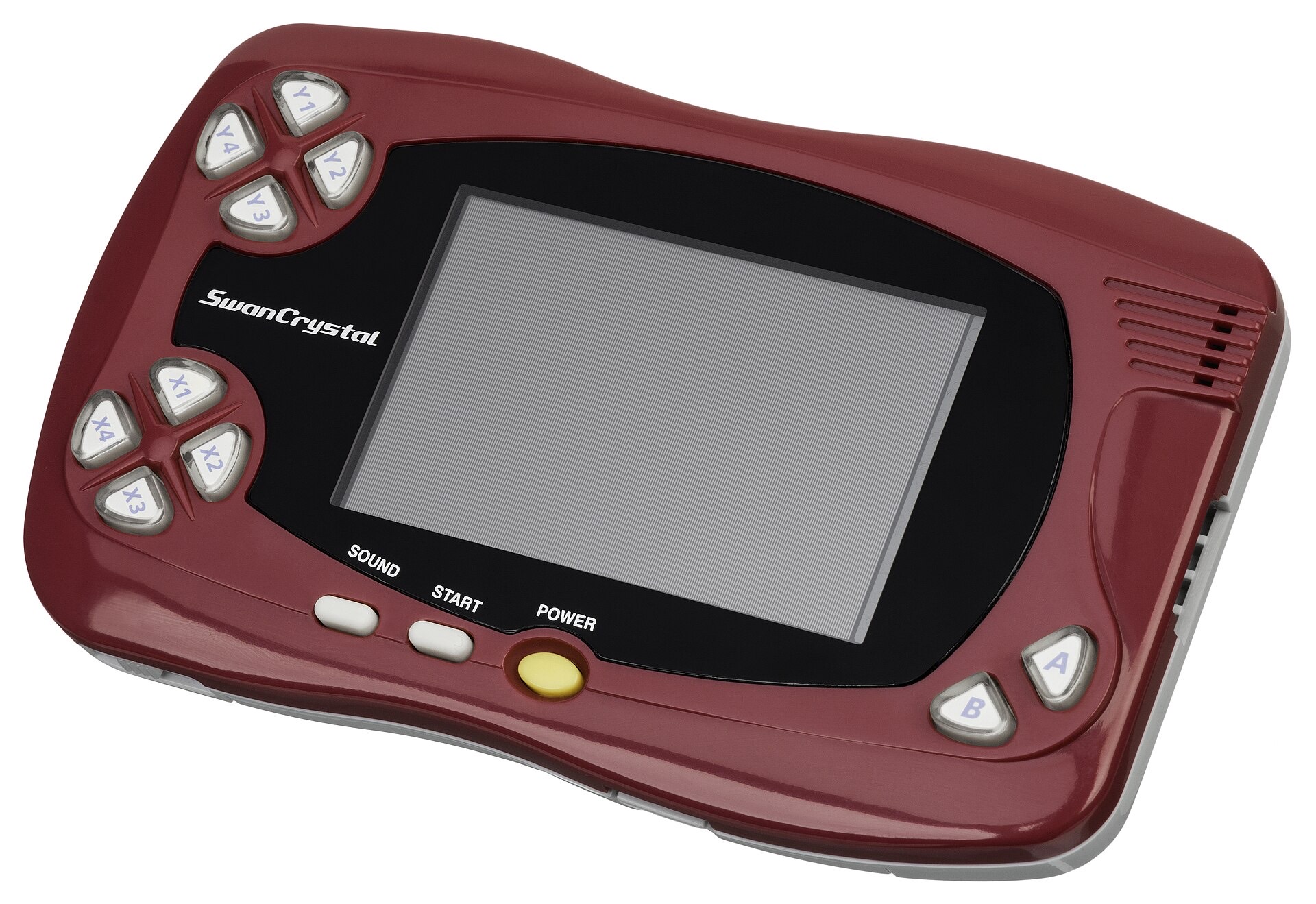

The last WonderSwan: a WonderSwan Color with a TFT screen in place of the older passive panel, giving a brighter picture without smearing in motion, while playing all the same cartridges and using the same accessories.
Background
Bandai announced the SwanCrystal on 8 May 2002 and showed it for the first time at its stand at the Tokyo Toy Show the next day. Bandai presented it as a higher-grade WonderSwan Color rather than a new system: the specifications are the same apart from the screen, which is a TFT panel chosen to make games brighter and easier to see. The case was redesigned with gentle curves meant to sit well in the hand whether the console is held upright or sideways.
Bandai planned to sell both models side by side. From 1 June 2002 the WonderSwan Color dropped to 4,800 yen for buyers who wanted a cheap console, while the SwanCrystal, at 7,800 yen, was for those who wanted a clearer picture. Bandai noted that 169 WonderSwan and WonderSwan Color games were already out and that all of them would run.
Launch and sales
It went on sale in Japan on 12 July 2002 at 7,800 yen before tax, in Blue Violet and Wine Red. Two Bandai games came out the same day, One Piece Grand Battle Swan Colosseum and Yakusoku no Chi Riviera, with Square’s Front Mission and several Bandai titles promised by the end of August. When it was shown in May, no game had been announced for the SwanCrystal alone.
Bandai’s target was 500,000 consoles by the end of March 2003, which it said would bring shipments of all three models to about 3.55 million. The SwanCrystal’s own total is not known: more than 3 million consoles of the whole line had shipped by February 2003, and the 3.32 million sold of the WonderSwan and WonderSwan Color leaves the SwanCrystal out altogether.
Two more case colours, picked by an online vote, followed in November 2002. An unusual bundle came out that month too: mama Mitte, which paired the console with a Tanita body-fat scale for pregnant women and an infrared cartridge.
Using it
In the hand it works like the WonderSwan Color: the same X and Y button groups, the same choice of sideways or upright play, one AA battery or the rechargeable pack, and the same settings screen opened by holding START at power-on, where the owner’s name, birthday, sex and blood type are stored along with a start-up volume from 0 to 3. The sound button steps through four levels, from loud to off. The body is about 3 mm larger along its short side than the Color’s, and 3 g heavier.
There are a few smaller changes. The contrast knob is gone, so the picture cannot be adjusted. The power button is now hard plastic, which ends the worn rubber contact that made some Colors hard to switch off. The start-up sound differs from the earlier models, and the panel itself was made by Citizen.
How it differs
The change from the WonderSwan Color is the display. Both are 2.8-inch reflective colour screens with no light of their own, but the Color uses a passive FSTN panel, while the SwanCrystal has an active TFT panel. Bandai’s own comparison put it simply: the TFT panel shows finer detail, can be read from wider angles and responds faster, so moving pictures no longer leave trails. A Game Watch writer who tried it at the Toy Show was struck by the colour and contrast, found no smearing at all, and wondered why the earlier models had not been made this way. The dark, smearing FSTN screen had been the Color’s best-known weakness, and the SwanCrystal was made to fix it.
The price of the better screen is battery life. One AA cell lasts about 15 hours, against about 20 on the Color and about 30 on the original WonderSwan; Game Watch’s reviewer thought that a fair trade. Resolution, colour count, processor, memory and sound are all the same as on the Color. An IPS screen kit sold in Akihabara in 2021 for owners to fit to the Color does not work on the SwanCrystal.
Games
Bandai stated that it is fully compatible with every WonderSwan and WonderSwan Color game and accessory. Original WonderSwan games run in black and white, as they do on the Color, and Color games run in colour. Because the screen technology differs, the same Color game can look noticeably different here, with stronger colours than on the Color’s own screen.
End of the line
The SwanCrystal was the last WonderSwan. Sales of the line were already falling against the Game Boy Advance, and on 18 February 2003, only months after the SwanCrystal came out, Bandai announced that its WonderSwan hardware would move to made-to-order production, which in practice ended the line. At the same time Bandai said it would publish games for the Game Boy Advance, with four in development and the first due that autumn. No further WonderSwan model followed.
Sources: bandai.co.jp, swan.channel.or.jp (archived) 1, swan.channel.or.jp (archived) 2, swan.channel.or.jp (archived) 3, swan.channel.or.jp (archived) 4, game.watch.impress.co.jp 1, itmedia.co.jp, game.watch.impress.co.jp 2, weekly.ascii.jp, famitsu.com 1, famitsu.com 2, ja.wikipedia.org 1, ja.wikipedia.org 2, en.wikipedia.org