
From TV Animation One Piece: Grand Battle Swan Colosseum
From TV animation ONE PIECE グランドバトル スワンコロシアム
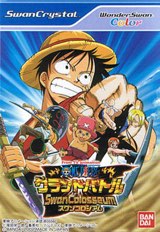
A 2D One Piece fighting game for the WonderSwan Color by Dimps, with 13 fighters from the Arabasta saga, a story mode and 60 wanted posters to collect and trade.
Screenshots
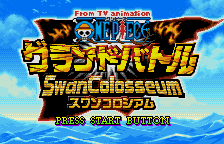
Title screen 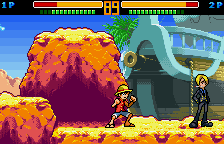
In play 
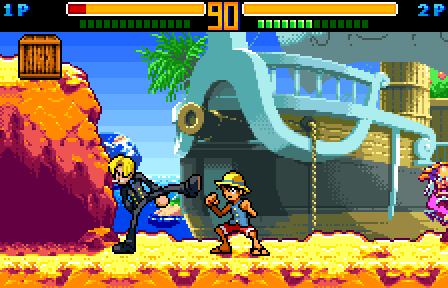
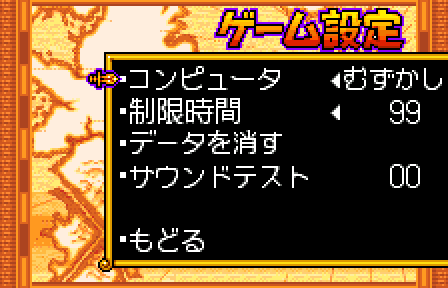
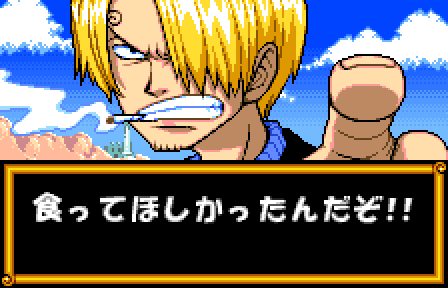
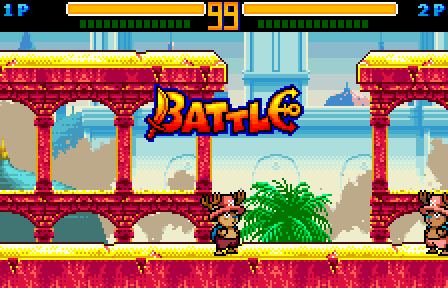
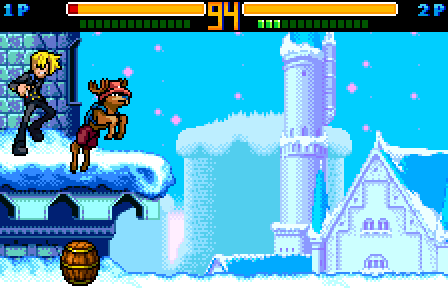
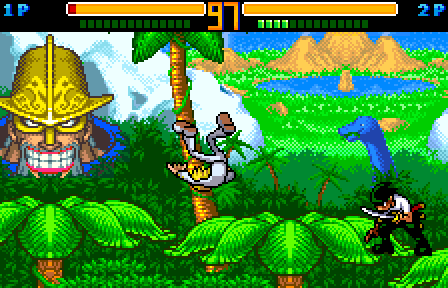
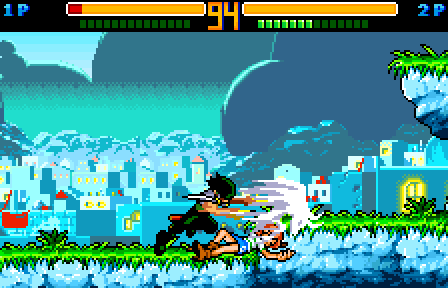
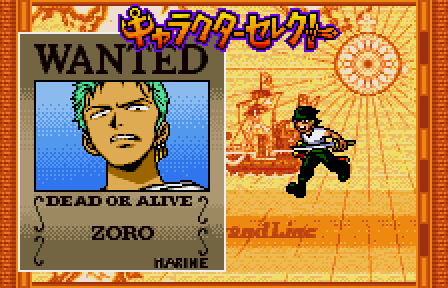
From TV Animation One Piece: Grand Battle Swan Colosseum is a fighting game based on the One Piece television anime. Bandai released it in Japan on 12 July 2002 for the WonderSwan Color, and Dimps, which had already made fighting games for the system in the Digimon Tamers Battle Spirit line, developed it. It was made as a handheld companion to the Grand Battle! fighting games on the PlayStation, but everything on screen, characters and backgrounds alike, is drawn in 2D sprites. The cartridge works only on the Color and the SwanCrystal.
There are 13 playable characters, taken from the Straw Hat crew and the people they meet up to the Arabasta part of the story. Two fighters share the screen at a time on wide stages with platforms that they can move around freely. A story mode called Event Battle follows the Arabasta events, a Grand Battle mode covers fights against the computer or, with the link cable, against a friend, and wanted posters won along the way unlock characters, stages, moves and a mini-game.
The story
The game draws its story almost entirely from the Arabasta part of One Piece, the stretch that runs from Reverse Mountain at the entrance of the Grand Line through Whiskey Peak, Little Garden and the Drum Kingdom to the desert kingdom of Arabasta. There Crocodile, the head of the secret organisation Baroque Works, is at work behind the scenes, and the Straw Hats are heading for the kingdom with its princess Vivi. The stages follow the same route, and characters from those places stand in their backgrounds as spectators, such as the whale Laboon and Crocus at the cape, the giants Dorry and Brogy at Little Garden and Dr. Kureha at Drum Castle.
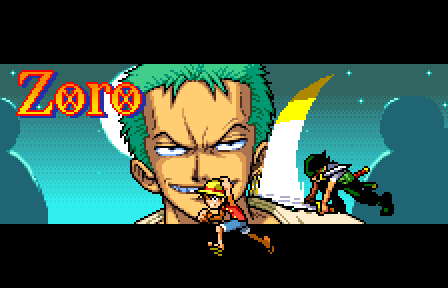
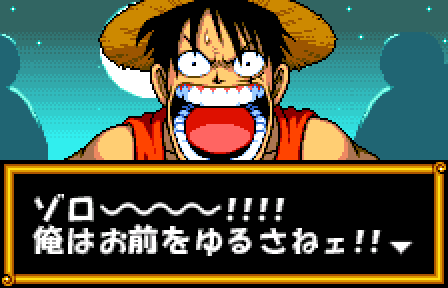
The story is told in Event Battle, where every one of the 13 fighters has a route of their own. A route is seven battles, with a short exchange of lines between the two fighters before each one, shown as text beside still portraits. The routes start with quarrels close to home. Luffy’s opens with Sanji scolding him on the slopes of Reverse Mountain for eating too much of the food Sanji was saving for Nami, and goes on to a brawl with Zoro at Whiskey Peak, where Luffy is angry that Zoro cut down the townspeople who had just fed them, and Zoro answers that they were enemies all along. Then come Smoker at Nanohana harbour and the people of Baroque Works.
Luffy’s route keeps closest to the original story and has the most dialogue. The other Straw Hats follow the Arabasta plot more loosely and fight their own crewmates and rivals on the way, and the Marines and Baroque Works members meet the characters they have history with in the original story, such as Tashigi and Zoro, or Mr. 2 Bon Clay and Sanji, often facing the same opponent more than once. The scenes are short, and the game counts on its players already knowing the characters and the story it draws from. The manual introduces the cast in a sentence or two each: Luffy the captain with his rubber body, Zoro the swordsman of the three-sword style, Nami the navigator with her new Clima-Tact weapon, Usopp the liar whose best skill is running away, Sanji the fighting cook who is gentle with women and has no time for rough men, and Chopper the doctor who carries on Dr. Hiriluk’s will and changes form with the Rumble Ball.
How it plays
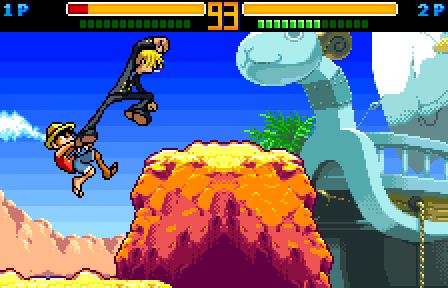
The console is held horizontally. The X buttons move, and the eight directions all count, A jumps and confirms in menus, B attacks and cancels, and Start pauses; the Y buttons are not used. A quick tap of A gives a short hop and a second press in the air a double jump. Pressing a direction twice quickly dashes, reversing quickly during a dash turns around, holding down guards, and down with A drops through a platform, except the lowest one. A pressed while being knocked flying lets the character recover in mid-air.
Attacks all come from the B button. Pressing it repeatedly near the opponent strings hits together into a chain, up or down with B gives a different attack, B in the air or during a dash gives others again, and toward the opponent with B at close range is a throw, which cannot be blocked. Each character has about ten ordinary techniques, and with the special moves Bandai counted more than twenty per character, among them combos and moves that break the opponent’s guard. Every hit, even a blocked one, fills the special gauge under the health bar, and each time it fills it turns into a bomb. Up to three bombs can be stocked. The special moves are A and B together, alone or with up or down, and the stronger ones cost two or three bombs. A special only goes off if the opponent is at the right distance and the timing is right, and only then is the bomb used up, so a miss costs nothing, but it cannot be used in the air. When one lands, the screen cuts to an animated still with the move’s name before the opponent is sent flying. There is no voice acting.
Fourteen kinds of item turn up during a fight, one at a time, from barrels, crates or treasure chests that have to be broken open, and an item that is not picked up within about five seconds disappears. Food and boosts take effect on touch: rice balls, tankards and meat restore health in small, medium and large amounts, a sword, crown or coin raises attack, defence or speed for a few seconds, a jewel raises all three, a pirate flag adds a bomb to the gauge, and the Amiudake mushroom hurts and paralyses whoever touches it. Five more are picked up with down and B and thrown with B, even in the air: bombs and lanterns that do damage, an iron ball and a flask of sleeping drug that knock the target out for a few seconds, and a cactus that scrambles the controls. Mashing the buttons wakes a stunned fighter sooner. The damage items hit lightly and the effects are short, so fights are decided mostly by attacks and specials.
Event Battle is the one-player mode for the story routes. Each route is seven fights, and the fourth is always the Kung Fu Dugong mini-game, in which the player beats as many dugongs as possible in 60 seconds. The player has five lives and may continue after each one. There are three difficulty levels, set in the options along with the time limit, and the hidden characters and the best rewards come only from the hardest. Luffy’s route ends with three fights in a row against Crocodile, and in the last of them he does far more damage. Clearing a route saves the game automatically. Grand Battle is for single fights, one player against the computer or, with two consoles joined by the link cable and a cartridge in each, against a friend, and the same character may fight himself. In a link battle each screen keeps its own fighter in the centre, so the opponent can attack from off-screen. Before release Bandai also announced two-against-two tag battles by cable, in which some pairings were stronger than others; whether they are in the finished game is not certain. A ranking screen keeps each character’s wins, knockouts and battle points, the bounty that rises with wins in link battles.
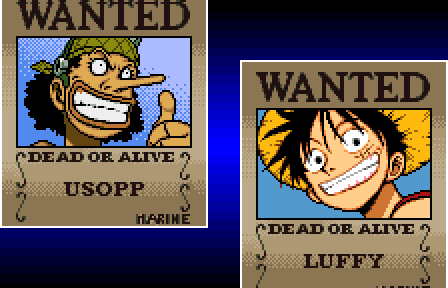
The wanted posters are the game’s collection and its way of unlocking things. There are 60, earned by finishing Event Battle routes, by good scores in the dugong mini-game and by trading with a friend over the link cable, and a new one is worth looking at straight away, since the game does not announce what it has opened. Each character has a poster that lengthens their health bar by 12 percent, and Dr. Kureha’s does the same for everyone. Others unlock the seven hidden fighters, two hidden stages and the mini-game as a mode of its own, which then runs for 180 seconds; another four give Luffy, Zoro, Sanji and Usopp a new special move; and about two dozen, such as cards of King Cobra or Igaram won with high dugong scores, are there only to be collected.
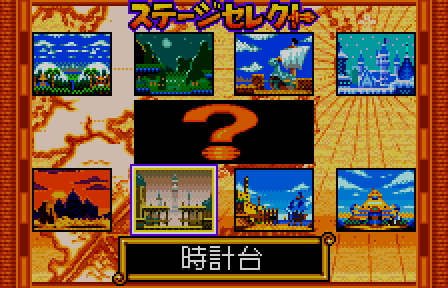
There are ten stages to choose from in Grand Battle, picked after the characters or left to chance. Eight are open from the start, among them Whiskey Peak, Little Garden, Drum Castle, Rain Base and Alubarna palace, and the Marine headquarters and the tomb of the kings are unlocked with posters. All are the same width and differ only in their platforms and how many item containers they hold, and some items appear more often on some stages than others. Every character also has a second colour scheme, chosen by pressing down on the selection screen. The sword fighters’ attacks tend to win exchanges, Luffy’s long reach is easy to lean on, and the computer opponent sometimes loses track of a fighter on a different level of the stage.
Development and release
Bandai priced the cartridge at 4,500 yen before tax and sold it for one or two players, with stereo sound and link-cable play. It promoted the game as the PlayStation series brought to the Swan, and stressed that the controls were simple enough for players who are not good at action games to pull off the big special moves. The game came out on the same day as the SwanCrystal, and Bandai tied the two together in a summer tournament campaign called Nettou! Swan Colosseum. From late June to mid-August 2002, shops around Japan held tournaments of the game, and their winners received a SwanCrystal and priority entry to area championships held at venues in five regions of the country during the August school holidays, where the champions won trophies and prizes.
Secrets and extras
The seven extra fighters are unlocked by finishing the hard difficulty with particular characters, which opens Tashigi, Smoker, Mr. 2 Bon Clay, Mr. 1, Miss All Sunday and Crocodile in turn. Portgas D. Ace appears after defeating more than thirty Kung Fu Dugongs on hard with Crocodile and winning without a continue. Clearing hard without continuing with Luffy, Zoro, Sanji or Usopp gives that character a hidden special move.
Reception
Fighting-game fans who returned to it years later found the damage and match balance steady and the pace quick, and praised the smooth animation and the cut-ins for capturing the feel of the anime. The hard setting is very tough, and the sound is generally thought the weakest part. Players mostly rated it as fun but thin, with some saying it loses its pull soon after it is finished.
Ports and other versions
Swan Colosseum was made for the WonderSwan Color and was never released on another system. Although it borrows the Grand Battle name, it is not a version of the PlayStation games. The first Grand Battle!, which Bandai released in March 2001 with Ganbarion as developer, shows its fighters as small, deformed 3D polygon models, while Dimps drew the Swan game entirely in 2D sprites and built it around its own wanted posters and link-cable tag bouts, making it a 2D fighter in the spirit of the console series. Dimps also made a One Piece side-scrolling beat ’em up for the Game Boy Advance, released in North America in 2005, but that is a different game in another genre, not a version of this one.
Notes
The title carries no wave dashes around Swan Colosseum, though some lists add them. The cartridge label gives the title as One Piece Grand Battle Swan Colosseum, with the From TV animation prefix as a parallel title. The box holds the cartridge, a 28-page manual, a flyer and a survey postcard.