
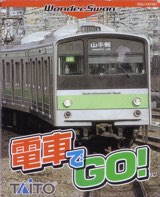
A handheld version of Taito's train-driving arcade game, in which the player runs a Japanese commuter train to the timetable on four real lines; a WonderSwan launch title.
Screenshots
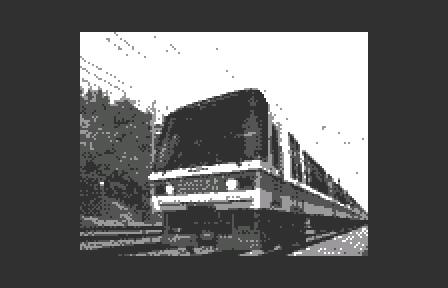
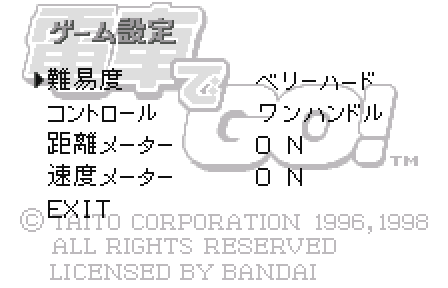
Title screen 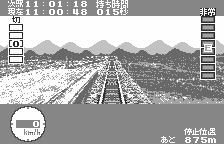
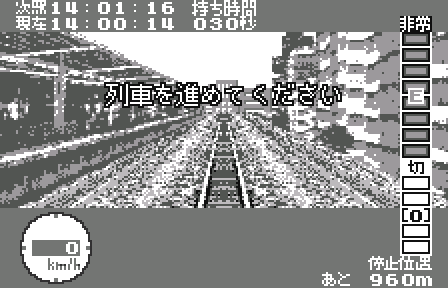
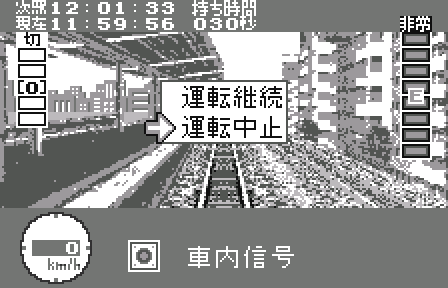
In play 
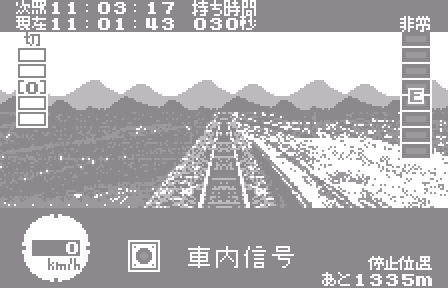
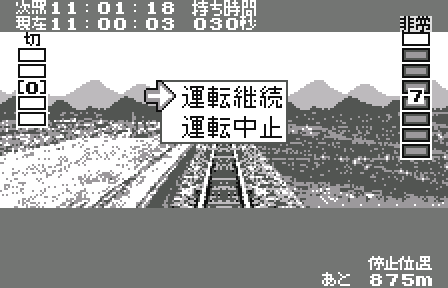
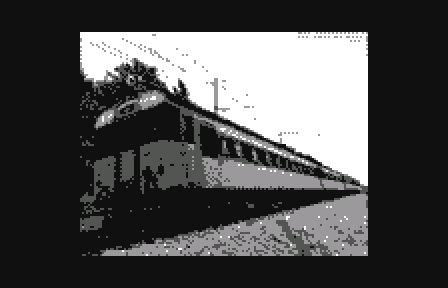
Densha de Go! for the WonderSwan is a portable version of the train-driving game that Taito first put in arcades in 1997. It was one of the titles on sale on 4 March 1999, the day the WonderSwan itself was released in Japan, at a price of 3,800 yen before tax.
The player drives a passenger train along one of four real Japanese lines, keeping to the timetable, obeying signals and speed limits, and stopping each train on its mark. Time is the score, and the run ends when the allowance of seconds runs out.
It was followed on the system in October 1999 by Densha de Go! 2, published by CyberFront.
The story
There is no plot. The player is simply the driver, and the game is about doing that job well: leaving on time, keeping to the rules of the line and bringing the train to rest at the right spot in front of waiting passengers. Bandai’s launch publicity framed it around the handheld itself, suggesting that owners take the WonderSwan onto a real train and drive one of their own on the way.
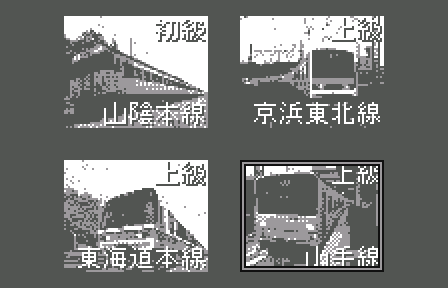
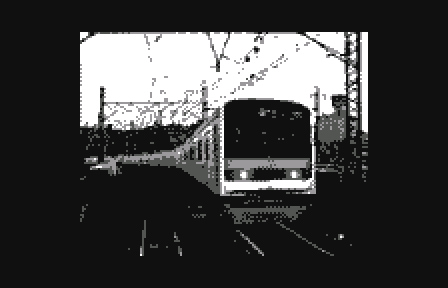
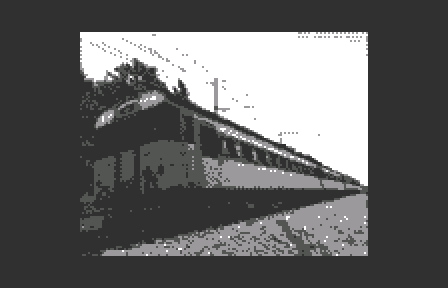
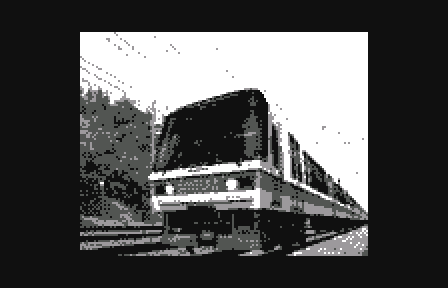
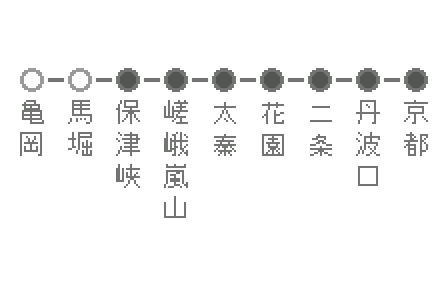
The setting is four real lines of the Japanese railway, each with its own train. The San’in Main Line run from Kameoka to Kyoto uses a KiHa 58 diesel railcar, the Tokaido Main Line run between Kyoto and Osaka is a rapid service with a 221 series train, the Keihin-Tohoku Line from Shinagawa to Yokohama uses the 209 series, and the Yamanote Line from Shibuya to Tokyo, the busy loop at the heart of the capital, uses the 205 series.
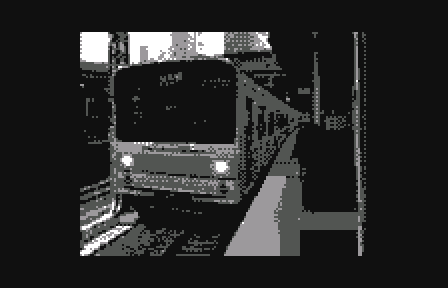
The scenery is copied closely from the PlayStation version, with oncoming trains and the shapes of platforms drawn to match. Umahori, the first stop on the beginner run, has the oncoming KiHa 58, the curve of its platform, the footbridge and even the warning sign before the platform in place.
The series mascot Tetsu-chan is on hand and is as cheeky as ever, pulling a silly face if the player declines to continue after a game over. The sound is taken from the PlayStation version as far as the hardware allows, from the spoken title call to level-crossing bells and the hum of the motors, and the theme song is included with its vocals. One slip is that the electric trains were given an engine sound. There are no railway photographs or other extras of the kind found in some home versions.
How it plays
The WonderSwan is held sideways. In the menus the X buttons act as the direction pad, A confirms and B goes back. Two control schemes are offered. In the two-handle scheme X1 and X3 move the master controller down and up a notch, X2 returns it to zero, A and B apply and release the brake a step at a time, and Y3 is the emergency brake; each power notch has its own top speed, and the brake has to be fully released before the train will take power again. In the one-handle scheme a single lever on X1 and X3 runs from braking through neutral to power, with X2 for neutral and Y3 still the emergency brake. X4 sounds the horn in both, and Start pauses the game with a choice to carry on or quit.
The options set the difficulty to easy, normal, hard or very hard, choose the control scheme, and turn the distance meter and the speedometer on or off. The game does not support lever controllers or voice input. The driving screen shows the time the train is due, the current clock, the remaining allowance, the speed, the distance to the next station, gauges for the master controller and the brake, the signs and signals ahead, and messages for bonuses and penalties.
Starting a game leads to a choice of the four runs. The San’in Main Line is the beginner course, and the Tokaido, Keihin-Tohoku and Yamanote runs are all graded advanced. These are the same four timetables as the PlayStation version; the extra runs of the EX arcade edition and the special modes of other versions are not included. There is a single save slot.
Each run is a string of stations. The train must wait for the door signal before it moves off, and leaving early costs seconds. Out on the line the train keeps rolling under its own weight once the power is off, so much of the skill lies in coasting. A green signal means proceed, an amber one shows a speed such as 45 km/h that must be held until the next signal, and red means stop. Speed-limit signs set a maximum such as 25 km/h, gradient signs warn of slopes that change the speed, and an X-shaped sign asks for the horn. Sounding the horn while a track-worker mark is on screen earns a hidden bonus.
Stopping is the heart of the game. The usual technique is to brake gently at first and then harder, aiming to halt with 0 metres left to the stop marker, while a sudden stop is penalised. After each station an evaluation screen reports any overshoot, any re-acceleration inside the station and the speed on entry, and seconds are added or taken away. When the allowance reaches zero the game is over, though the player can continue.
The game is hard, as the original was, and the small screen makes it harder. The view moves in coarse steps of about one frame for every 5 metres, so the last few metres before a stop are difficult to judge, a sense of speed is hard to get, and the rail-joint clicks come far more often than they would on a real line. Even so the rules and interface are kept whole, unlike the cut-down Game Boy Color version, and the jerky frame rate is a compromise that leaves the game quite playable.
Development and release
Taito published the WonderSwan version itself, and Bandai’s launch publicity sold it on the idea of carrying the console onto a real train and playing there. The same material put the detailed scenery down to the WonderSwan’s fine screen and fast graphics handling and to the 32-megabit cartridge. Bandai also promoted a Densha de Go! strategy book among its guides for the system, issued by Taito and sold through the publisher Takahashi Shoten at 850 yen before tax.
Modes and features
The game has stereo sound. It is a single-player game with no link-cable play.
Reception
Weekly Famitsu’s Cross Review gave it 21 points out of 40, in issue 534. The reviewers were split: one felt the systems had come across almost intact and only the graphics let it down, another found it hardly recognisable next to other versions because the scenery was not precise enough to drive by, and a third thought the simplified controls made it easier to pick up, noting that the control setting works as a further difficulty option. It is generally regarded as an ambitious port that mostly pays off, with detailed if not smooth graphics, digitised voices and the high difficulty of the original game, and a fair result for a handheld.
Ports and other versions
The game began in Japanese arcades in 1997, and a revised EX edition followed later that year with bug fixes, extra runs on the Keihin-Tohoku and Yamanote lines and driving in snow. Home versions came next: the PlayStation in December 1997, sold alongside a dedicated controller from Taito that puts a brake handle and a power lever side by side; the Sega Saturn in October 1998 with the EX edition, which Takara took over after the publisher first announced for it, Nihon Flex, went bankrupt; and Windows in April 1999, rebuilt from the arcade material. The WonderSwan cartridge of March 1999 was the first version for a handheld, and a Game Boy Color version from CyberFront followed in December 1999.
What the WonderSwan keeps is the core of the arcade game: its four regular lines, the timetable and the stopping rules, played sideways on the buttons with stereo sound. Bandai put its scenery down to the screen and the large cartridge. The graphics are finely drawn but do not move smoothly, there are recorded voices, and the difficulty is as high as in the original. One of the Famitsu reviewers felt the WonderSwan scenery was too rough to drive by and the game hardly recognisable next to other versions, while it is generally thought a more successful squeeze onto a small screen than the Game Boy Color version. On the home side, Dengeki PlayStation found the PlayStation graphics below the arcade original.