
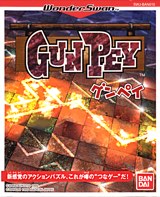
A line-connecting action puzzle game planned by Gunpei Yokoi's company Koto and released by Bandai as a launch title for the WonderSwan, held upright.
Screenshots
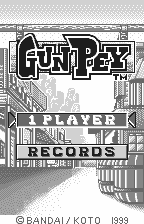
Title screen 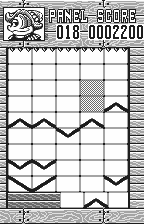
In play 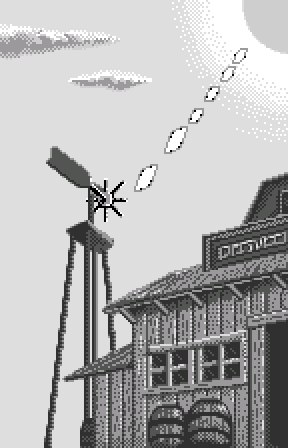
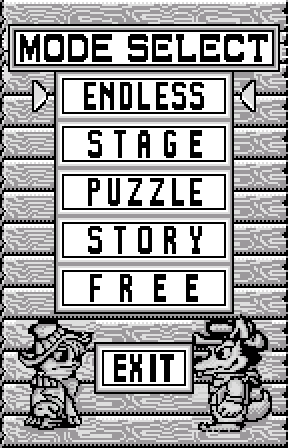
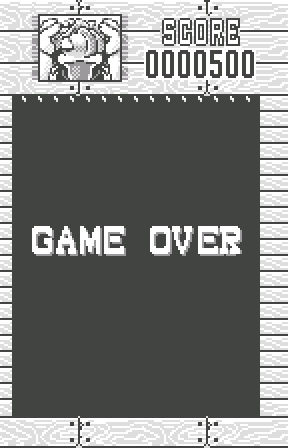
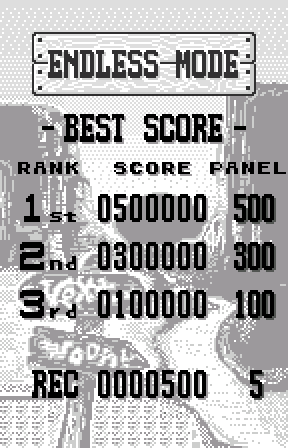
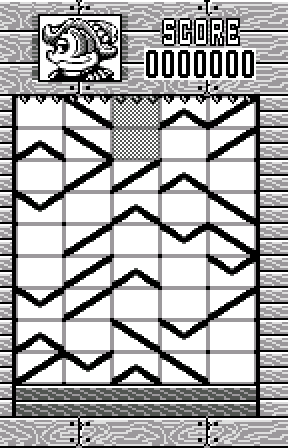
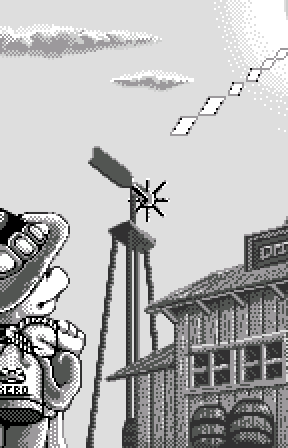
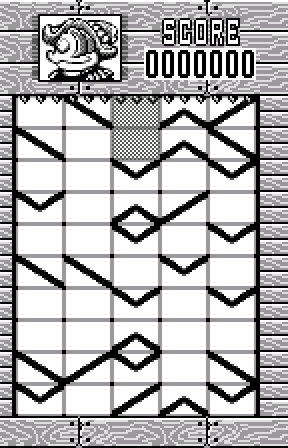
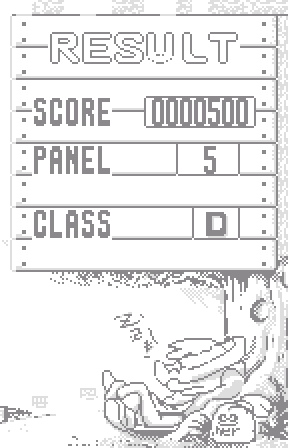
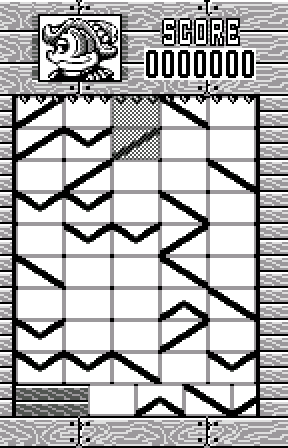
GunPey is an action puzzle game released by Bandai on 4 March 1999, the day the WonderSwan went on sale. It was planned for the console by Koto, the company Gunpei Yokoi set up after leaving Nintendo, with Yokoi supervising. Yokoi had also advised on the WonderSwan itself but died in 1997, before either was released. The game was first announced under a different reading of its name, and its title became a tribute to him. It grew from Henoheno, an earlier keychain LCD game from Koto, and it is played with the console held vertically.
The player swaps panels that rise from the bottom of a five-by-ten field to build unbroken lines from the left wall to the right, and the game ends when the panels reach the top.
Modes include an endless game, a normal mode with a set number of panels to clear, puzzles that must be cleared in one go, a story mode against computer opponents and a training mode with no game over. Two players can play against each other over the link cable. GunPey came to be seen as the WonderSwan’s signature puzzle game, and Bandai later sold it in a pack with a WonderSwan to mark 200,000 copies sold. A Tare Panda version, a PlayStation version and the colour GunPey EX followed.
The story
GunPey is a puzzle game first, and most of its modes have no story at all. What it has is a Wild West theme: the line segments on the panels stand for lengths of fuse, and joining them from wall to wall sets them off. The look is simple, with plain monochrome graphics and sound.
The story mode gives that theme a thin plot. The player’s character is Vincent, a frog, who sets out to rescue a cat called Sherry from a gang of outlaws. He does it by beating a series of opponents who turn up one after another, nine in all, among them a pig who waits near the end of the run. Each meeting is little more than an encounter that turns into a puzzle battle, and the mode tells its tale almost without dialogue.
The player’s character never changes in the single-player modes, while the opponent’s face stays on screen during play and changes expression as the match goes. Short demo scenes play when a game starts and when a stage is cleared, and a voice calls out short cheers such as OK, nice and yeah after a clear, with a rarer excellent for a very large one.
How it plays
The WonderSwan is held upright, and the field is five panels wide and ten high. Each panel carries one of four line segments, two diagonals and two angles shaped like an upward and a downward arrowhead, dealt out at random. The cursor covers two panels stacked one above the other and is moved with the Y buttons, and the X3 button swaps the pair; only vertical swaps are possible. Rows of new panels rise from the bottom, a row of spikes at the top marks the danger line, and the X2 button pushes the panels up early.
A line clears when it runs unbroken from the left wall to the right, so the shortest clear takes five panels. Lines can climb and fall diagonally and snake across several rows, so a single clear can take in far more panels than the width of the field. A finished line flashes for about three seconds before it disappears, and the panels can still be moved during that time, so branches and extra segments can be hooked onto it, and a second line can be completed while the first is still vanishing. Cleared panels leave empty spaces rather than letting the panels above fall. The flashing can also be cut short when there is nothing to add.
The score for a clear depends only on how many panels go at once, not on the shape of the line or the technique used: n panels are worth n times n minus four, times 100 points. Five panels give 500 points, six give 1,200, ten give 6,000 and twenty give 32,000, so large clears are worth far more than many small ones, and clears of more than 30 panels, worth over 100,000 points, are possible. Players named the ways of building them: the basic straight clear, the branch clear closed with one last panel, zigzags, adding segments while a line flashes, and clearing a second line during the first. Emptying the whole field adds a bonus of 10,000 points.
There are five single-player modes. The endless mode runs until the panels reach the top, with the rising speed climbing level by level until, at around one million points, panels come up very fast. The normal mode, which the record screen calls the stage mode, sets a quota of panels for each stage and raises both the quota and the speed as the stages go on and goes on past stage 39. The puzzle mode sets fixed fields that must be cleared in a single go and keeps the time taken as its record. The training mode has no game over, and the story mode runs through its nine opponents.
The story mode and the two-player link-cable mode are battles, though the opponent’s field is never shown. Clearing about ten panels at once drops a panel covered with a question mark onto the opponent’s field, hiding its line, and clearing the panel underneath removes the cover too. Clearing also fills a special gauge, and a full gauge sets off the character’s special attack automatically. The computer opponents in the story mode use tricks such as scrolling the field sideways and dropping bombs that the player can send back upwards at them, while the player’s only special in that mode wipes the covers off their own field. Because covers are easy to clear and the gauge fills slowly, battles feel much like two single-player games run side by side.
Records are kept for every mode: score and panels cleared in the endless mode, score and stage reached in the stage mode, and time in the puzzle mode, each with a class from D up to A. In the endless mode the line between classes B and A lies at about two million points, while the stage mode grades by the stage reached, with class B from about stage 30. A single game can last a long time. Experienced players advise building large clears before the speed rises around the one-million mark and, once it does, clearing early and leaving no stray segments behind, which lets a run go on much longer.
Development and release
The keychain game behind GunPey, Professor Henoheno, came out in 1997, published by Hiro in a series of LCD keychain games. It had a cult following among Japanese players and was regarded at the time as the last game Yokoi himself helped plan and develop. Its field was only four panels wide and six high, and it offered two modes, one with a quota of panels to clear in each stage and one in which every panel on screen had to be cleared in one go. For the WonderSwan the field was enlarged to five by ten, and the endless, story and training modes and link-cable play were added. Yokoi supervised the game at Koto, with Bandai as publisher.
Modes and features
Records for every mode are saved on the cartridge’s 16k EEP-ROM. In the two-player link-cable mode each side has its own set of tricks for disrupting the other.
Reception
The four Weekly Famitsu reviewers scored the game 9, 9, 8 and 7, a total of 33 out of 40, which placed it in Famitsu’s gold hall of fame. A Famitsu writer recalled in 2023 that many on the magazine’s staff became hooked on it, and it was a considerable hit for a WonderSwan game. Players found every mode enjoyable and admired how much depth the simple rules allowed; the larger field makes the endless mode easier but the puzzles harder than on the keychain. The sound and graphics were thought plain, but that was felt to suit a game built on its system, and some players wished for a short timed score-attack mode, since a single game could run for a long time.
Ports and other versions
GunPey was designed for the WonderSwan, although its rules began on Koto’s keychain game, which had a smaller field and fewer modes. On the WonderSwan itself it was followed in December 1999 by Tare Panda no Gunpey, the same game with San-X’s Tare Panda character and two extra modes built around it, one stacking defeated pandas for a record and one observing them through the seasons, and a year later by the colour reworking GunPey EX, which has its own page.
The first version on another system was GunPey for the PlayStation, released by Bandai on 16 December 1999. It is an enhanced port of the WonderSwan game with four modes, developed by Tose. Bandai promoted it mainly for two-player battles and for a national GunPey championship ranking held from 20 December 1999. It was the only version for a home console, and an arcade version released by Banpresto in 2000 plays very much like it.
GunPey also reached mobile phones in Japan. Mobile GunPey was built into NTT DoCoMo’s P502i handset, from before i-mode phones could download Java games, and in October 2004 GunPey was among the launch games of Bandai Networks’ Bandai Collection i-mode service, which Bandai Networks presented as revivals of well-known games. This phone version may have been based on GunPey EX.
The PlayStation version scored 27 out of 40 in Weekly Famitsu’s review, against 33 for the WonderSwan original. The reviewers agreed that the play itself was almost unchanged from the WonderSwan, and one of them found it somehow less satisfying than expected.
Later history
Q Entertainment revived the series with new games rather than ports: Connect the Sounds! Gunpey Rebirth for the Nintendo DS in October 2006, which added music elements, a built-in sequencer and a Break rule in which panels above a cleared line drop down, and GunPey-R for the PSP, released abroad first and in Japan in January 2007, with changing skins and music in the manner of Lumines and a ten-by-ten mode. Bandai Namco followed with a free-to-play smartphone game in February 2017 that closed in December of the same year. The game also has a place in Evangelion films: in Evangelion: 2.0 the character Asuka is often seen playing GunPey, and viewers of the later Shin Evangelion thought a game she plays there looked like it too.