
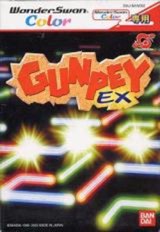
A colour remake of the WonderSwan launch puzzle game GunPey, released with the WonderSwan Color, adding coloured lines, same-colour bonuses and WonderGate ranking battles.
Screenshots

Title screen 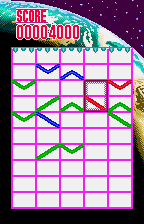
In play 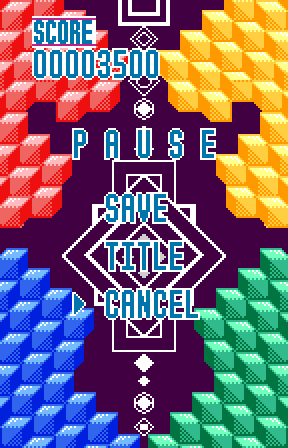
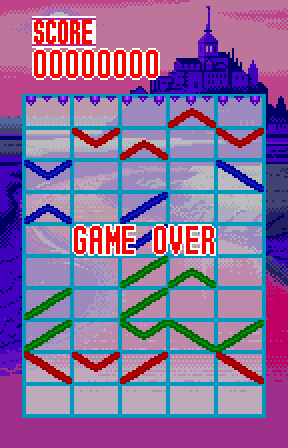
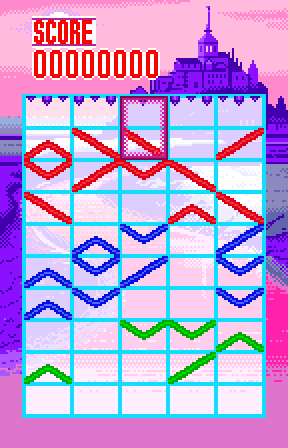
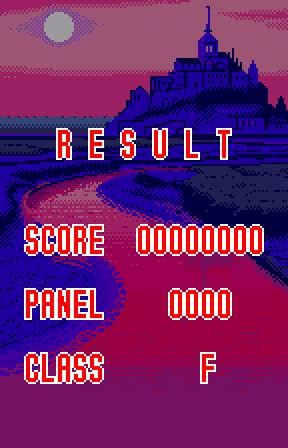
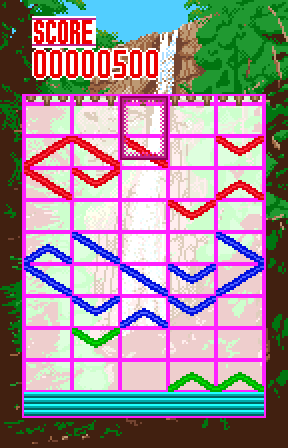
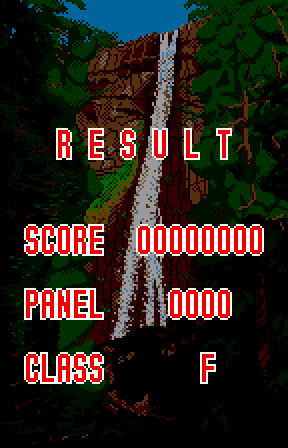
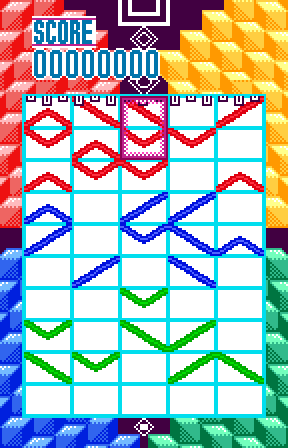
GunPey EX is a new version of GunPey, the line-connecting puzzle game that launched with the WonderSwan, made for the WonderSwan Color. Bandai released it on 9 December 2000, the same day as the Color itself, as one of the console’s first games. It is credited to Koto Laboratory, the company founded by Gunpei Yokoi that made the original, though the game itself names no developer.
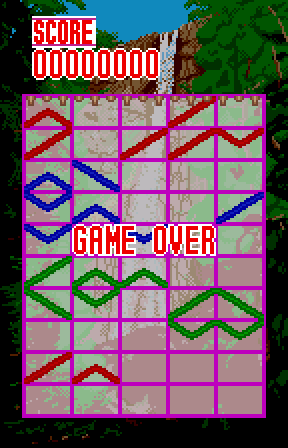
The basic rule is unchanged: panels rise from the bottom of a tall, narrow field, and the player swaps them to join the left and right walls with a continuous line. The difference is colour. The line segments now come in different colours, a line built from a single colour earns a bonus, and a new mode challenges players to score as much as they can within a time limit.
The game also adds a suspend feature, so a long session can be stopped and picked up later. Two players can compete over the link cable, and with the WonderGate adapter players could join nationwide ranking battles. Like the original, it is played with the console held vertically. The cartridge is for the Color only and does not run on the original black-and-white WonderSwan.
The story
GunPey EX has no story. The first GunPey had a story mode with a cast of opponents and a fixed hero, but EX drops the characters altogether, and the story mode went with them. What is left is a pure puzzle game with nobody on screen but the player’s own field.
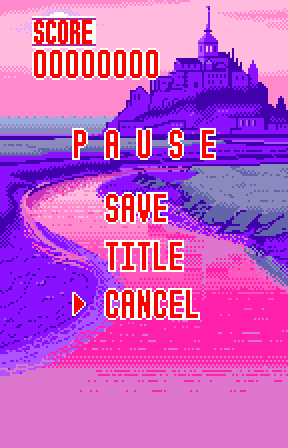
The presentation is built around the colour screen instead. The grey line segments of the original are joined by red, blue and green ones, the backgrounds are in colour, and the wallpaper behind the field can be changed during play. The graphics are simple but clear, and the music is the weakest part of the package.
All of the game’s on-screen text is in English, which is rare among WonderSwan Color games. The competition takes the place of a plot: the game came out on the Color’s launch day with a WonderGate ranking battle campaign, inviting players to post their scores against the rest of the country.
How it plays
The basic rules and controls are those of the first game. The console is held upright, panels carrying four kinds of line segment rise from the bottom of the field, and the cursor swaps two panels stacked one above the other, never side by side. A line that runs unbroken from the left wall to the right flashes and then vanishes, panels can still be moved while it flashes to hook more segments onto it, and the game ends when the panels reach the top.
Colour is the new layer. Every segment is red, blue or green, and a line still clears whatever its colours, but a line made of a single colour earns bonus points on top of the usual score and flashes for longer, which leaves more time to add segments to it and build a bigger clear. Bandai also promised time bonuses for same-colour lines. The bonus points themselves are slight enough to seem of little use.
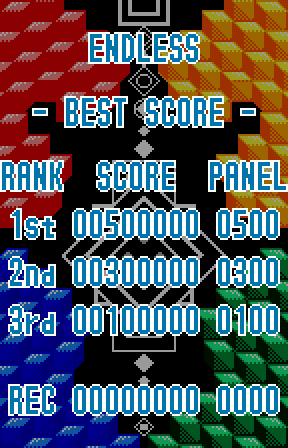
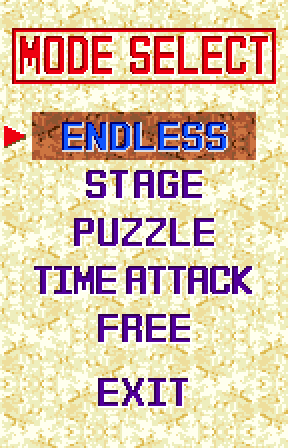
There are five modes. Time attack gives two or five minutes to clear as many panels as possible. The endless mode has no time limit and runs for as long as the player survives, the stage mode sets a quota of panels to clear within a time limit for each stage, and the puzzle mode sets out fixed groups of panels to be cleared, with swaps that can change the colour of a line, so colour becomes part of the solution. The free mode is for practice. The story mode of the first game is gone, and time attack takes its place.
Two players, each with a WonderSwan Color and a cartridge, can play against each other over the link cable. The special attacks work much as they did in the first game, but since there are no characters any more, each player picks the special attack to use directly instead of having it tied to a character.
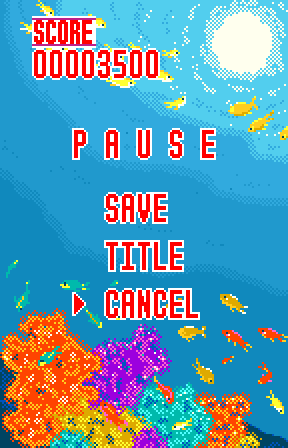
A suspend feature lets a game be stopped and picked up later, so a long high-score run in the endless mode can be played in short sittings. Records are saved on the cartridge, and over the WonderGate a score could be sent to the national ranking.
Development and release
The game carries no developer credit: the only copyright line is Bandai’s, dated 1999 and 2000. Bandai announced it before the details were settled, promising that the bonuses for same-colour lines would include extra time as well as points and that more would be revealed later. It uses the same 8-megabit cartridge with a 16-kilobit EEPROM as the first game, with vertical play, stereo sound, one or two players over the link cable and WonderGate support, and it sold for 2,980 yen before tax, the same price as the original.
Modes and features
The WonderGate connection, made through a mobile phone, gave access to an online score ranking, and the link cable connects two Colors for head-to-head play.
Ports and other versions
GunPey EX is a reworking of the 1999 WonderSwan GunPey for the WonderSwan Color, so its forerunner is on the same family of consoles rather than on another system. Colour is the main change: lines now come in several colours and a single-colour line earns extra points, a bonus generally thought of little use, while the story mode of the first game is gone, leaving endless, stage, puzzle, time attack and free play. The graphics were found plain but serviceable and the music poor, but the game was still rated highly.
The PlayStation and arcade versions of GunPey are versions of the first, black-and-white game, and EX itself was never ported or re-released on another console. The GunPey offered on NTT DoCoMo phones from October 2004 may have been based on EX, though Bandai Networks named only GunPey and never said which version it followed.