
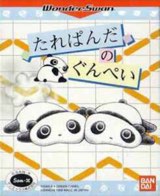
A version of Bandai's line-joining puzzle game GunPey dressed up with San-X's Tare Panda character, with new panda-themed modes added to the original ones.
Screenshots
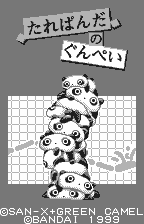
Title screen 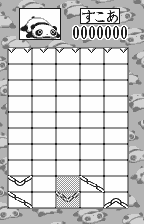
In play 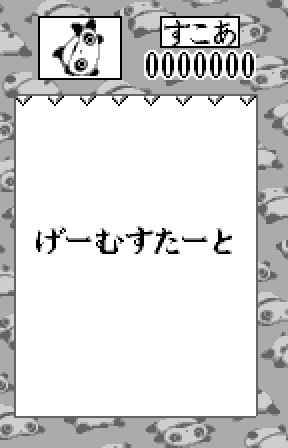
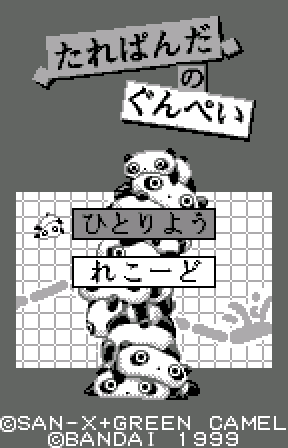
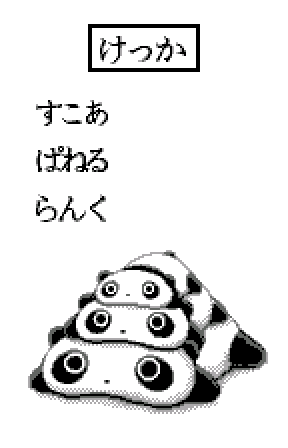
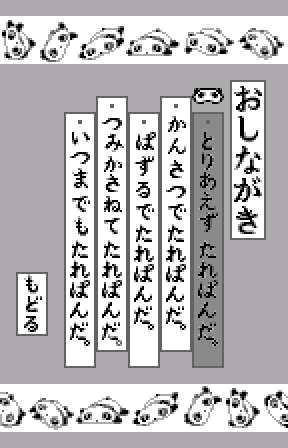
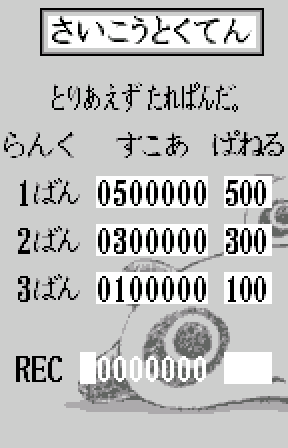
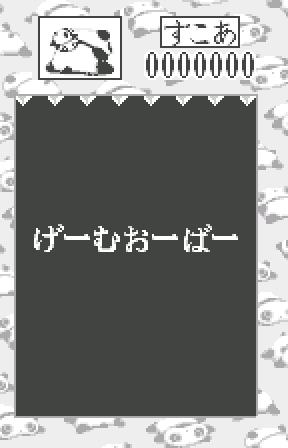
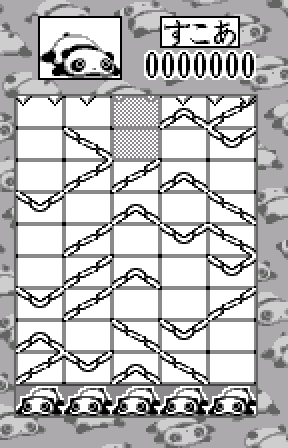
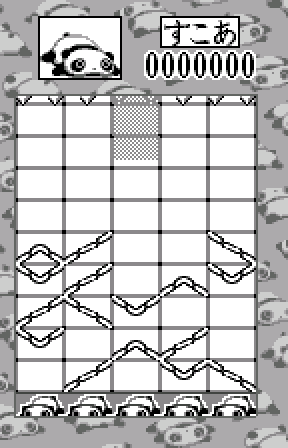
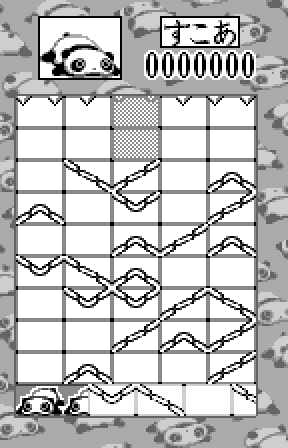
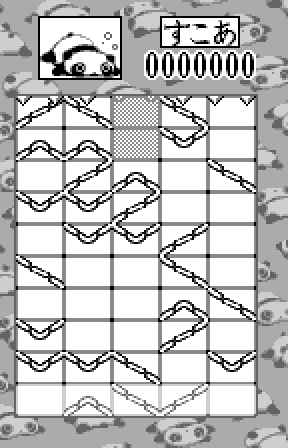
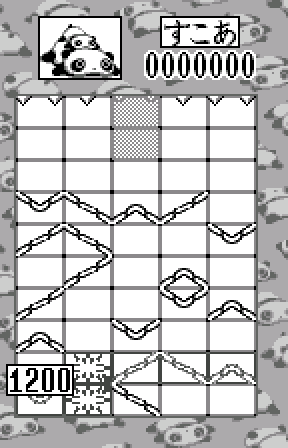
Tare Panda no GunPey is a WonderSwan puzzle game that combines GunPey, the line-joining puzzle that launched alongside the console in March 1999, with Tare Panda, a drooping panda character from the Japanese company San-X that was very popular at the time. Bandai released it on 9 December 1999, nine months after the original game.
The puzzle itself is the same as in GunPey: the console is held upright and the player rearranges pieces of line until they run unbroken from one side of the field to the other. Every mode of the original is kept, and two panda modes are added on top.
Two players can play against each other with the link cable. On the same day Bandai also sold the game in a set with a WonderSwan in an exclusive colour, with Tare Panda printed on the console. The cartridge saves to built-in EEPROM.
The story
GunPey has no plot to speak of, and this version swaps the original’s framing for Tare Panda. The character was drawn by Hikaru Suemasa at San-X and began life as a sticker design before a boom in Tare Panda goods took off in 1998. It is a panda lying flat on its belly with a blank expression, sold as a soothing character. It gets about only by rolling, at 2.75 metres an hour, it likes the soft rice sweet called suama, and several of them piled on top of one another make a stack known as tsumitare.
The game builds its presentation from those traits. The opening demo shows Tare Panda turning slowly and idly on the screen, and a second demo then shows rivals waiting in different countries, much like the line-up screen of a fighting game. The single-player story mode follows Tare Panda as it rolls from one set destination to the next around the world, collecting photographs of other Tare Panda and slowly turning into a pile of pandas. This replaces the original GunPey’s Wild West setting and its story of the frog Vincent rescuing the cat Sherry.
The two new modes keep to the same easy-going theme. One piles up the pandas the player has beaten in versus play, with a record height to aim for. The other lets the player watch Tare Panda’s life through spring, summer, autumn and winter, one stage at a time. The tone stays calm throughout, and the short messages in the demos give the panda much of its charm.
How it plays
The WonderSwan is turned on its side and held upright, so the tall screen shows the whole field at once. The field is five cells wide and ten tall. Each panel carries one of four shapes: a rising diagonal, a falling diagonal, an upward point and a downward point, so that each one meets its neighbours at an upper or lower corner on each side. The cursor swaps two panels that sit one above the other, and the aim is to make a line that runs without a break from the left wall to the right wall. Panels rise from the bottom at intervals, and the game ends when they reach the top.
A finished line flashes for a moment before it vanishes. During the flash the player can still move panels, and any piece swapped onto the line in that time joins it and is cleared too, a late addition that works like an active chain. Lines that branch clear more panels at once and score more, and clearing every panel on the field earns a bonus. An upward point placed just above a downward point lets the line pass through the same column twice, which is a way to clear several panels stacked in one column, though the line still has to cross all five columns.
All the modes of the original GunPey are kept: an endless game, a mode in which a set number of panels must be cleared, a puzzle mode in which every panel has to go at once, a story mode, a training mode with no game over, and versus play over the link cable. The menu entries carry panda-style names, such as Toriaezu Tare Panda and Puzzle de Tare Panda.
In the story mode, which the manual names Tsumikasanete Tare Panda, each stage asks the player to clear a given number of panels while question-mark panels get in the way and hide the field. The stacking mode, Tsumitare Panda, counts up the pandas defeated in versus play, and the observation mode, Kansatsu de Tare Panda, unlocks the seasonal scenes as stages are cleared.
The rules are simple but take some getting used to. Branches at the ends of the line are easy to make, so the panels in the middle columns tend to be left behind, and the rising field leaves little time to set up the column trick. Beginners are better off learning in Toriaezu Tare Panda or Puzzle de Tare Panda before trying the story mode with its question-mark panels.
Development and release
Bandai sold the game on the pairing of a character then in fashion with what it called the WonderSwan’s killer application. It came on an 8-megabit cartridge with 16 kilobits of EEPROM, played upright, with stereo sound and link-cable play for one or two players. The cartridge alone cost 2,980 yen before tax, and the bundle with the console 7,600 yen. The bundle has its own model number, SWJ-BAN021, and its console colour is called Tare White. The console is a milky white, half-transparent shell on which the menu symbols are redrawn with Tare Panda designs rather than simply covered by a sticker. The copyright lines on the cartridge are those of San-X with Green Camel and of Bandai.
Modes and features
The panda theme runs through every part of the screen: the face window, the mask over the incoming panels, the score display, the menus and the effects shown during play and in the demo, which even moves at a lazy panda pace. The music is rearranged from the brisk tunes of the original into slower versions. Players found two details awkward: the menus are written entirely in Japanese, which makes the familiar modes harder to pick out at a glance, and the panel design changes with the mode without any way to choose it, though some designs are harder to read.
Reception
The character swap was seen as done with care and as leaving the puzzle unharmed, and the panda was found more appealing than the original game’s own characters. At the time this version was recommended over the original to anyone buying GunPey, provided the price stayed the same.
Ports and other versions
This edition was made for the WonderSwan as a character version of the WonderSwan’s own GunPey, and it was never ported or re-released. GunPey itself did travel: a PlayStation version followed a week after this one, in December 1999, then an arcade release and GunPey EX for the WonderSwan Color in 2000, a version built into an NTT DoCoMo mobile phone, Nintendo DS and PSP games in 2006 and 2007, and a smartphone game in 2017. Those are versions of the plain puzzle; among all of them, this cartridge is the only one dressed in a licensed character, with its two panda modes and slower, rearranged music on top of the original modes.
Notes
The developer is unknown. Koto, the company that developed GunPey, counted the original GunPey and GunPey EX among its works but not this Tare Panda version, and only Bandai is credited.