
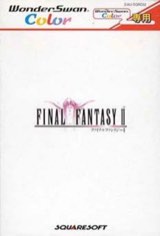
Square's WonderSwan Color remake of the second Final Fantasy, with graphics, music and controls reworked, faster battles and a monster encyclopedia added.
Screenshots
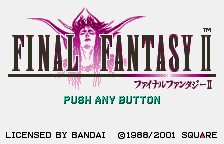
Title screen 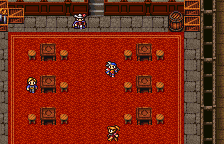
In play 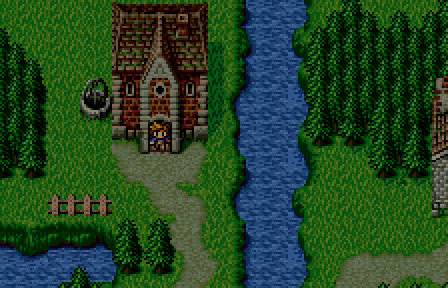
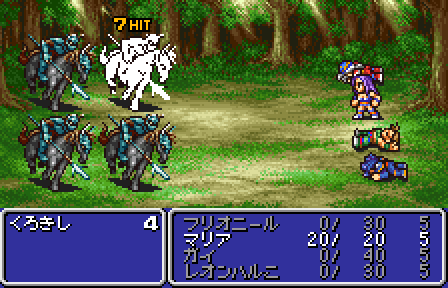
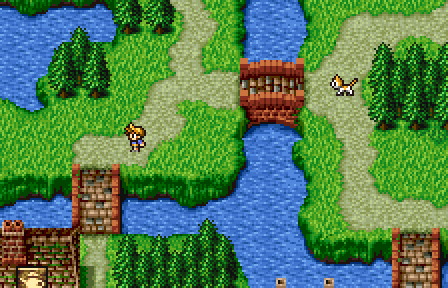
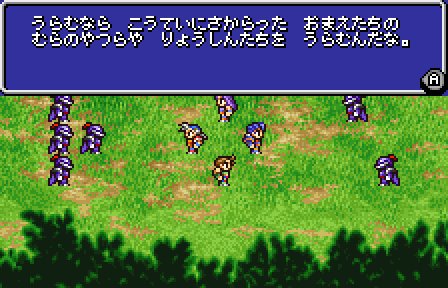
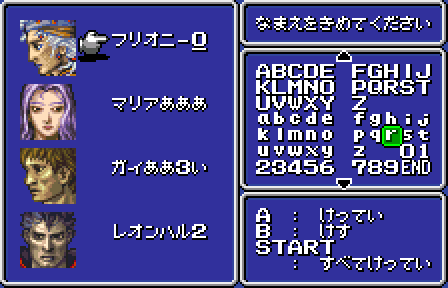
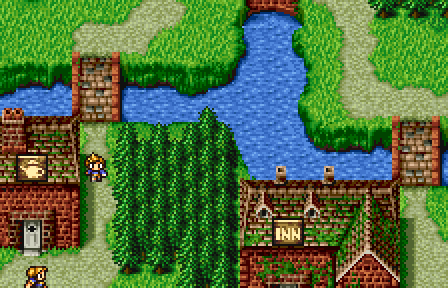
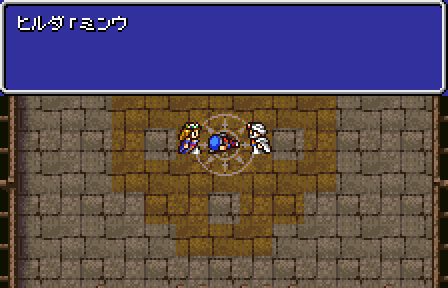
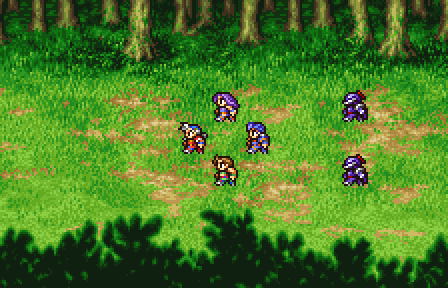
Final Fantasy II for the WonderSwan Color is Square’s remake of the second game in its Final Fantasy series, first released on the Famicom. It went on sale on 3 May 2001, about five months after the remake of the first game, and was sold both on its own and in a set packed together with a WonderSwan Color. The story of four young people who join a rebellion against the Palamecian Empire is unchanged, as is the series’ most unusual system: characters have no experience levels, and their abilities grow according to what they do in battle.
For the WonderSwan Color the graphics, music and controls were rearranged throughout, damage now pops up as numbers in battle and the player can dash, so the game moves noticeably faster. A monster encyclopedia and a hidden memory card game were added, and after the game is finished an Original Mode becomes available whose rules are somewhat closer to the Famicom version.
Square’s Osaka development division developed it together with the company Kan Navi. The cartridge needs a WonderSwan Color or SwanCrystal, and it became the model for the PlayStation version that followed.
The story
The Emperor of Palamecia has called up monsters from the underworld and set out to conquer the world. The kingdoms of Fynn, Kashuan and Deist stood against him, but the empire’s armies overran them. Fynn Castle has fallen, and what is left of its royal family has escaped to the small frontier town of Altair, where Princess Hilda leads a rebel army.
The game opens with four young people from Fynn who have lost their parents in the invasion: Firion, Maria, her brother Leon, and Guy. Fleeing the city, they are chased down by four Black Knights of the empire, a fight the party cannot win. In the WonderSwan version this opening was extended with a chase before the battle. Firion, Maria and Guy wake up in Altair, rescued by the rebels and healed by the white mage Minwu, but Leon is nowhere to be found.
The three ask to join the rebellion so they can look for Leon and fight the empire that killed their families. Hilda at first turns them away as too young, then gives them their first tasks: slip back into occupied Fynn, and later travel north to the town of Salamand in search of mythril for the rebels’ weapons. The rebels’ password, the words wild rose, opens doors among allies, while saying it to an imperial soldier starts a fight.
The game is a serious war story told across a large world map. Allies join the party for a while and then leave, towns change as the war goes on, and some places cannot be entered again once events have moved past them. This was also the series’ first game with chocobos and a character named Cid. The WonderSwan script follows the Famicom text closely, but the long written introduction now runs over illustrated scenes, and a few events were added or staged more fully.
How it plays
The game is played with the WonderSwan held horizontally. Exploration works in the classic way: the party walks a world map between towns, castles and dungeons, fights random battles, talks to people and buys equipment, spells and items in shops. Holding the B button makes the party dash, and the game can be saved at any point on the world map. The party has four places: Firion, Maria and Guy, plus a fourth member who changes as guests join and leave over the story.
There are no experience points, levels or classes. After each battle a character’s statistics rise according to what happened in it: maximum HP goes up when the character lost a good share of HP during the fight, maximum MP when MP was spent, and strength, agility, stamina, intelligence, spirit and magic grow with the actions that use them. Some rises can lower an opposing statistic, so heavy use of black magic can cut stamina and white magic can cut strength. In this version HP tops out at 9,999, MP at 999 and the other statistics at 99.
Every weapon type, shields, fighting unarmed and every single spell have their own skill level from 1 to 16, which climbs with use. Any character can equip any weapon or armour, so the starting choice of sword for Firion, bow for Maria and axe for Guy is only a suggestion. A character holding a weapon in each hand adds the power of both in this version, though the second hand gets only half of the strength bonus. Characters in the back row cannot be hit by ordinary attacks but can only strike back with bows. Heavy armour lowers evasion and secretly weakens spells, which is why light equipment and high evasion are the usual advice for spellcasters.
Spells are learned by using a spell tome bought in a shop or found, and a spell’s MP cost equals its current level. Instead of stronger versions such as the -ra and -ga tiers of later games, each spell simply grows stronger as its own skill level rises. Any command or spell can target an ally, an enemy or a whole side, and healing spells such as Cure and Raise hurt undead monsters. In this version Raise revives fallen allies in battle, even when cast on the whole party.
Conversations use a keyword system. Important words in what people say are highlighted, in colour on the WonderSwan, and the player can memorise them with Learn and then Ask other characters about them, or show them key items. The story moves forward this way, and the passwords and rumours gathered also point to the next destination.
Travel opens up with vehicles: a canoe, a ship that can land almost anywhere, the snowcraft for icy fields, chocobos that run twice as fast as walking with no random battles, and later an airship, with paid ship and airship services early on. The world is largely open, so dangerous regions lie close to Altair and a careful party can reach the magic town of Mysidia early for strong equipment. Inn prices rise with how much HP and MP the party has lost, and a won battle gives either money or an item, never both. The Captains guarding occupied Fynn hit very hard early on, and taking them on deliberately is a well-known strategy. Enemies tend to run away when the party’s HP is high.
The remake smooths many of the Famicom game’s rough edges. Most known bugs were fixed, monsters spread their attacks more evenly instead of picking on Guy and Maria, statistics still grow when a character ends a battle under a status effect other than KO or stone, and bonuses from several pieces of equipment add up. The party can carry twice as many items, although items still do not stack. Because the random encounter table is now saved with the game, saving and reloading no longer skips battles, which makes the early trip to Mysidia harder than on the Famicom.
Development and release
Square’s Osaka development division made the remake with Kan Navi, the studio that went on to make the PlayStation version. In April 2001 it was announced that the 5,200-yen cartridge would arrive on 3 May together with a special WonderSwan Color bundle priced at 12,000 yen, which came with a strap bearing the crest of the kingdom of Fynn from the game.
Modes and features
The cartridge holds eight save files. The dash and the auto-target option can be switched off, which fans of the original welcome because players sometimes keep a battle going on purpose to train skills. Every spell’s animation now changes as its level rises, some events are shown in larger, film-like pictures, and party members spread out and gesture during scenes. Damage, hit counts and status effects appear in real time during battle, and a character’s HP turns yellow under a status effect and red when critical. Two new boss themes were composed, and the field theme gained a second half. Ultima, notoriously weak on the Famicom, now grows stronger with the caster’s other weapon and spell skills. Original Mode, opened by finishing the game, removes the dash and auto-target.
Secrets and extras
A hidden memory card game can be started by entering a button command while riding the snowcraft. Fewer mistakes win better prizes, and if a party member knows Toad at level 16 the cards turn into frogs, with a harder game and better rewards. The Famicom trick of choosing a command and cancelling it repeatedly to inflate skill growth still works in this version.
Reception
Weekly Famitsu’s Cross Review gave it 30 out of 40, a Silver Hall of Fame score, and it sold 241,601 copies. It is generally rated a good game and regarded as the remake that stays closest to the Famicom version, ahead of the later PlayStation, Game Boy Advance and PSP releases. The complaints about it are smaller: Original Mode changes too little to be worth unlocking, the new music for the Behemoth fight is felt to weaken a famous moment, and the warning that Teleport can drain a character’s hit points was removed.
Ports and other versions
Final Fantasy II first came out on the Famicom on 17 December 1988 and stayed in Japan for many years. Before this remake it had only been reissued almost unchanged, on a 1994 Famicom cartridge that also held the first game. The WonderSwan Color version was the first to rework it, and it set the pattern for the PlayStation release of 31 October 2002, again made by Kan Navi. That version keeps nearly all of the WonderSwan content and balance but adjusts the graphics and music to the stronger hardware, adds computer-generated films, a gallery of Yoshitaka Amano’s illustrations and a quick save that lasts until the power goes off, and was the first release of the game in English, as part of Final Fantasy Origins in 2003. It was later sold as a download for the PlayStation 3, PSP and PS Vita.
The Game Boy Advance collection Final Fantasy I & II: Dawn of Souls of 2004 arranges the WonderSwan and PlayStation graphics but changes far more of the game: character portraits appear in dialogue, the lines were rewritten, saving is allowed in dungeons, skills grow faster, and a new story, Soul of Rebirth, opens after the ending. Japanese mobile phone versions from 2005 follow that edition without its extra story and the memory game. The PSP remake of 2007 builds on the Game Boy Advance content with fully redrawn graphics, brings back the PlayStation films and adds new dungeons, and the smartphone versions from 2010 are based on it.
The Famicom game itself was released on the Virtual Console for the Wii in 2009, the Wii U in 2013 and the Nintendo 3DS in 2014. The Pixel Remaster arrived in 2021 for Windows through Steam, iOS and Android, in 2023 for the Nintendo Switch and PlayStation 4, and in 2024 for the Xbox Series X and S.
How the versions compare depends on the reviewer. Famitsu’s Cross Review scored the Famicom original highest, this WonderSwan remake a little lower and the PlayStation release lower again. Of the later versions, IGN welcomed the improved translation and save-anywhere convenience of Dawn of Souls, and TouchArcade’s review of the Pixel Remaster still preferred the Game Boy Advance edition because the remaster leaves out its extra story.