
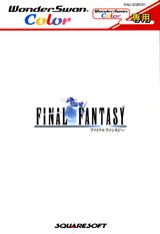
Square's remake of the first Final Fantasy with redrawn graphics, released for the WonderSwan Color on the day the console went on sale and also sold packed with it.
Screenshots
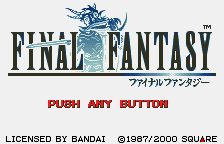
Title screen 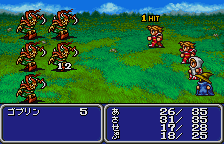
In play 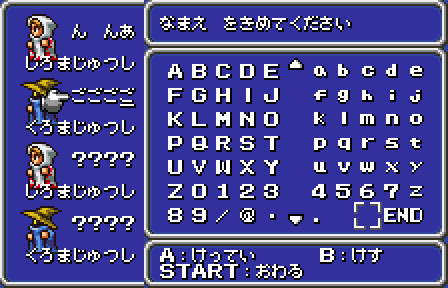
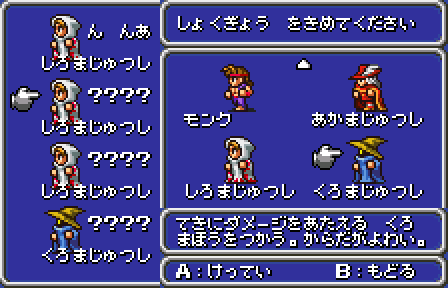
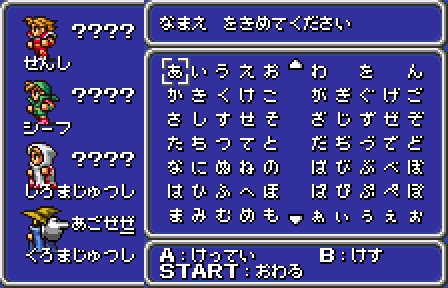
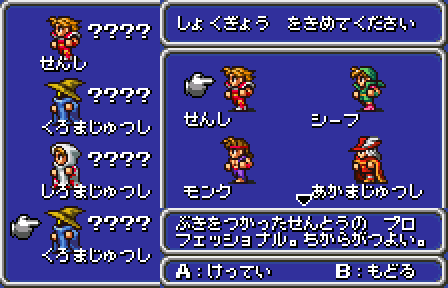
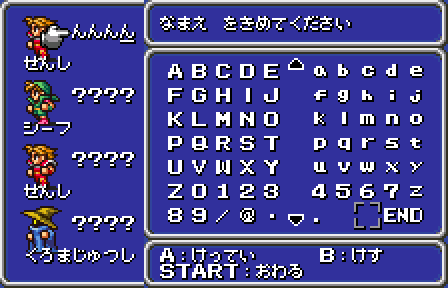
Final Fantasy for the WonderSwan Color is Square’s remake of the first game in its Final Fantasy role-playing series. It was announced together with the WonderSwan Color itself in August 2000 and went on sale on 9 December 2000, the day the new console was released. Besides the cartridge on its own, it was sold in a limited edition packed together with a WonderSwan Color. It was the first time the series could be played on a handheld, and ports of Final Fantasy II and III were already planned.
The world, the setting and the story are unchanged from the original. When the game was announced, Square’s president described it as closer to a remake than a straight port. The graphics were drawn again from scratch for the Color’s palette, with characters and monsters redone in the style of the Super Famicom games of the series, the battles were given full background pictures, and the sound moved from mono to stereo with a rearranged soundtrack. The game’s systems were also reviewed.
The cartridge is made for the Color and does not run on the original black-and-white WonderSwan. Its redrawn graphics became the starting point for several later versions of the game.
The story
The game is set in a world that is never given a name. The forces of earth, fire, water and wind, which keep it alive, have been cut off, and the land is sliding into darkness. Its people hold on to an old prophecy: when the world is at its darkest, four Warriors of Light will come to save it.
After a long journey, four young travellers arrive in the kingdom of Cornelia, each carrying a crystal whose light has gone out. The crystals mark them as the warriors of the prophecy. The four are deliberately blank. They have no history, no fixed personalities and no lines of their own; the player chooses each one’s name and calling at the start, and the story is told through the people they meet rather than through them.
Cornelia has troubles of its own. Garland, once a knight of the kingdom, has carried off Princess Sarah and shut himself away in the Chaos Shrine. The king asks the newcomers to bring her back, and this rescue is the first quest of the game, a short dungeon with a boss at its end. In thanks, the king has his soldiers rebuild the bridge that leads out of Cornelia, a moment the WonderSwan Color version shows as a new scene with the army at work, and the princess gives the warriors a keepsake. The four then cross into the wider world. Their first stop is Pravoka, a port town held by the pirate Bikke and his crew, and winning there puts a ship in their hands.
From that point the aim is to bring the light back to the crystals, one at a time. The story is built around the map opening up: each new means of travel reaches new coasts, towns and dungeons, and townspeople and kings point the way to the next trouble. The tone is classic heroic fantasy, with short dialogue and a quest that grows from a local errand into the fate of the whole world. The remake keeps the 1987 plot as it was, but conversations with townspeople run longer, over several windows, and new scenes with the character sprites fill out key events.
How it plays
The cartridge is played with the WonderSwan Color held horizontally. The party of four is chosen at the very start and stays the same for the whole game. Each member takes one of six classes, Warrior, Thief, Monk, White Mage, Black Mage and Red Mage, and the same class can be picked more than once. Any line-up can finish the game. Classes cannot be swapped later, but a story event in the second half lets each one change into a stronger version with more equipment and spells and a new sprite. On the maps only the leader is shown; status, items and spells are handled on a separate menu screen, and a single press of the confirm button talks to a person or examines an object.
The six classes play very differently. The Warrior wears the heaviest armour and does most of the fighting with weapons, and later gains a little white magic as a Knight. The Thief fights less well but is lucky and best at running away, and later becomes a Ninja with far more equipment and some black magic. The Monk fights barehanded, grows much stronger with each level and needs little spent on gear, which makes him cheap to keep. The White Mage heals and cures, the Black Mage is frail but hits hard with attack spells, especially against an enemy’s weak element, and the Red Mage mixes weapons with a share of both schools of magic, though not the highest levels.
Battles come at random on the world map and in dungeons and are turn based. The view is from the side, with the party standing in a diagonal line along the background’s perspective as in Final Fantasy VI and the monsters opposite. Characters hop forward to strike and swing once for each hit, the number of hits appears over the attacker and the damage pops up from the target, as in Final Fantasy III onwards, and status icons are shown on enemies. If the target of an attack has already fallen, the blow now goes to another enemy instead of being wasted. The order of the party matters, because characters higher in the line are attacked more often, and it can only be changed outside battle. If all four are killed or turned to stone, the game is over and play resumes from the last save.
Magic is not learned by levelling up. Spells are bought in white and black magic shops in the towns, and what a character can buy depends on the class. There are eight levels of spells, with four white and four black spells at each level, but a character can learn only three per level, so every purchase is a choice; in the remake a learned spell can be forgotten to make room, which the Famicom game did not allow. Instead of a single pool of magic points, each character has a number of uses for each spell level, which grows with experience and is refilled by a night at an inn. Each spell has a fixed range, such as one ally or all enemies, and cannot be spread or narrowed. Characters can reach level 50.
Items and equipment were made far easier to handle. The party shares one inventory with no limit on how much it holds, shops sell in bulk, and any member can use items in battle; some curing items now work in battle too, and silence no longer stops a character from using them. Weapons and armour, not only shields, can be changed mid-fight, and equipment can be taken straight off another member. Spells and equipment that did not work as described in the original were fixed. Shops are now small rooms with a counter that the party walks into, and staying at an inn shows a short scene of the party asleep and waking up.
Travel starts on foot. The world map labels place names, and in towns and dungeons holding a button makes the party dash at double speed, a feature that can be switched off on the configuration screen. The ship sails the seas at twice walking speed but can only land at ports, the canoe crosses rivers and lakes, and the airship, reached much later, flies at four times walking speed over any ground, meets no monsters on the way and lands only on plains. The rate of random encounters was also adjusted for the remake. The game is saved by staying at an inn or by using a tent or cottage on the world map. There are eight save slots, and a quick save can be made anywhere outside battle; it ends the session and is erased once play resumes from it.
The early levels go by faster than on the Famicom, but bosses have more hit points and healing is still scarce, so spell uses and healing items have to be rationed between inns. There is no easy mode; one was added only in the PlayStation version. Because the top of the line draws most attacks, the sturdiest fighters belong there and the mages further down, a party without a healer has to lean heavily on bought items, and the spells for each level are worth choosing with care, since only three of the four fit.
Development and release
Square published the game, but the remake itself was made by the contract developer Tose. Square and Bandai unveiled it at the WonderSwan Color press event in Tokyo on 30 August 2000, where a playable version stood in the demonstration area. At that event Square’s president, Hisashi Suzuki, named Final Fantasy, Seiken Densetsu and SaGa as the series the company meant to bring to the system, and the program was about ten times the size of the Famicom original. The cartridge cost 4,800 yen. The bundle, at 9,999 yen, paired it with a WonderSwan Color in a colour made for the set and was sold only in December 2000. Queues formed outside shops on launch day, and the console’s first shipment of 300,000 units sold out within two days.
Modes and features
Beyond the new graphics and the changes to the rules, the remake reworked the presentation. The logo was updated, and the battle screen was laid out like those of Final Fantasy II onwards, with the whole fight on one screen and its text in a window along the bottom. New scenes were added, such as the opening and the building of the bridge, the staff roll moved from the start to the ending, and some monsters were renamed. Nobuo Uematsu’s music was rearranged and several new pieces were added, among them more than one boss theme. Several bugs were fixed and bosses were given more hit points, so the balance shifted even though the story did not.
Secrets and extras
The hidden sliding-tile puzzle from the Famicom version is still reached by holding the A button and tapping the B button repeatedly while on board the ship. In the original it paid a flat 100 gil. In the remake the puzzle runs against a clock: every solve still pays 100 gil, setting the first, second and third best times pays 10,000, 5,000 and 2,000 gil, and finishing quickly earns healing and curing items, so it is a quick source of money once the ship is won. Starting the puzzle also plays the game’s opening theme.
Reception
Weekly Famitsu’s Cross Review gave the remake 30 out of 40 and placed it in its Silver Hall of Fame. It sold about 370,000 copies, the most of any WonderSwan game, or around 510,000 if the console bundle is counted. Its balance is judged mixed: the early levels are easier, while bosses are tougher and healing remains scarce.
Ports and other versions
The game first appeared on the Famicom on 18 December 1987. Before this remake it had only been carried over with little change: Micro Cabin converted it to the MSX2 on floppy disk in 1989, with music arranged for the FM-PAC sound cartridge and a smaller playing area framed in black, and in 1994 Square put it on one Famicom cartridge with Final Fantasy II. The WonderSwan Color version was the first true remake in the series.
The WonderSwan version then became the base for the next ones. The PlayStation release of 2002, sold in Japan as Final Fantasy and with Final Fantasy II in a premium package, and in English in 2003 as Final Fantasy Origins, keeps its design but draws the graphics in finer detail, arranges the music anew, and adds computer-generated films, a gallery of Yoshitaka Amano’s art, a bestiary, an easy mode and a memo save kept in the console’s memory in place of the WonderSwan’s quick save, while dropping the menu screen’s own music; it was later sold as a download for the PlayStation 3, PSP and PS Vita. The Game Boy Advance collection Final Fantasy I & II: Dawn of Souls of 2004, again by Tose, redraws the WonderSwan graphics with more colours but changes the rules far more: magic runs on a pool of points instead of charges per level, experience comes faster, the script was heavily revised, and four bonus dungeons were added. The PSP remake of 2007 follows the Game Boy Advance rules with all-new, sharper graphics and another new dungeon, and it was the basis for the smartphone versions from 2010 and a Japan-only Nintendo 3DS release in 2015 with stereoscopic 3D. Japanese mobile phones received their own versions from 2004, which mix battle and menu screens close to the WonderSwan and PlayStation ones with towns and maps built on the Famicom game.
The Famicom original itself returned through the Virtual Console on the Wii in 2009 and on the Wii U and Nintendo 3DS in 2013, and on the NES Classic Edition in 2016. The Pixel Remaster of 2021, for Windows through Steam, iOS and Android, followed by the Nintendo Switch and PlayStation 4 in 2023, goes back to the Famicom game as its model, restoring the original monster designs and spell charges while keeping some later conveniences; an Xbox Series X and S release followed in 2024.
Among English-language reviews, IGN praised the WonderSwan Color version’s new environments, characters and monsters, IGN’s reviewer of Dawn of Souls rated its translation above every earlier one, and the PSP remake was received less warmly, with GameSpot finding that its new graphics added little.
Later history
Final Fantasy II followed on the WonderSwan Color in May 2001. Final Fantasy III was also in development for the system, but, as Hiromichi Tanaka, director of the Famicom game, later explained in an interview, it was never finished because of technical problems and a lack of cartridge space.