
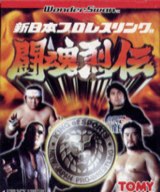
Tomy's New Japan Pro-Wrestling game for the WonderSwan launch: six real wrestlers, four single-player modes and simple punch-and-kick matches seen from the side in 2D.
Screenshots
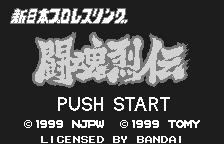
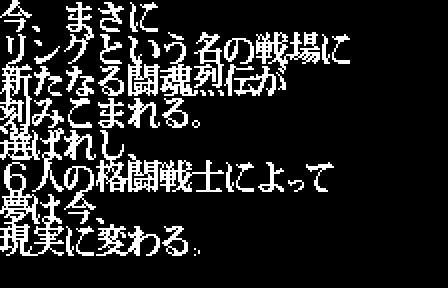
Title screen 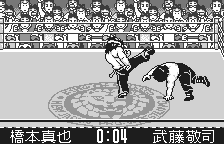
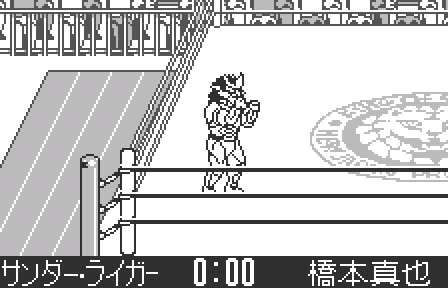
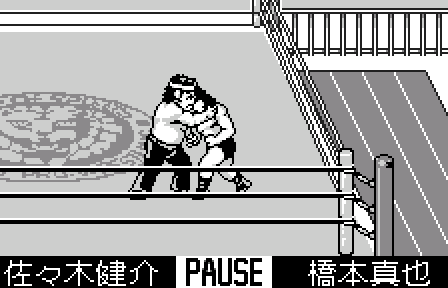
In play 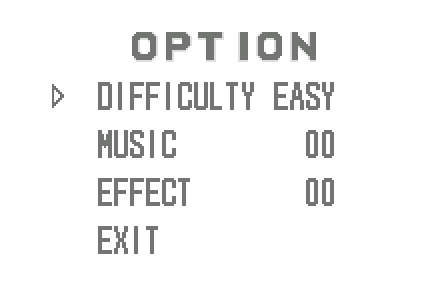
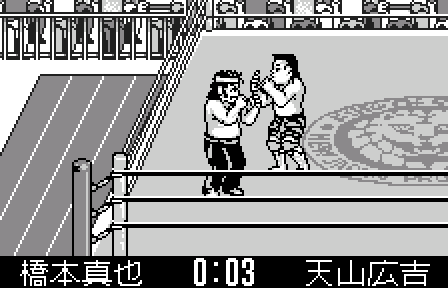
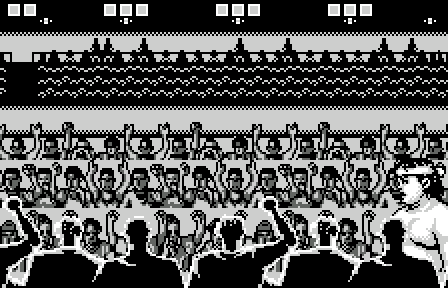
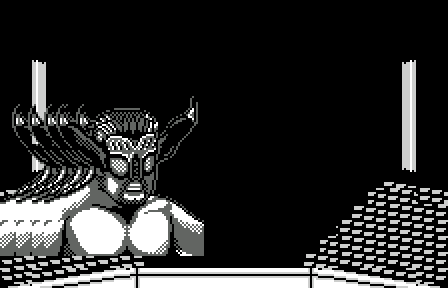
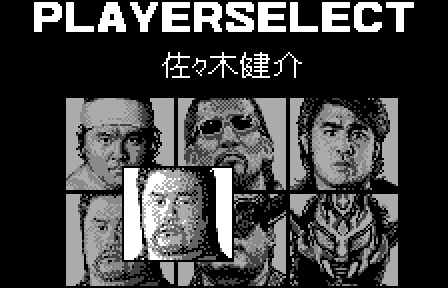
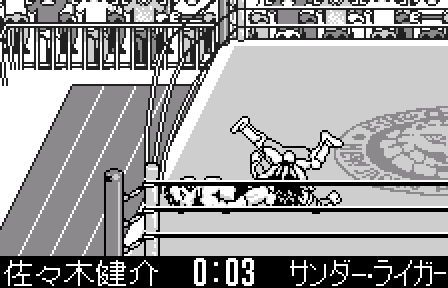
Shin Nihon Pro Wrestling: Toukon Retsuden is a professional wrestling game licensed from New Japan Pro-Wrestling and published by Tomy. It belongs to the Toukon Retsuden series, which began on the PlayStation with games made by Yuke’s and continued on the Dreamcast. The WonderSwan cartridge went on sale on 4 March 1999, the same day as the console, and was one of its launch titles. The handheld version is sometimes credited to TOSE rather than Yuke’s, though this has never been confirmed.
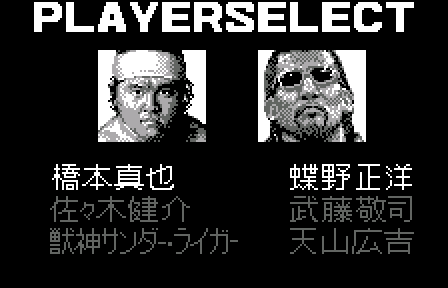
The roster is small: six New Japan wrestlers who were active when the game came out, among them Keiji Muto, Masahiro Chono, Shinya Hashimoto and Jushin Thunder Liger. The player picks one of them for one of four modes: a title match for the IWGP championship belt, the G1 Climax league, a time attack and a training mode.
Where the console games of the series used 3D polygons, the handheld versions are drawn in 2D to suit the hardware. The WonderSwan game also leaves out the three-way, rock-paper-scissors style system that the console games were known for, and it is a game for one player only.
The story
The game has no story. Its premise is the real New Japan Pro-Wrestling of early 1999: its wrestlers appear under their own names, and Bandai’s preview presented it as a game in which the player gets to settle who is the strongest wrestler in New Japan, a promotion it called the hottest in the country.
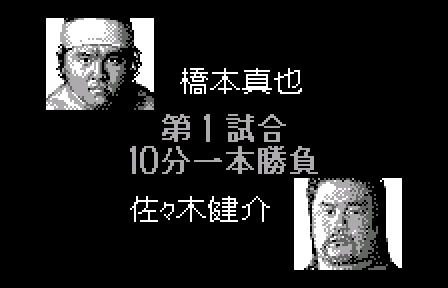
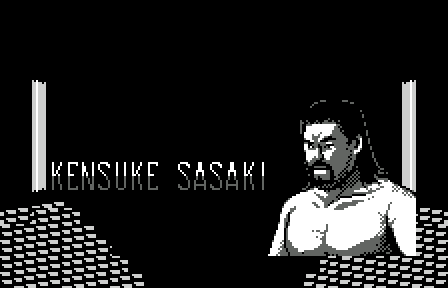
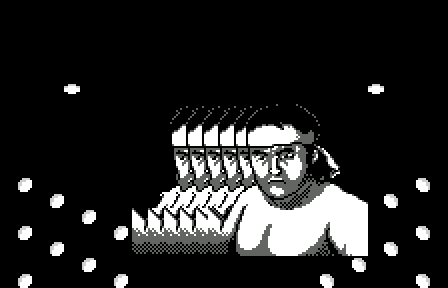
The six men on the roster are introduced as the stars they were at the time. Bandai’s preview billed Masahiro Chono as the leader of nWo Japan and billed Shinya Hashimoto as the Bakusatsu Shooter, alongside Keiji Muto, Kensuke Sasaki, Hiroyoshi Tenzan and Jushin Thunder Liger. Each wrestler is shown with a digitised photograph when he is introduced, and matches open with an entrance scene set to music.
What framing there is comes from the promotion’s own events. The title match mode is a climb towards the IWGP heavyweight belt, and the G1 Climax mode is a round-robin league like the real tournament of that name. There are no cut scenes, no rivalries scripted between the wrestlers and no ending to reach: on the WonderSwan, the title match mode simply carries on with further opponents once the belt has been won.
How it plays
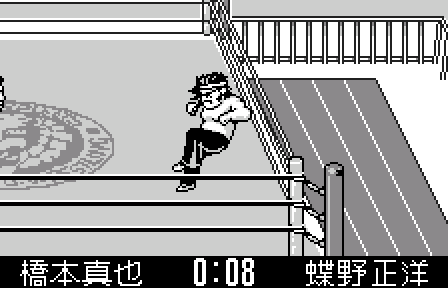
The console is held upright and matches are seen from the side. The X buttons move the wrestler and the A and B buttons punch and kick. Nothing like the series’ three-way system survives, in which throws, strikes and holds beat one another in a fixed order that decided which move took priority and whether it could be reversed, and grapples are not decided by pressing at the right moment either. The controls are closer to an older fighting action game built on punches and kicks.
Throws come out of the strikes. A punch thrown at close range becomes a grab, and once the opponent is held, the direction pressed decides which way he is thrown. The more punishment a wrestler has taken, the longer he takes to get back up, which leaves him open to kicks and jumping attacks. Punching an opponent who is down puts him in a hold: near his legs the wrestler goes for the legs, near his head he locks on a head scissors, and keeping the hold on for ten seconds without the opponent breaking free wins the match. The move list runs to several dozen of the wrestlers’ familiar techniques.
The title match mode sends the player through the rest of the roster in pursuit of the IWGP heavyweight championship, and on the WonderSwan it keeps going after the belt is won, with one challenger after another. The G1 Climax is a round-robin league in which the chosen wrestler meets each of the other five in turn; a run with Liger, for example, faces Hashimoto, Chono, Muto, Sasaki and Tenzan. The time attack is played against the clock and counts how many opponents can be beaten before time runs out. The training mode is for practising each wrestler’s moves.
The ring itself offers little to work with. The corner posts cannot be used, the ropes do not stop a wrestler and the fight never goes outside the ring. Big moves are no more likely to be kicked out of or reversed early in a match than late, so they can be strung together freely, which makes matches repetitive, and pressing buttons more or less at random is enough to produce moves and win. The game offers little resistance for anyone used to wrestling games.
Everything is played alone against the computer. There is no versus mode of any kind, and the link cable cannot be used to set up a match between two consoles.
Development and release
The game was listed at 3,980 yen before tax, on an 8-megabit cartridge with a small EEPROM for saved data, played with the console held upright and with stereo sound. The six playable wrestlers are Masahiro Chono, Shinya Hashimoto, Keiji Muto, Kensuke Sasaki, Hiroyoshi Tenzan and Jushin Thunder Liger, and the game has several dozen familiar moves, among them the Kenka Kick, the Dragon Screw, the Mongolian Chop and the DDT. Its copyright line names only New Japan Pro-Wrestling and Tomy, and the developer is unknown. Yuke’s developed the series’ PlayStation, Dreamcast and Game Boy Advance titles for Tomy.
Modes and features
The wrestlers are introduced with digitised photographs, and the small figures in the ring look plain beside them; the music of the entrance scenes is simple too. The options menu sets the difficulty and has a sound test for the music and sound effects.
Reception
The game disappointed at launch. Players who had looked forward to it as a launch title found that pressing buttons more or less at random was enough to win, that matches became repetitive because big moves could be chained freely, and that the game fell far short of what the Toukon Retsuden name promised. Later verdicts are milder: the graphics are reasonably detailed, but the small roster, the missing three-way system and the lack of a versus mode are a disappointment.
Ports and other versions
Although the cartridge shares the series name, it is not a conversion of any of the console entries but a title of its own, released between the third PlayStation game of 1998 and the fourth game for the Dreamcast, and it was never ported or re-released. The series’ other handheld entry, Toukon Retsuden Advance for the Game Boy Advance in 2002, is likewise a separate game drawn in 2D. Set against the 3D console games, which also reached arcades with the third and fourth instalments, the WonderSwan cartridge stands apart with its six-man roster, single-player play and simpler controls without the three-way system.