
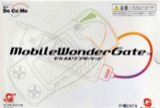
NTT DoCoMo's adapter set that put the WonderSwan online through a DoCoMo mobile phone, with a cartridge for web browsing, email and mini-game downloads.
Screenshots
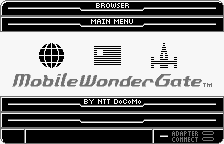
Title screen 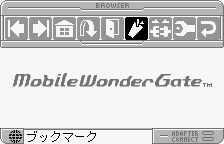
In play 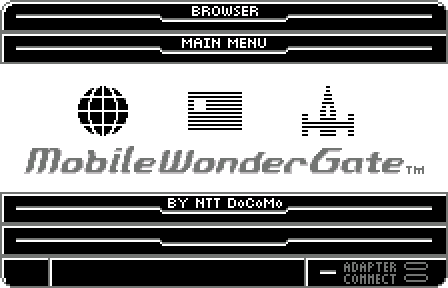

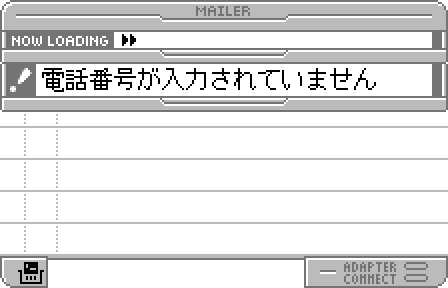
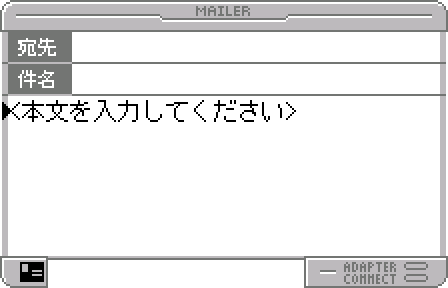
MobileWonderGate is the set that let a WonderSwan connect to the internet. It went on sale in Japan on 14 July 2000 for 10,200 yen and was announced and sold by NTT DoCoMo, the mobile phone operator, rather than by Bandai. The box held two parts: a small adapter with a cable that joins the WonderSwan to one of DoCoMo’s digital (PDC) mobile phones, which acts as the modem, and a cartridge that connects to mopera, DoCoMo’s internet service.
The cartridge contains a simple web browser, an email program and a tool for downloading mini-games. The connection ran at 9,600 bps and was charged by call time, so a reviewer at the time warned that browsing could become expensive. Downloaded mini-games were stored on the cartridge, each one about 32 KB.
The adapter was also used by games. With a compatible cartridge, players could see national score rankings or download extra content; early examples were SD Gundam G Generation: Gather Beat, which offered extra units and characters, Final Lap 2000 and Lode Runner. Bandai planned a range of such titles around the launch. DoCoMo ended the mopera service for MobileWonderGate on 31 December 2004, saying that almost nobody had been using it in the preceding months.
The story
MobileWonderGate has no story. It is a set of tools rather than a game, with no characters, no setting and nothing to win, and the cartridge opens on a plain menu with the browser as its leftmost choice. What it offered in place of a premise was the idea Bandai sold it on: the WonderSwan as a pocket internet terminal that could go online anywhere a DoCoMo phone had a signal, so that its owner could read web pages and mail away from home, fetch new data for games and send scores to national rankings. The one game ever offered for download, a fifteen puzzle, has no story either.
How it plays
Setting up takes three steps. One AAA battery goes into the adapter, the cable stored on the adapter’s back plugs into an 800 MHz DoCoMo digital phone, and the cartridge goes into the back of the WonderSwan; together the console and kit weigh under 200 grams. The phone does the dialling and acts as a 9,600 bps modem over an ordinary circuit-switched call, not a packet connection. Browsing needs no sign-up for a DoCoMo phone user, because every page goes through mopera. Mail needs an account, either DoCoMo’s moperaPOP service at 500 yen a month before tax or any other POP3 provider, set up by hand with the access-point number, account name, POP3 server and mail address.
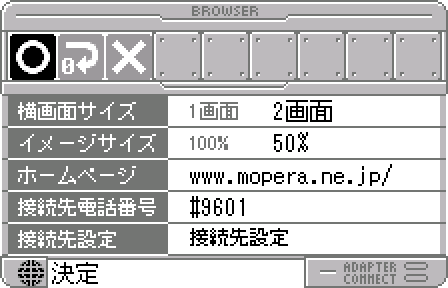
The browser is started from the cartridge’s menu. The A button follows links and opens bookmarks, holding B while pressing the directional pad scrolls the page, and Start opens a six-item browser menu where up to 20 bookmarks are kept. Every page passes first through a mopera server, which reshapes it for the browser, and arrives a few kilobytes at a time; to websites the browser identifies itself as InfoBridge-mopera. It handles roughly HTML 3.2 with tables and GIF images. Pages built from frames appear as a list of links, one for each frame, which can then be opened in turn. Secure pages and Flash do not display, and cookies are not accepted, so Yahoo! personal services and Hotmail did not work. Scrolling back up a page comes from memory, but going back to the previous page always loads it again. The most important habit is hanging up: a mail session ends the call by itself, but a web session stays connected, and keeps costing money, until the user disconnects by hand.
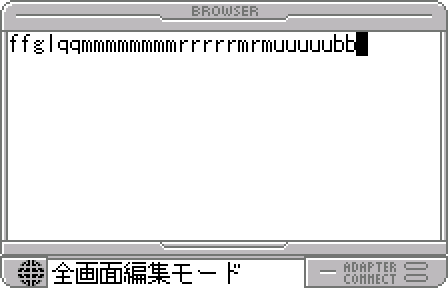
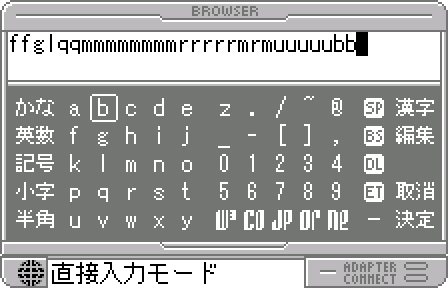
Text appears in a 12-dot font with 18 full-width characters on each of 10 lines, and 10-dot and 14-dot fonts can be chosen instead; both levels of the JIS kanji set are included. All writing is done on an on-screen keyboard, picking each character with the directional pad and confirming it with A or B, much like entering a name in a role-playing game. It works, but it is slow, and the 2000 reviewer found it better for reading mail away from a computer than for writing it every day.
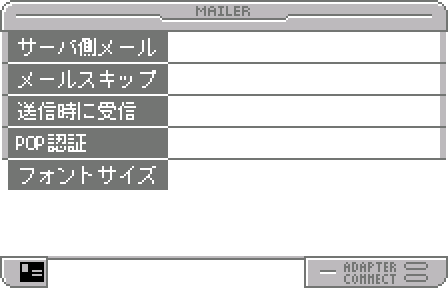
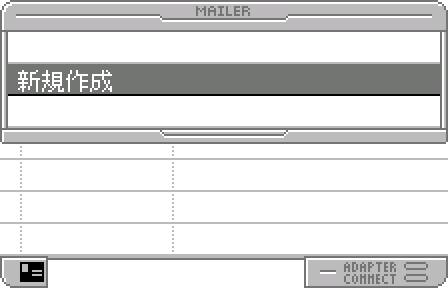
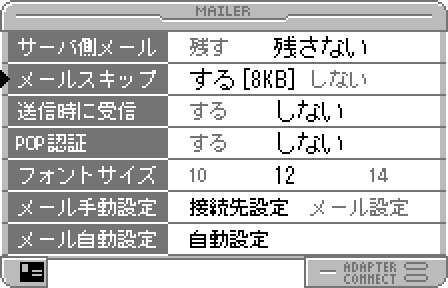
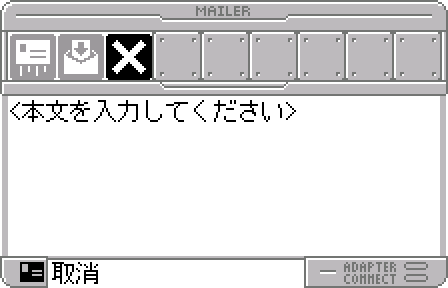
The mail program speaks POP3 and SMTP. A message sent can be about 1,000 characters long and a message received about 4,000, the inbox keeps up to 128 messages in 32 KB and the outbox 32 in 16 KB, and the address book holds 20 entries. Mail can be left on the server, and messages larger than 8 KB can be skipped. Attachments cannot be opened, and HTML mail is shown as plain text with its tags removed. One flaw stood out at launch: the mail settings hide the password on the reading screen but show it in plain text on the edit screen.
The download tool fetches a mini-game from Bandai’s server into the cartridge’s 32 KB storage area, which holds one game at a time, and the call is charged like any other. Compatible games use the adapter with their own cartridge in place of the MobileWonderGate one. Through it they sent scores to national rankings or downloaded extra data such as maps, units and scenarios; nothing was ever played live against another player. Bandai closed the game services on 31 March 2003 and DoCoMo’s mopera stopped serving the browser and mail at the end of 2004. The browser checks every address with a mopera server before loading it, so it cannot open any page now, but in 2023 a replacement for that server, run on a Linux computer joined to the WonderSwan through a serial adapter, brought it back to life.
Development and release
A prototype of the kit was announced in June 1999, and at the Tokyo Toy Show in March 2000 it was presented as WonderGate, a Bandai kit nearing completion that DoCoMo expected to release around June for roughly 10,000 yen. The finished set was announced by DoCoMo in early July 2000, with a translucent white adapter in place of the prototype’s look. Bandai said it would follow with software built to use it, and at launch a version for PHS phones was also expected.
Modes and features
The adapter measures 70 by 43 by 25 millimetres, weighs 50 grams with its single AAA battery, lasts about three hours of continuous web use, and ends in a 13-centimetre cable to the phone. The cartridge gives about 128 KB of user memory. Only one downloaded game can be stored at a time, and the set cannot send DoCoMo’s short messages or pager messages.
Bandai advertised three uses for compatible games: uploading scores or player-made data to Bandai’s server for national rankings and tournaments, downloading rankings, maps and special data, and, as a feature still being planned, battles and trades over the network. The compatible games of the time only downloaded or uploaded data, with nothing played live.
Reception
The Keitai Watch reviewer liked the small, light adapter and thought the browser and mail program were well made for such a cheap internet tool. He found the set handy for checking mail away from home but tiring for everyday writing, criticised the mail settings screen for showing the password in plain text, and judged that, with few compatible games and no live play, it did not yet offer much as a game accessory.
Ports and other versions
The kit and its cartridge were made for the WonderSwan alone and never appeared on another system; the PHS model expected at launch was never released. The nearest counterpart elsewhere is Nintendo’s Mobile Adapter GB, a separate product that went on sale in January 2001, about six months after the WonderSwan set, to join a Game Boy Color or Game Boy Advance to a mobile phone. The Nintendo adapter served mainly as a way for games to swap data with a server through its own provider, and its services closed in December 2002. The WonderSwan kit differed in shipping with a general web browser and mail program of its own on the cartridge, besides serving its compatible games.
Later history
The game services had early troubles: in September 2000 the ranking server could not be reached for about ten days by six titles, among them Final Lap 2000 and Pocket Fighter, and further maintenance stops followed in April 2001. Bandai ended the game-side services on 31 March 2003, cutting off the online features of 16 titles, while the browser and mail kept working. DoCoMo announced in August 2004 that mopera would stop serving the WonderSwan at the end of that year, which closed the last of the kit’s functions.
Notes
The only mini-game ever offered through the download tool was a fifteen puzzle, although Bandai had promised games, fortune-telling and puzzles. The developer of the cartridge software is unknown, and so is its catalogue number.