
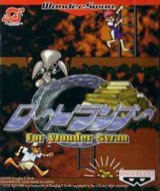
Banpresto's WonderSwan version of the classic dig-and-collect puzzle game Lode Runner, with stages of the player's own making that can be traded over the link cable.
Screenshots
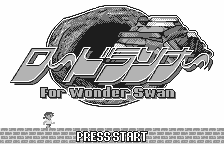
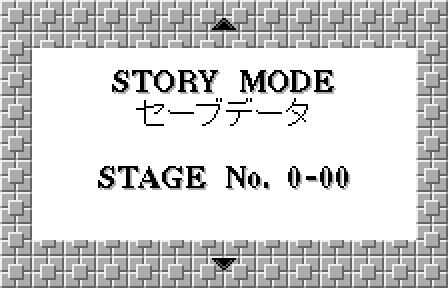
Title screen 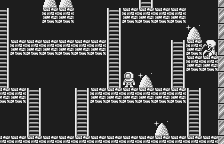
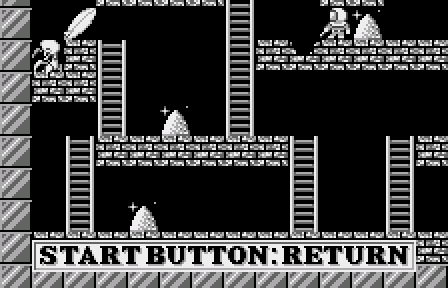
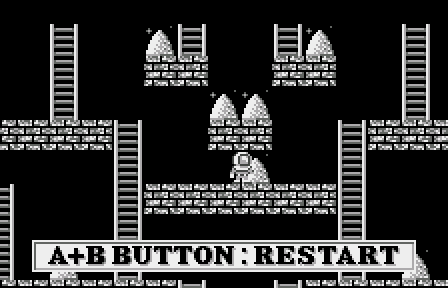
In play 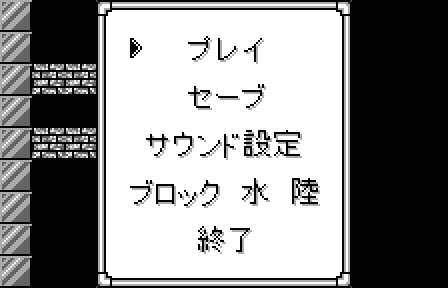
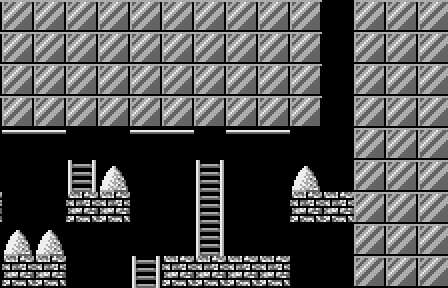
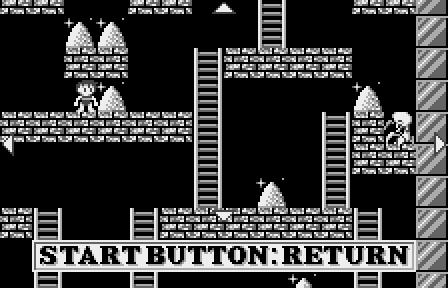
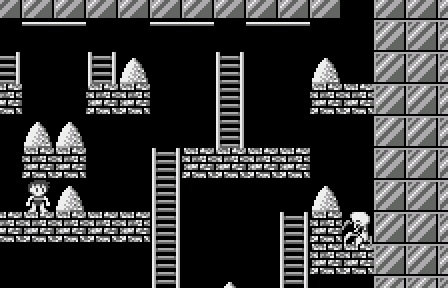
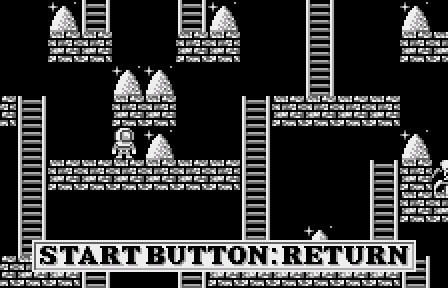
Lode Runner for WonderSwan is a version of Lode Runner for the black-and-white WonderSwan, released by Banpresto on 20 April 2000 and developed by Aisystem Tokyo. Lode Runner began as a 1983 Apple II game by Douglas E. Smith, published by Broderbund, and became well known in Japan through Hudson’s Famicom version of 1984.
The rules are those of the original: the player collects every piece of gold in a stage while digging holes to escape or trap the guards, then climbs out at the top. The WonderSwan game adds stages that are partly or wholly under water, a diving suit, new block types and collectable bonus items, and players can build stages of their own and trade them over the link cable.
The story
The game gives the old puzzle a light treasure-hunting frame. After diving again and again, the runner, a young surfer, finds a golden kingdom on the sea floor, a vast palace that may hold legendary gold. The setting is what brings water into the series: many of the mazes are flooded in part or in full.
The box shows the runner as a spiky-haired cartoon boy in a white shirt, drawn in an anime style, and calls the guards robots. Under water the runner meets a sea-going robot shaped like a shark as well. The surfboards and arowana fish scattered through the stages fit the undersea theme.
Beyond that premise, Story Mode groups the stages into five chapters, each opened by a short scene in which the runner tells of the sunken palace in the first person, and the runner is a boy or a girl depending on the owner’s gender set in the WonderSwan. Other modes let the player pick any stage on its own or play stages made in the editor.
How it plays
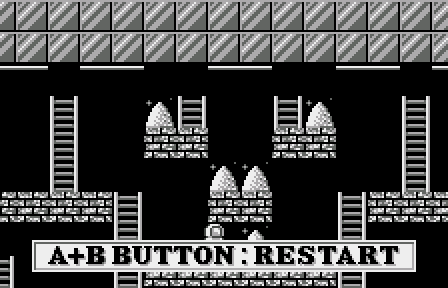
The WonderSwan is held sideways. The runner walks, climbs ladders and moves hand over hand along bars, and he cannot jump. He digs with two buttons, one for a hole to his left and one for a hole to his right, and pushing diagonally on the direction keys lets him step smoothly onto a ladder, and the game responds well to it even though diagonals are awkward to press on the WonderSwan. A stage is wider than the screen, so the view scrolls as he moves; there is no shrunken overview of the whole stage, and the player scrolls to look around instead, for example to see where a guard will reappear. The top row of a stage sits in the shadow of the screen’s frame and is easy to miss.
The core loop is that of the 1983 game. Touching a guard costs a life. A guard who runs into a hole is stuck for a moment and is buried when the hole fills back in, after which he comes back at the top of the stage. Once all the gold is collected, a ladder appears that leads out of the stage. The guards here always head for the runner, so luring them away, a staple of the old computer versions, works less well, and digging is often the only way out of a tight spot. Both the runner and the guards move fast, which on a scrolling screen means a guard can appear from off screen with little warning.
Water is the new system. At the start of each stage the player chooses whether to wear the diving suit. With it the runner moves quickly in water but slowly on land; without it the runner is quick on land but slow in water. Digging through a floor that holds back water lets it pour out and flood everything below, so a player without the suit can save the underwater gold for last, while one wearing it can flood the stage early to make it easier to move through. Speed in water helps the runner get away from the enemies that share the flooded parts of a stage.
Some bricks are traps that look like ordinary floor and drop the runner through, as in earlier versions. New are bricks that crumble a moment after he steps on them and do not come back, so a careless step can remove the footing needed to reach some gold and force a restart. Later stages call for the series’ advanced tricks, such as digging holes in a timed sequence and crossing a gap on the head of a falling guard. Getting stuck with no way out is common, and finding the route through a stage by trial and error is much of the game.
The 120 main stages are split into five chapters of 24. Surfboards and arowana are optional; collecting enough surfboards in a chapter opens an extra stage at the end of it, which brings the total to 125. None of them is needed to clear a stage, and some are placed so that reaching them takes a trick of their own. Difficulty rises steadily, from approachable early stages to demanding ones near the end.
The stage editor sits alongside the main game. Finished stages can be sent to a friend’s WonderSwan over the link cable, which is used only for trading stages, not for playing together.
Development and release
Banpresto had already released Lode Runner 3D for the Nintendo 64 in July 1999, and the WonderSwan game followed in April 2000 at a budget price of 2,980 yen. The game was released under Douglas E. Smith’s copyright and his trademark on the Lode Runner name.
Modes and features
The WonderSwan game adds water to the series for the first time, along with the diving suit and two new items, the surfboard and the “lucky arowana”, which count towards the score and towards opening hidden stages. The cartridge holds more than 120 stages, alongside the stage editor.
The game was announced as WonderGate-compatible: connecting through a mobile phone was to deliver more than 50 further stages made for the service. The service did run, delivering one stage at a time into the map editor; it has long since closed, and none of its stages is known to survive.
Ports and other versions
Lode Runner for WonderSwan is not a straight conversion of any one earlier release but a new handheld take on the 1983 Apple II game, keeping its rules while bringing in things the series had not had before, such as underwater sections, the diving suit and new scoring items. Bandai presented it as the classic game arriving on the WonderSwan. Whether any of its stages are taken from the Apple II or Famicom releases is unknown. The WonderSwan game itself was never released on another system.
Hudson’s Famicom version offers a comparison. It has 50 stages, each spread over two screens’ width, a hidden fruit bonus and an editor limited to stages one screen wide. The WonderSwan game holds more than 120 stages, and its own editor adds the trading of finished stages over the link cable, with further stages promised through the WonderGate.
Two other Lode Runner games of the same period are separate games rather than versions of this one: Banpresto’s Lode Runner 3D for the Nintendo 64, and Xing Entertainment’s Lode Runner: Domudomu Dan no Yabou for the Game Boy, which reached shops eight days after the WonderSwan game and also works with the Game Boy Color.