
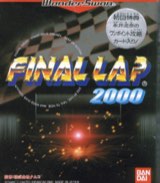
The first handheld game in Namco's Final Lap racing series: open-wheel racing on the WonderSwan with a world tour, a track editor and track trading over the link cable.
Screenshots
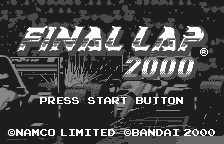
Title screen 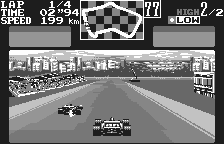
In play 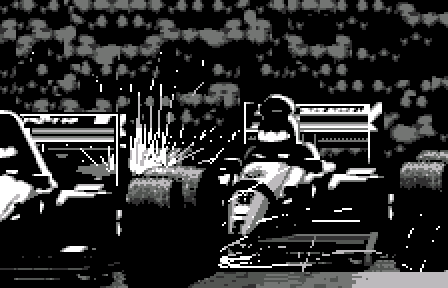
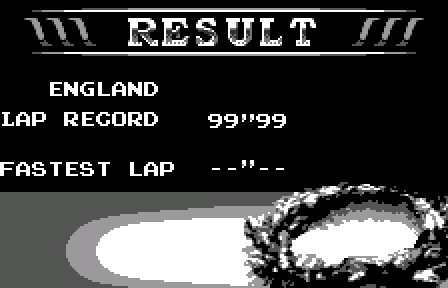
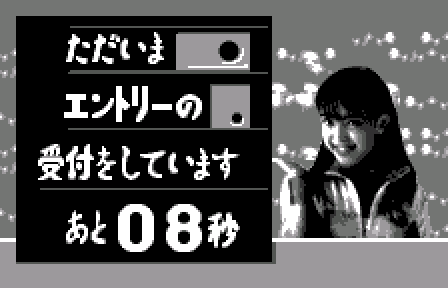
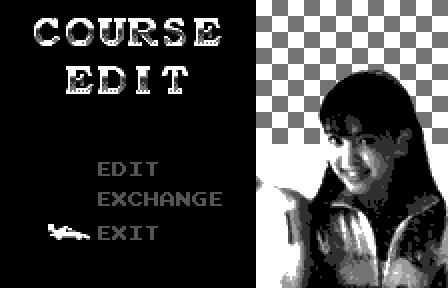
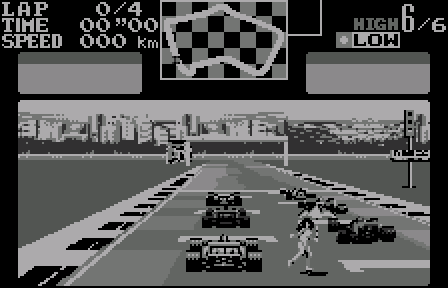
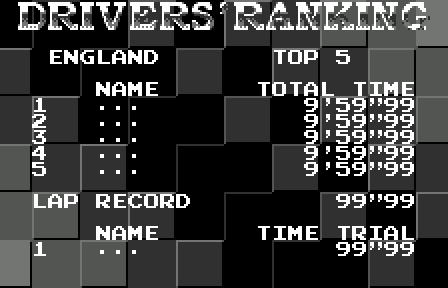
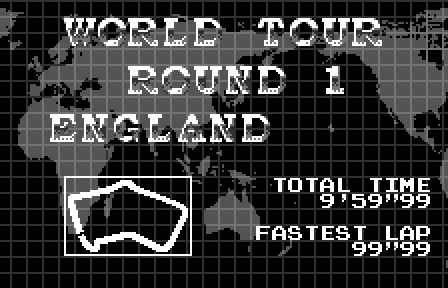

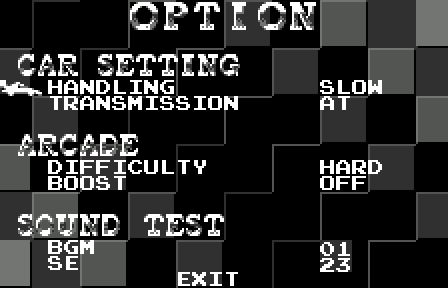
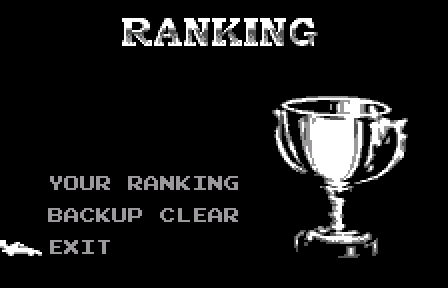
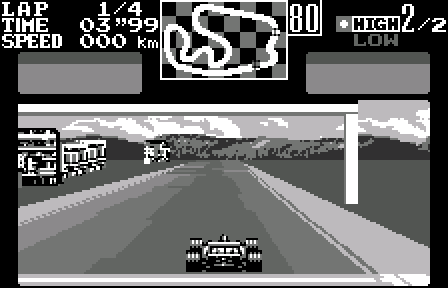
Final Lap 2000 is a racing game for the black-and-white WonderSwan, published by Bandai on 23 March 2000. It belongs to Final Lap, the racing series Namco began in the arcades in 1987 as a follow-up to Pole Position, and it was the first game of the series on a handheld. Bandai developed and sold it under Namco’s supervision; the studio Soft Machine is also credited with making it, though this has never been confirmed.
There is only one kind of car, an open-wheel formula racer, and three ways to race it: a World Tour against five rivals, an Arcade race against one opponent and a solo Time Trial. The WonderSwan game also adds a course editor, and two WonderSwans joined by the link cable can race each other or trade home-made courses.
The story
Final Lap 2000 has no story. Its framing is a season of formula racing: the World Tour takes the player round a string of circuits across the world in pursuit of the world championship, racing against five rival cars, and the championship is played one race at a time.
The circuits are named after countries and places, among them Monaco, Brazil, Australia and England, and each has its own run of corners, but all of them are drawn with the same circuit scenery, so Monaco looks no different from any other track, and there is little climbing or falling. The road surface is shaded in square patches that look like dirt on the track once the car is moving. Trackside hoardings carry the WonderSwan mark and adverts for Namco’s other WonderSwan games, Tekken Card Challenge and Klonoa. The game runs with the console held sideways, in black and white with stereo sound, and Bandai used the screen’s resolution to put a rear-view mirror in the picture that shows the cars behind.
The one human face in the game is that of Runa Nagai, the image girl, whose photograph appears on the entry screen before a race and in the course editor.
How it plays
The console is held sideways. The A button accelerates and letting it go slows the car, B brakes, and left and right on the X pad steer. With the manual gearbox chosen, up and down on the X pad change gear, though as in the arcade game there are only two gears, low and high. In Arcade mode Y3 switches the view to the rival’s car and a second press switches it back, and in Time Trial START ends the run. On the menus the X pad moves the cursor, A confirms and B goes back.
The handling follows the arcade original. The car swings round at the slightest touch of the steering and the track feels slippery, as if the cars were on ice, although the steering response can be softened in the options. The game also keeps cars from crashing into the stands, so even reckless driving seldom ends in a crash. Driving well means braking properly before a corner, feathering the accelerator and changing down for the tight turns.
As in the arcade game, a car’s power depends on its place in the race: cars that fall behind get extra speed, so the field stays bunched and a lead is never safe until the last lap. Contact matters too. A car hit from behind while it leans into a turn spins, and the tip card packed with first copies suggested using this to knock rivals out of the way in corners.
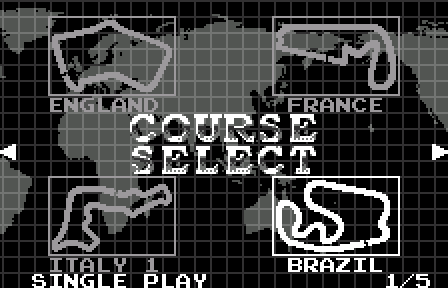
The World Tour is the main mode. The player races the five rivals circuit by circuit, and the tour ends as soon as a race is finished in the points but out of first place, so it has to be won race after race. Arcade mode is a single race against one opponent on a chosen track, and Time Trial is a solo run on lap times measured to a tenth of a second. Fifteen circuits are open from the start. Suzuka is not among them, though it may be the locked entry shown as question marks on the course list. The number of laps cannot be set and a race cannot be paused.
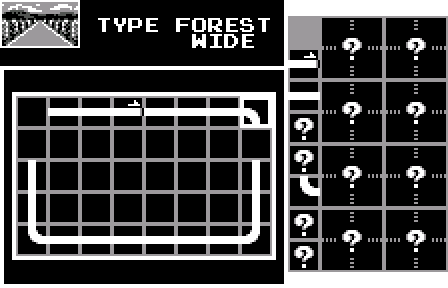
In the course editor the player moves a cursor over a grid and places track pieces on it, pressing A to set a piece down and again to turn it; holding B while using the X pad picks a different piece, Y2 and Y4 change the type of road, and START finishes the course. Very short ovals and zigzags of hairpins can be built, and finished courses join the normal course list. Up to four courses can be saved. Only simple pieces are available at first, and new ones are earned by winning in the World Tour, which makes them hard to collect.
Two players can race in real time over the link cable, and the same connection sends a home-made course to a friend’s cartridge. The cartridge saves the player’s records along with the courses.
Development and release
Bandai sold the cartridge at 3,990 yen including tax. It supports two players, the link cable and stereo sound, and it carries a Bandai copyright line together with a note that Namco supervised the conversion.
The model and television personality Runa Nagai (永井流奈) was the game’s image girl, and her photograph appears on the race entry screen. Copies from the first shipment came with a card showing her photograph and a driving tip; one of these cards explained that a car hit from behind while leaning into a turn will spin, and suggested using this to knock rivals aside in corners.
Reception
On release it was seen as faithful to the arcade game for better and worse: the cars swing round at the slightest touch of the steering and seem to have almost no grip, there is little sense of speed, and the race length cannot be set nor a race paused. Its simple, old-fashioned racing on a handheld was still welcomed, the catch-up rule was found exciting against a friend though irritating against the computer, and the course editor was enjoyed. Later players often call it the WonderSwan version closest to the arcade game, and some praise the way it rewards careful braking and a light touch on the accelerator. Others find the controls hard: some who expected an easy drive kept retiring from races, and others dislike the very light steering and the way the game seems to stop reckless driving from ending in a crash, which keeps races between strong and weak players too close.
Ports and other versions
Final Lap 2000 was made for the WonderSwan and was never ported or re-released. It is not a straight conversion of the 1987 arcade game either, but a separate game in the Final Lap series, distinct from the home versions of the arcade original, which reached the Famicom in 1988, the PC Engine as Final Lap Twin in 1989, Windows on a Namco compilation disc in 1999 and current consoles as an Arcade Archives release in 2026.
Bandai still presented the cartridge as the arcade racer recreated on a handheld. It keeps the arcade rule that a car’s power depends on its race position and the head-to-head link play, while the World Tour and Time Trial modes and the course editor are additions of the WonderSwan game. The arcade machine races on the Suzuka Circuit alone, whereas the WonderSwan game spreads its fifteen open circuits around the world and leaves Suzuka out.
Later history
Bandai followed the game in November 2001 with Final Lap Special: GT & Formula Machine, a second Final Lap for the WonderSwan Color that adds GT cars alongside the formula cars. The black-and-white game is also easier to follow on the SwanCrystal, whose screen leaves less blur behind the scrolling track than the WonderSwan Color’s.