
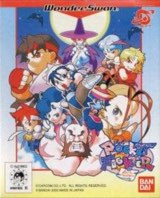
Capcom's super-deformed arcade fighter in black and white, with twelve fighters, gems told apart by shape, a Point Battle mode, a card battle game and WonderGate rankings.
Screenshots
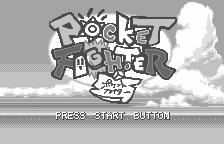
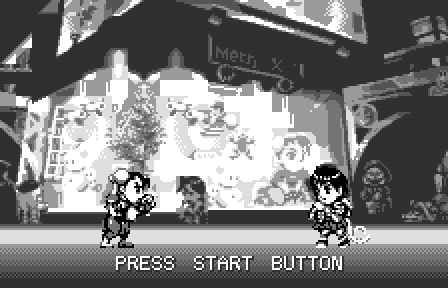
Title screen 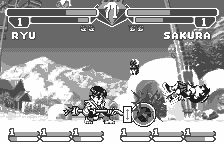
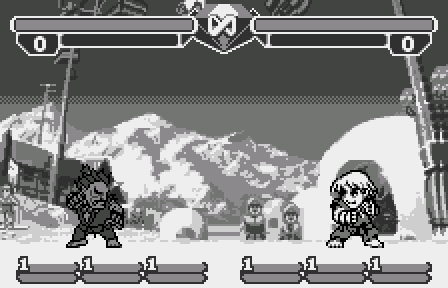
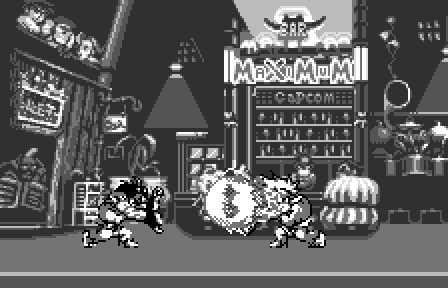
In play 
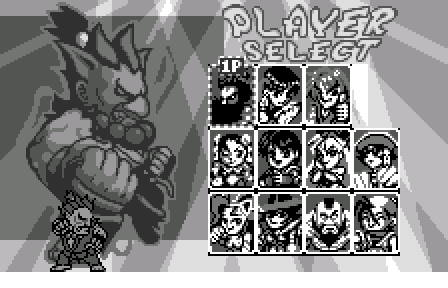
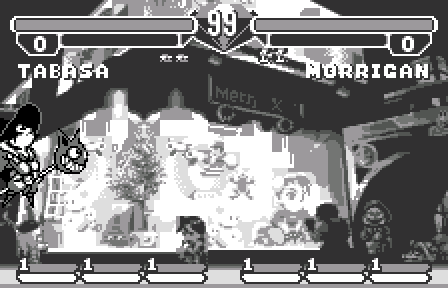
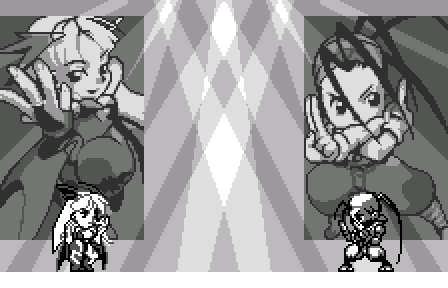
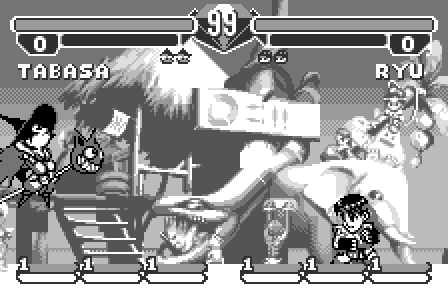
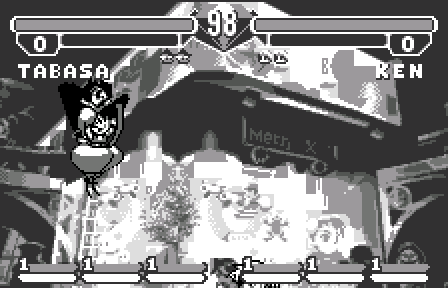
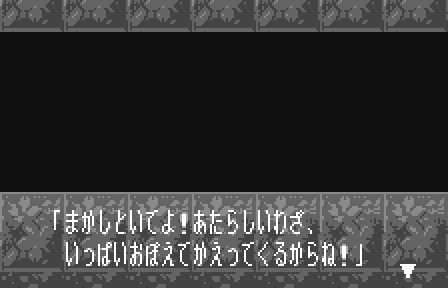
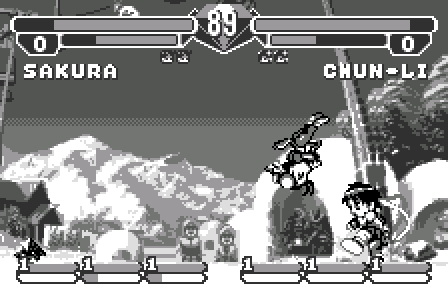
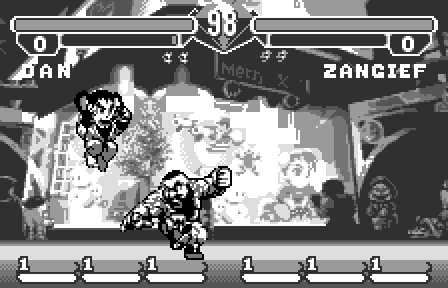
Pocket Fighter is a one-on-one fighting game first released by Capcom in arcades in September 1997, on its CPS-2 hardware. Its cast are characters from Capcom’s fighting games drawn as small, big-headed figures, in the style of the falling-block puzzle game Super Puzzle Fighter II X from the year before. Bandai published the WonderSwan version in Japan on 6 April 2000; the port is usually credited to Soft Machine, though this has never been confirmed.
The controls stay simple, with punch, kick and a special attack. During a fight, players pick up gems that strengthen their special moves and build up a gauge for Mighty Combos.
On the WonderSwan the game is shown in black and white with the console held sideways, and it has two modes of its own, Point Battle and a card game that Bandai promoted as Card Fighter. Two players can fight each other over the link cable, and the game was announced as one of the first to work with the WonderGate mobile phone adapter, through which character cards could be downloaded from a dedicated website and a national ranking of the top 50 players viewed.
The story
The WonderSwan game has no plot to follow. It is built around its cast: Capcom’s fighting-game stars redrawn as tiny, cheerful figures in the manner of Super Puzzle Fighter II X, trading blows in a game that pokes fun at Capcom’s own more serious fighters. A run through Arcade Battle is a series of eight computer opponents, with continues allowed.
The command list in the manual covers twelve fighters. From the Street Fighter series come Ryu, Ken, Chun-Li, Sakura, Zangief, Dan and Akuma, who is called Gouki in Japan, together with the young ninja Ibuki from Street Fighter III. Morrigan, Felicia and Hsien-Ko, known in Japan as Lei-Lei, come from Darkstalkers, and Tessa, called Tabasa in Japan, from Red Earth. Each brings special moves from those games, such as Ryu’s Hadouken, and the game even has a button just for taunting.
What the WonderSwan version adds to this cast is a collection. Doing particular things during a fight earns digital cards showing the characters, their stronger special moves and their Mighty Combos, and Bandai’s promotion made much of cards turning up suddenly in the middle of a bout. The cards build up into a numbered gallery and are the pieces of the separate card game, so the fighters double as a set to be collected and traded.
How it plays
The console is held sideways. With the default layout the X buttons move the fighter: up to jump, forward and back to walk, down to crouch, and back also guards, while crouching and then jumping gives a higher jump. B punches and A kicks, and the Y buttons hold the special attack, the taunt and a punch plus special shortcut. The options let the player swap which button group acts as the stick and rearrange the buttons. Bouts are best of three rounds with a timer of 99 counts each, and when time runs out the fighter with more health left wins; the number of rounds, the timer, the difficulty and the game speed can all be changed.
Gems are the heart of the system. Hits knock gems out of the opponent, and picking them up raises the gem gauges, which level up three of each fighter’s special moves; at level three a move becomes far stronger. On the monochrome screen the three kinds of gem are told apart by shape, a square, a diamond and a circle, instead of the arcade game’s red, yellow and blue. Hits and gems also fill the Mighty Combo gauge, which can hold up to nine stocks, and each Mighty Combo is a stick motion plus the special button. A hamburger and a cake sometimes drop out with the gems and restore a good and a small amount of health.
The special button alone performs a Guard Crush, which steals gems when it hits. It can be charged, and the longer the charge the more gems it takes, but a standing guard pressed together with special turns it back. Punch and kick together throw an opponent at close range, even in the air, and the same pair breaks a fall when the fighter is knocked flying. There are also dashes, attacks out of a dash and a pursuit on a fallen opponent. When a hit is about to land for certain, such as during an air throw, punch, kick and special together trigger a Mega Crush or Counter Crush, which spends all the gems and the combo gauge to escape and needs at least one level of Mighty Combo gauge.
The fighting side has three modes. Arcade Battle is a run against eight computer opponents with continues allowed. Point Battle is the same eight fights, but points are earned for the special moves used and how hard they are to pull off, and the aim is the highest total before the game ends. Free Battle is the two-player mode over the link cable. A personal ranking of scores and points is kept on the cartridge, which has a single save slot that is overwritten each time, and clearing Arcade Battle shows a password used by one of the extras.
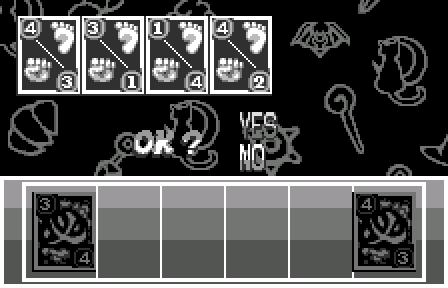
Special actions in fights earn digital cards of three kinds: character cards, cards for each fighter’s level two and level three special moves, and Mighty Combo cards. The Card Gallery shows the cards collected so far, and two players can swap cards over the link cable, though trading closes once a player has the whole set. The cards are used in Card Battle, the name the game itself gives the card mode, which can be played alone against eight computer opponents or as a single linked bout against a friend.
Card Battle is a turn-based game for thinking rather than reflexes. Each player holds six cards and plays up to six of them in combination as a single move. The first card played decides the initiative, and the side with the higher initiative attacks while the other defends; the fight then plays out automatically on the fighting screen. Damage is the attack value of the cards plus a bonus for their rank, with special move cards ranking above normal attack cards and those above the evasion, healing and gem cards. Spent cards are discarded and the hand is refilled, and when both sides tie for initiative both hands are thrown away and played again, with healing cards still taking effect.
Combinations are where the card game gets its depth. Four normal attack cards make a Flash Combo, which adds two to initiative and strikes with the attack of every card but loses to higher-ranked cards such as special moves. An evasion card with a normal attack card wins against any special move or Mighty Combo regardless of initiative, but fails against a plain normal attack. Gem cards raise the power of a special move card, though playing one alone throws away the whole hand, and a Guard Crush card cancels every card and guarantees the attack, unless both players use one, which is a draw. Cards won in the fighting mode add more: a matching special move card levels a move up for the rest of the battle, a character card adds one to initiative until the bout ends, and a Mighty Combo card always hits for ten points.
The WonderGate features needed the adapter, a mobile phone and, for the paid services, a prepaid Web Money card. Through them players could upload their Arcade Battle and Point Battle results and download national rankings, overall, by mode and by character. Bandai also offered downloadable cards of seven popular female characters, changing over time, which could not be used in Card Battle, and extras that were played from the options menu: a training mode with a chosen stage and opponent and no time limit, a sound test, a viewer for the game’s event scenes, the command lists, a data reset tool and Password Fighter, in which a fighter raised in Arcade Battle and recalled with its password takes part in Free Battle.
Development and release
When Bandai first listed the game on its WonderSwan site, it was planned for early December 1999 at a provisional price of 3,800 yen, with a copyright line naming Capcom and Bandai and dated 1999. It slipped by about four months and came out on 6 April 2000 at that same price. Only Bandai and Capcom are named on the game.
The game’s WonderGate support was promised before the adapter itself was ready. At the Tokyo Toy Show in March 2000 the WonderGate was still being shown as a near-finished product, with NTT DoCoMo aiming for a release around June and naming Pocket Fighter among the games due to work with it, and by July the adapter had been dated for 14 July 2000 at 10,200 yen. Owners of the cartridge therefore had to wait several months after buying it before the online features could be used.
Ports and other versions
The WonderSwan cartridge was the third home version of the arcade game. Capcom had already brought Pocket Fighter to the PlayStation on 11 June 1998 and to the Saturn on 9 July 1998, the Saturn release making use of the 4MB RAM expansion cartridge, and the PlayStation edition was reissued at a budget price in February 2000, two months before Bandai’s version appeared.
The WonderSwan game is the one that departs furthest from the arcade original. With no colour to work with, the red, yellow and blue gems became a square, a diamond and a circle, and the arcade game’s item pickups were cut down to two healing foods and its character voices were dropped. In their place came two modes found in no other version: Point Battle, which scores each cleared fight, and Card Fighter, played with cards for normal and special moves. The two 32-bit versions went the other way and added to the arcade game. Both have a Running Battle mode, and the PlayStation release also has a mode for building and raising a character, called Tsukutte Fighter in Japan, along with voiced story scenes, though it lost some graphics and effects to fit the console’s memory; the Saturn edition is a close match for the arcade game apart from its extra mode.
Later releases all go back to the arcade game rather than the WonderSwan one. It was included in the PlayStation 2 compilation Street Fighter Zero Fighter’s Generation in 2006, known in English as Street Fighter Alpha Anthology, which added hidden modes of its own, and Capcom put the PlayStation version on sale as a Game Archives download for the PlayStation 3 on 13 April 2011, and for the PSP and PS Vita. In 2022 it appeared in Capcom Fighting Collection for the PlayStation 4, Switch, Xbox One and Windows, which adds online play and a switch to the overseas version, and in Capcom Arcade 2nd Stadium that year.