
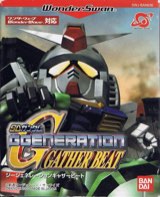
The first G Generation tactics game on the WonderSwan, a crossover retelling of the One Year War that links to a PlayStation game and to mobile phones.
Screenshots
Title screen 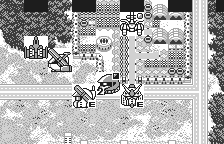
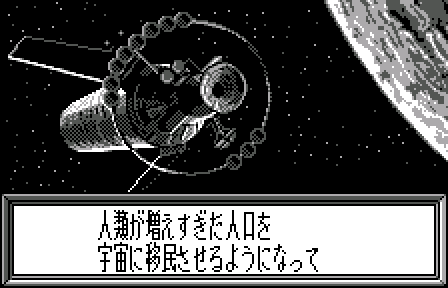
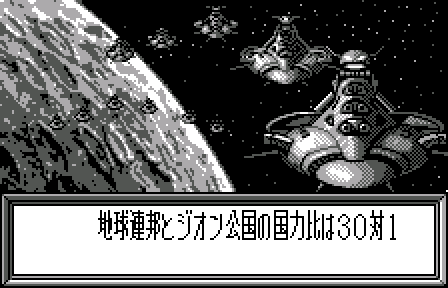
In play 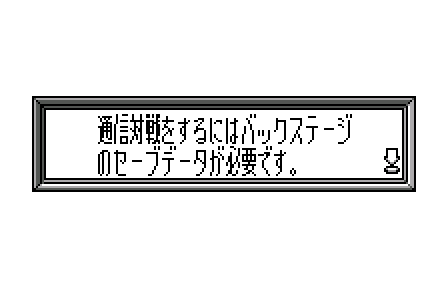
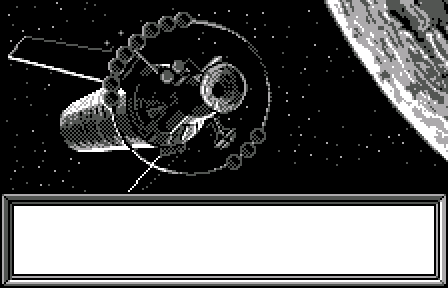
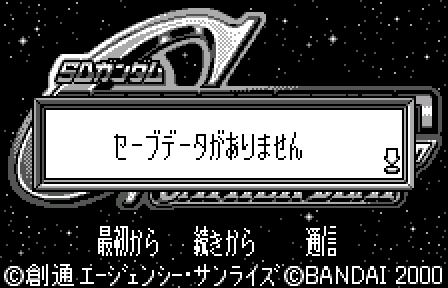
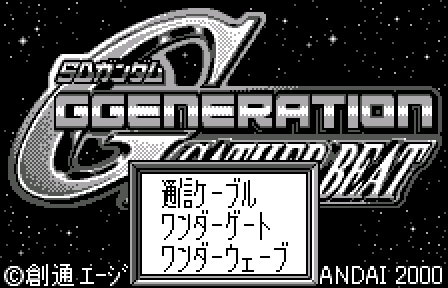
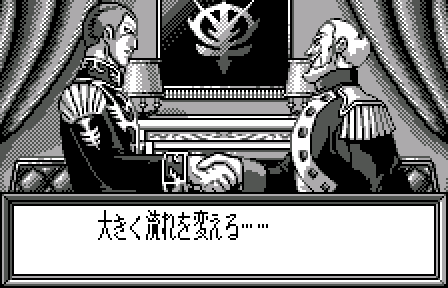
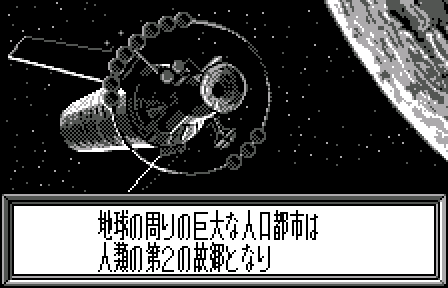
SD Gundam G Generation: Gather Beat is a tactical role-playing game for the original WonderSwan, developed by Vanguard and released by Bandai on 13 July 2000. The G Generation series began on the PlayStation in 1998 and stages battles from across the Gundam franchise with small, super-deformed mobile suits and simple controls. Gather Beat was the first of its WonderSwan entries, although in its systems it is largely a follow-up to the earlier WonderSwan game SD Gundam: Emotional Jam, from which much was carried over.
The campaign is an original crossover retelling of the One Year War from the first Mobile Suit Gundam. Units fight turn by turn on a map, and two players can face each other in versus play.
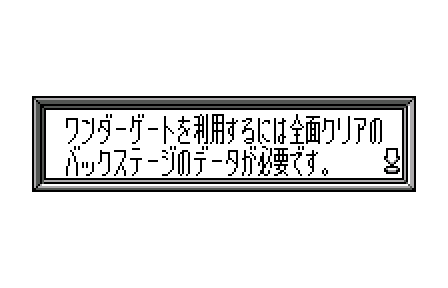
The game connects to several devices. Two consoles can be joined by the link cable. Through the WonderWave infrared adapter and a PocketStation it could exchange data with the Action Version that came with the PlayStation game SD Gundam G Generation-F, and a limited WonderWave Special Package sold on the same day included the adapter and a cloth badge. Over the Mobile WonderGate the game could also connect to a mobile phone to download extra mobile suit and character data.
The story
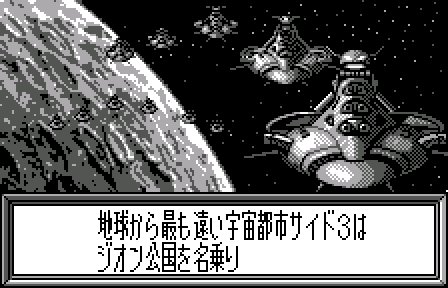
The game tells what its makers called the Neo One Year War: the war of the first Mobile Suit Gundam, set in the year UC 0079, with characters and machines from later series as far forward as Turn A Gundam drawn into it. Unlike the home-console G Generation games, which retrace each anime’s episodes, it tells one original crossover story in the manner of Super Robot Wars. There is no single hero. The player commands a Federation unit whose pilots come from many different Gundam works, and familiar faces turn up in new roles in a war that starts like the one in the anime and soon drifts away from it.
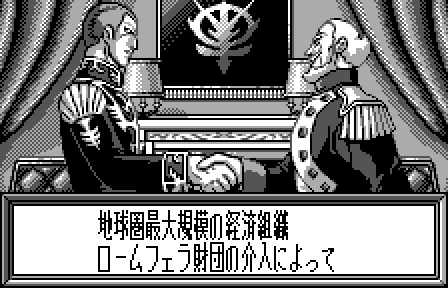
In this version Zeon has been able to build its mobile suits with the help of the Romefeller Foundation from Gundam Wing. The story opens in September 0079 as Zaku break into Side 7. The Frost brothers from Gundam X have passed word of the Federation’s V Project to Char, and they take part in the raid in their own suits; when the fighting is over they disappear, taking Amuro’s father Tem Ray with them. White Base asks Luna Two for help and is told to make its own way down to Jaburo. What the Frost brothers and Romefeller’s Duke Dermail are really after is the question that runs under the whole campaign.
The opening stages follow the anime’s route closely while new people join it. White Base’s descent is knocked off course to North America, Sayla meets Char again, Matilda’s supply team arrives, and Yu Kajima’s test squad from the game The Blue Destiny joins up. Loran Cehack’s Flat comes down to Earth, Sayla seeks out Ramba Ral for news of Char, and Amuro, resentful at being made to fight when there are professional soldiers on board, loses the will to go on for a while. When White Base reaches Jaburo, Bright’s crew are made an independent unit of the Federation fleet, and the war widens from there.
The campaign runs over twenty main stages, grouped into a few arcs named after the ships the unit flies from, starting with White Base. Six hidden stages branch off it, each with its own scenes, and events break into the battles often, sometimes with still pictures. Much of the pleasure is in the meetings between series: characters from different shows talking, arguing and fighting side by side. Because the story stays mostly in the first series’ war, minor characters from the original anime who seldom appear in games have parts too. Who joins and who leaves depends on what the player does in battle, so two runs of the same story can turn out differently.
How it plays
Each stage is a map of hexes on which the player’s units and the enemy take turns to move and attack, and every fight between units plays out as a short battle animation, which cannot be skipped. Between stages comes a backstage phase in which the player organises the army, buys parts and builds new machines, and sometimes picks an operation that sets off a conversation. Each stage is short, a hidden stage taking around ten minutes, but there are more than twenty of them. Emotional Jam’s in-battle production of units and its separate battle screens are gone.
Stacks are the heart of the game. Up to three units can be grouped into one stack, either when they are deployed or later on the map, and split up again at any time. A stack moves as one unit at the speed of its slowest member, and joining a unit that has already acted ends the whole stack’s turn. In a fight each machine keeps its own hit points, so a stack is hard to wipe out, and its members attack together with far more force than they could alone; the cost is that a stack is easier to hit. Enemies stack in the same way, and three Zaku IIs from the first stages can be enough to bring down Amuro in the Gundam. Targets are fixed before the fight starts, so if the first attacker destroys the enemy, the others’ attacks can be wasted.
Attacks come in several kinds. Melee and shooting both reach only the next hex, and beam rifles count as shooting. Melee attacks can be used without limit but always strike after an enemy’s shooting. Long-range attacks belong only to warships and some units, have a limited number of uses and many different ranges, and can scatter an enemy stack into separate units around it, ready to be picked off one by one; when there is no room or the attempt fails, they do ordinary damage instead. A few rare weapons, such as the Zeta Gundam’s Hyper Mega Launcher, hit every unit in a stack at once.
Pilots bring ID commands, the game’s version of the spirit commands of Super Robot Wars. Each is named after a well-known line from the anime, costs SP and can be used a limited number of times. They cost little SP, and they can still be used after a unit has moved. The communication command lets a unit talk to another; it does not end the unit’s turn, and it starts events, brings in recruits and gives bonus experience. Any pilot can fly any machine, and there are no pilot types, so anyone can use the Mobile Fighters’ Mobile Trace System. Characters cannot level up in the middle of a battle, the maximum level is 30, and experience is scarce, because earlier stages cannot be played again within the same run.
Machines are built up with parts. The supply screen is a shop where points are spent on option parts and units, and new stock keeps arriving, so a Gundam can be bought outright. On the formation screen before a stage, a machine can be combined with option parts to turn it into a named variant, often one from the anime: the Gundam G3 with Chobham Armor becomes the Alex, for example, and every new part adds more plans. Units with different weapons are different units here, so changing a Gundam Mk-II’s armament means buying a bazooka and using it up as material. Taking a machine apart leaves only parts and cannot be undone, which can lose a one-off part for good. An enemy can be captured by surrounding it when it is alone and down to a quarter of its hit points or less, but many enemies can never be captured.
Clearing a stage within a set number of turns, or meeting another condition such as destroying or capturing a particular enemy, opens one of the hidden stages; choosing one does not mean skipping the next main stage. Many recruits and events hang on flags of this kind and can be missed for good, which makes it hard to see everything without a guide. Players disagree about the difficulty. Enemy aces dodge often and experience is tight, which makes some find it fairly hard, but enemy attacks do little damage, ID commands are cheap and supply points pile up quickly, so others find it easy, especially after playing Gather Beat 2. Because the gap between machines is small, early suits stay useful late in the game, and Hayato, who can restore a unit’s hit points in full, is in the unit from the start.
Development and release
The game was made by Vanguard together with Bandai. Vanguard is the studio behind the line of handheld G Generation games that grew out of Emotional Jam’s systems, and this was the first G Generation game it developed. The standard cartridge is SWJ-BAN030 at 3,800 yen, and the WonderWave Special Package released the same day was a separate product, SWJ-BAN031, at 5,300 yen, both prices before the 5% consumption tax. The still pictures shown at story events were adapted from illustrations that the anime’s character designer Tsukasa Dokite drew for a novelisation.
Modes and features
Bandai’s preview promised more than 150 units, more than 190 characters and more than 20 theme and insert songs from the anime, and the music gives the game a lift over Emotional Jam, which had used only original tunes. There are twenty main stages and six hidden ones. The game has three save slots and a cast drawn from more than a dozen Gundam works, from the original series through the 08th MS Team, F91, Victory, G, Wing, X and Turn A, along with characters from the MSV designs and the Gihren’s Ambition games. There is no encyclopedia mode. The link cable is used only for head-to-head battles, while the Mobile WonderGate service handed out ten upgraded versions of existing mobile suits, and some units and parts were obtainable only that way. With the WonderWave, units raised in this game could be called up on the premium disc of G Generation-F, and 3D models of the game’s original machines could be viewed there. The data travels by PocketStation and can be brought back after each stage, although units lost in the action game do not return.
Secrets and extras
Clearing the game opens a Special Edition, a second run with more enemies, stronger enemy tactics, extra events and new parts, and a free battle mode in which the cleared army can take on original stages as often as the player likes. The extra stages open only when the player meets conditions during a map, such as finishing within a set number of turns or capturing or defeating particular enemies, and each has its own scenes rather than serving as a simple bonus. Which characters join depends on a web of story flags, and before the final stage a conversation plays for whichever lead character has the highest level, with effects that differ by character. Hidden machines include upgraded versions of the 08th MS Team’s Ez8 that can fight in space, and a Gundam assembled from junk parts recovered from Balls.
Reception
It is generally regarded as a good game: rough in places, but a substantial piece of work that laid the foundations for the later Gather Beat games and made full use of the WonderSwan and its peripherals. Players praise the crossover scenario and its many hidden events, and criticise the battle animations that cannot be skipped, the lack of an encyclopedia mode, the strict experience economy, events that can be missed for good, and the very uneven treatment of different series. The original scenario, the all-star cast and the balance between mobile suits are well liked; some players found the range of machines small for the series and the game easy, more so than Gather Beat 2, while others find it somewhat hard because enemy aces evade often. Players who hope for a return of these handheld G Generation games remember the Vanguard line fondly for its crossover what-if stories, its ID commands tied to famous lines and the care they felt in the details, and some recall Gather Beat as their first G Generation game.
Ports and other versions
Gather Beat was made for the WonderSwan and is not a conversion of a game from another system, even though it builds on the systems of Emotional Jam. The cartridge itself was never ported, but in 2003 Vanguard and Bandai released SD Gundam G Generation Advance for the Game Boy Advance, a remake of Gather Beat. It was the only G Generation game on the Game Boy Advance and the first game Bandai published for the system.
The remake keeps the One Year War as its backbone and many of the same story events, but it adds Gundam SEED, which was still on the air when the game came out, so much of its story after the opening is new. It also adds a profile mode and a new last boss, an original giant mobile armour that revives three times. The story follows Gather Beat while the rules lean towards the main G Generation games, with stacking, long-range attacks and the ID commands carried over from the WonderSwan game, and there are optional stages reached by searching between missions and a harder mode after clearing. The event pictures adapted from Tsukasa Dokite’s novel illustrations are used again in the remake. Where Gather Beat has three save slots, Advance has only one, and the remake is aimed more at lighter players.
The remake is often taken as a sign of how good the original was. Advance is praised for its scenario, its balance and its battle animations, and criticised for its slow cursor response and its single save.
Later history
Gather Beat 2 followed on the WonderSwan Color in 2001 and Mono-Eye Gundams in 2002. In 2005 the line moved to the Nintendo DS with SD Gundam G Generation DS, which is built on Gather Beat 2 and Mono-Eye Gundams.