
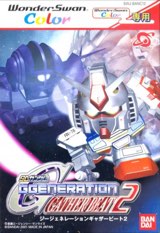
The second G Generation tactics game on the WonderSwan, made for the Color, following the Gundam story from Jaburo to late Zeta Gundam with downloadable stages.
Screenshots
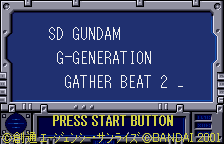
Title screen 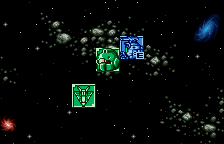
In play 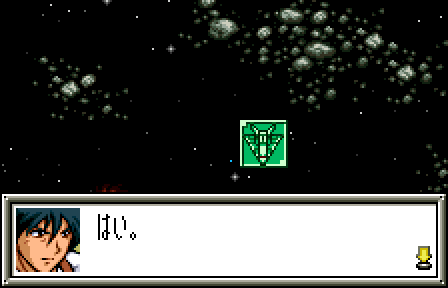
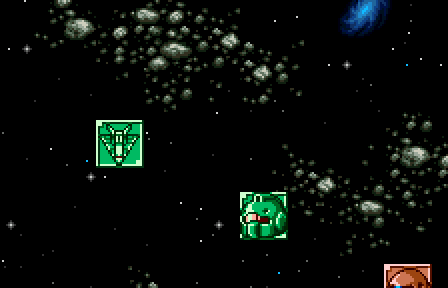
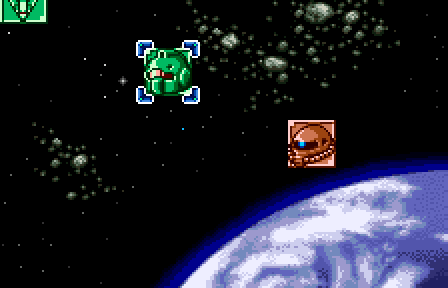
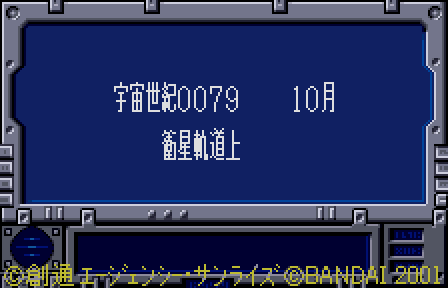
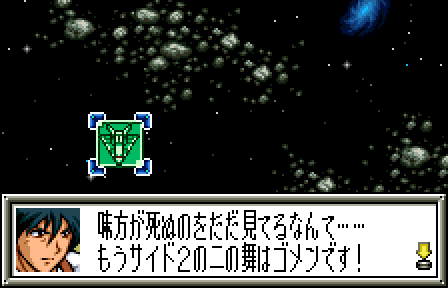
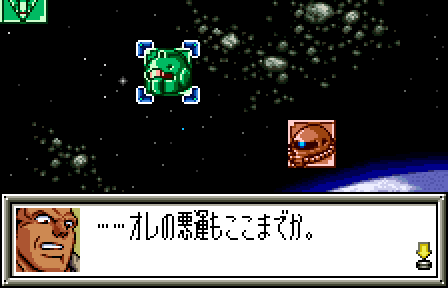
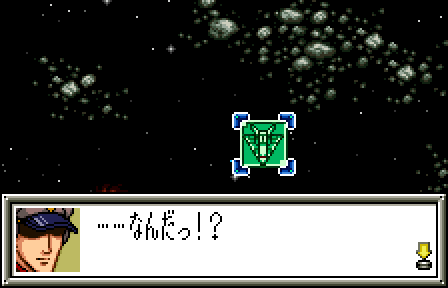
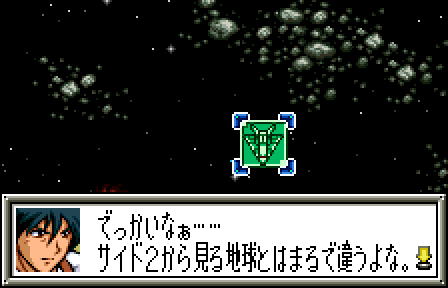
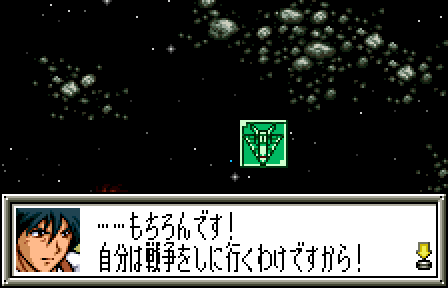
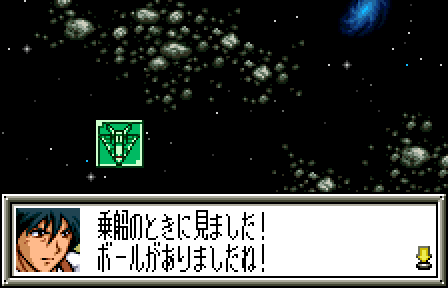
SD Gundam G Generation: Gather Beat 2 is a tactical role-playing game that Bandai released for the WonderSwan Color on 14 June 2001. Like the first Gather Beat, which came out on the original WonderSwan a year earlier, it was developed by Vanguard. It belongs to the G Generation series, which turns battles from the Gundam anime into turn-based strategy with super-deformed mobile suits.
The story opens with the fight for Jaburo during the One Year War and carries on to the closing stages of Zeta Gundam, pulling in other Gundam works along the way, among them side stories such as 0080 and 0083. As in the first game, two consoles can be joined by the link cable, and the game is for one or two players.
Gather Beat 2 again supported the Mobile WonderGate. Players with a compatible mobile phone could download additional stages based on Gundam ZZ and Char’s Counterattack, and clearing them opened a bonus stage drawn from Hathaway’s Flash. The game was made for the Color and does not run on the original black-and-white WonderSwan.
The story
Gather Beat 2 tells one original crossover story set in the Universal Century. It is built on the events of the original Mobile Suit Gundam from the battle of Jaburo onward and carries on through Zeta Gundam, with the side stories of 0080, 0083 and The 08th MS Team woven in. The war follows the anime closely but not exactly: the enemy ranks already include figures such as Johnny Ridden, Anavel Gato and Haman Karn, and characters from later series turn up long before their own time. There is no single hero. The player commands Federation forces, and the story is told mostly from the viewpoint of Bright Noa, captain of the White Base.
The game opens before the title screen with a retelling of the first episode of The 08th MS Team. Shiro Amada joins a fight between GMs and Zaku in a Ball, and he and Aina Sahalin end up adrift in space before each is rescued. A short recap then covers the rest of the war up to the Federation’s victory in the Odessa operation, and only after that does the real title screen appear.
The first stage is set at Jaburo. Shiro’s 08th MS Team has just been posted to the White Base, and while its members are introducing themselves, Char and the Cyclops team attack. A stage cleared quickly leads to an extra stage in which the Federation, preparing for the battle of Solomon, sends the White Base, the Troy Horse and a new Gundam out as a decoy. During the fighting Nimbus steals the second Blue Destiny, and Yu Kajima, flying the third, hears Marion’s voice. In the next stage the White Base is carrying the new Gundam to Side 6, Shiro finds Aina aboard the Apsaras, and Bernie’s team slips into Side 6, where he meets Chris.
The campaign then moves on in large arcs. The One Year War takes up roughly the first six stages, after which the story jumps to the events of 0083 and then to the Zeta Gundam era, and from Operation Stardust onward the other Gundam series mix in more and more. At three points the player chooses between two works, G Gundam or Gundam Wing, Victory Gundam or Turn A Gundam, and Gundam X or the Zeon side drawn from Gihren’s Ambition, so the cast and stages differ from run to run. Much of the appeal lies in the conversations between characters from different series, and characters who die in the anime can be kept alive and brought into the player’s army.
How it plays
Each stage is a turn-based battle on a map, and every fight between units plays out as a battle scene that cannot be skipped. The units are drawn from captured 3D renders; they have no dodge animation and simply stand still when they defend. Most of the music is arranged from the series’ theme songs, and there is no sound test. Moving the cursor and the units is slow, which makes the game feel a little sluggish. Unit hit points run into the thousands.
Up to three units can be grouped into a stack that moves and fights as one, and the enemy forms stacks too. Units come in three sizes, small, medium and large, which matters when building stacks; a medium unit works best paired with another medium one. The player’s army is small, a lost mobile suit is expensive to repair, and losing even one unit weakens the force badly.
Each pilot has ID commands that cost SP and are named after lines from the anime, and pilots also differ in how often they land critical hits. Heero Yuy is one of the strongest: two of his commands cost 6 SP each, one making an attack hit for double damage and the other restoring all of his hit points. The Contact command lets one unit talk to another, which starts events, gives bonus experience and recruits new characters. Only Amuro, Chris, Kou, Shiro and Yu join automatically; Uso and Loran depend on the route chosen, and everyone else has to be won over through hidden conditions. Some of these require the player not to destroy certain enemies, and the conditions are hard to guess without a guide. Without the events the army stays weak. The maximum level is 30, which a player who triggers most events can reach around stage 17.
Enemy units can be captured, taken apart for parts and combined with other units and parts into new machines. An early favourite is the Gelgoog Marine, made by capturing two Gelgoogs, dismantling one and combining the parts with the other. There are around two hundred mobile suits and mobile armours, some of them original designs, but fewer kinds of unit than in other G Generation games.
There are 22 main stages and six extra ones, plus the downloadable stages. Extra stages open when the player meets a condition, such as clearing the first stage within ten turns. Stage 6, crowded with named enemy aces, is a well-known hard point, and a Big Zam collected from the free battles makes the early and middle game much easier. Those free battles can be replayed for experience as often as the player likes, so the game never becomes impossible to finish. A first run takes about 25 hours, and the first six stages alone can take eight and a half hours; because of the route choices it takes two runs, around 50 hours, to see everything, and after the ending the player can also play the bonus stage of each work not chosen.
There are three save slots, and the game can be saved after every action, which makes it much easier for a player willing to reload after a failed capture or a lost unit. A cleared game opens the encyclopedia of units, characters and ships and the Special mode, and two cleared games can trade units over the link cable. Any unit can be traded but parts cannot. Through the Mobile WonderGate, players spent points on extra units, parts, pilots and scenarios.
Development and release
Vanguard handled the whole production, as it had for the first Gather Beat. Bandai’s preview stressed how much the sequel had grown: the cartridge doubled from the first game’s 32 megabits to 64, and because the game was made only for the Color, every unit was drawn again, with around two hundred mobile suits and mobile armours, some of them original designs, all rendered from 3D models. It sold for 4,980 yen before tax as model SWJ-BANC12. Bandai offered first buyers a large coated poster devoted to the Jaburo chapter.
Modes and features
Bandai’s preview promised that Newtype abilities would be clearer than in the first game and that the range of upgrade combinations would be much wider. Besides the campaign, the game has an encyclopedia of units, characters and ships, a link-cable mode for trading units between finished games, and Mobile WonderGate support for extra content.
Secrets and extras
Bandai promised special events and hidden units that appear only on a second run after the game has been cleared. Clearing the game opens a Special mode, which inserts an extra stage partway through the campaign, adds further recruits and units and changes how enemies behave. Units can also be copied by trading them into spare save slots.
Reception
Gather Beat 2 is well regarded by fans, who praise the crossover between Gundam series, the original scenario, the conversations between characters, a soundtrack built around the series’ theme songs and the coloured graphics. Their complaints are that the difficulty depends heavily on knowing how to trigger the hidden events, a slow cursor, the lack of a way to skip battle scenes, and some rough edges, including a freeze when every enemy is defeated during an event.
Ports and other versions
Gather Beat 2 was made for the WonderSwan Color and was never ported, remade or re-released on another system. The handheld line went on with Monoeye Gundams on the WonderSwan Color in 2002 and SD Gundam G Generation Advance on the Game Boy Advance in 2003. Advance is in effect a remake of the first Gather Beat, not of this game, and no later game is built on Gather Beat 2’s story.
Notes
The title is usually spelled with ギャザービート in Japanese, though Bandai’s preview page wrote it as ギャザビート; in Latin letters it is written SD Gundam GGENERATION GATHER BEAT 2. The Mobile WonderGate service has long since closed, so the downloadable scenarios can no longer be played and the encyclopedia cannot be completed.