
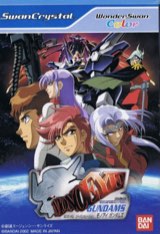
The last G Generation game on the WonderSwan, a Color-only tactics game with an original Zeon pilot as its hero, running from the One Year War into the Gryps Conflict.
Screenshots
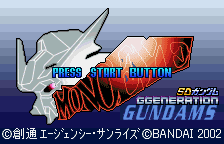
Title screen 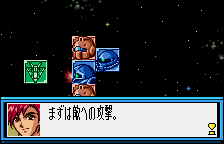
In play 
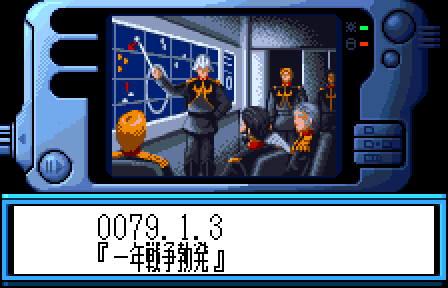
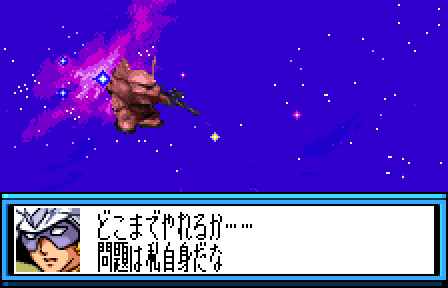
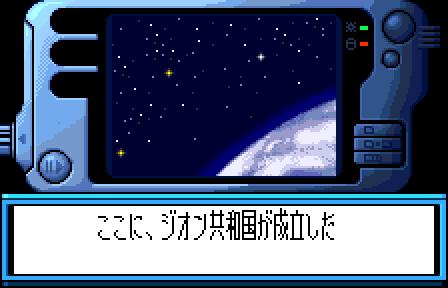
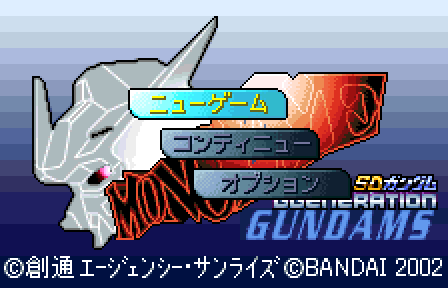
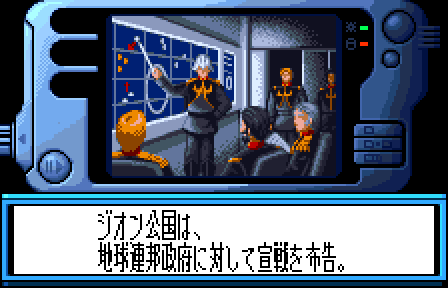
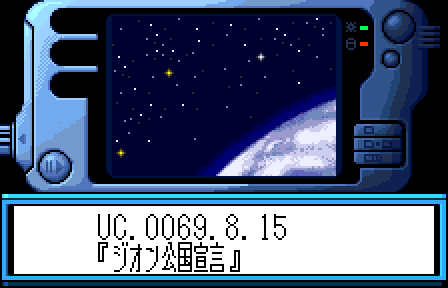
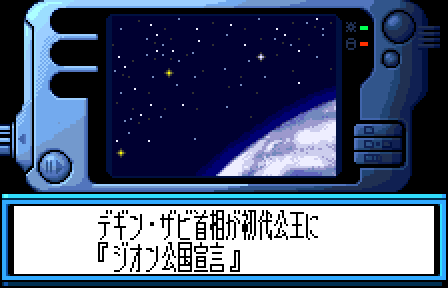
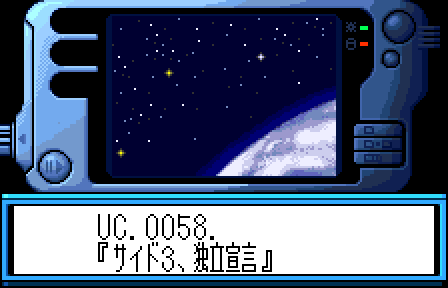
SD Gundam G Generation: Mono-Eye Gundams is a tactical role-playing game that Bandai released for the WonderSwan Color on 26 September 2002. It followed Gather Beat and Gather Beat 2 and was the last G Generation game made for the WonderSwan; like them, it was developed by Vanguard. Battles are fought turn by turn with super-deformed mobile suits, as elsewhere in the series.
What sets it apart is its story. Earlier entries replayed the anime with its own casts, while this one is built around an original character, Sig Wedner, making it the first game in the series with a clearly defined lead. He starts as a pilot on the Zeon side in the late stages of the One Year War, and the story carries on into the Gryps Conflict of the Zeta Gundam era. Three Gundam-type mobile suits fitted with a single mono-eye sensor are central to the plot and give the game its name.
A hidden unit is an early version of the Strike Gundam from Gundam SEED, included before that series had begun airing. The cartridge is Color-only and supports the link cable.
The story
The game opens in December of the year 0079 of the Universal Century, in the last weeks of the One Year War. Sig Wedner, an ensign in the Zeon forces whose full name is Siegfried, a name he dislikes, is put in charge of a newly formed mobile suit unit in the Brad squadron, a group commanded from a Musai by Lieutenant Colonel Brad Farren. His recruits fly Rick Doms, and for most of the campaign the player is effectively fighting on the Zeon side.
Two Newtypes serve with him. Serein Experi comes from the Flanagan Institute; she grew up in a laboratory, is awkward with other people and slowly warms to Sig in the early stages. Ein Levi, Sig’s subordinate, is drawn to Serein. Mian Farren, the commander’s daughter, is Sig’s childhood friend and is in love with him, and she becomes more central once the story reaches the Zeta Gundam period. Johnny Ridden acts as an older brother to Sig, Shin Matsunaga and Anavel Gato join early, and a twelve-year-old Haman Karn takes part in the One Year War chapters, where she is a rival to Lalah Sune for Char’s attention. At the heart of the story is Sig’s mono-eye Gundam, the Sisquiede, set against an original rival machine, the Dezpada.
The first stages show how the campaign is told. The opening stage is a first sortie that doubles as a tutorial, the next has the squadron chasing the White Base with Char’s forces arriving as reinforcements, the third sets Serein in her Elmeth against Bask’s Federation troops, and the fourth is the retreat from Solomon. After the war ends the story jumps seven years ahead, and Sig is fighting for the AEUG under Char against the Titans. In all, the story covers the years 0079 to 0088.
Characters from many series cross into this plot: Amuro and the White Base crew, Char and Lalah, Roberto and Apolly, Bask, Scirocco and Yazan, and figures from Wing, G Gundam, Gundam X, Turn A, Victory and F91, such as Garrod, Uso and Gyngham. More than a thousand events are packed in, many of them pairing characters who never meet in the anime. The early chapters lean towards romance, with something of the feel of a dating game, and the tone grows more serious once Sig joins the AEUG. There are several endings.
How it plays
Battles are turn-based on a grid map, with super-deformed mobile suits. Each unit has three commands besides attacking: Move, ID and Contact. Melee attacks hit more often but strike second, while shooting strikes first and does more damage but misses more. Indirect attacks cannot be dodged or blocked unless the target is in a stack and scatters, and they can break a stack apart; the bits of Serein’s Elmeth count as indirect attacks. Up to three small units, or two medium ones, can be stacked to attack together. An enemy can be captured by lowering its HP and surrounding it with three or more units.
The ID command spends SP on a character’s personal ability, played with a line from the anime and a boost to statistics. Many raise attack power by 1.25, 1.5 or 1.75 times; Keith, Amuro and Loran can seal the enemy’s counterattack, Emma heals every ally, Chris revives a unit and Tiffa raises reaction. Some characters learn a third ID around level 30. Contact talks to an adjacent ally or enemy, which can start events and can bring enemy pilots over to the player’s side. Some machines go into a hyper mode, among them the V2 Gundam with Uso and the Full Armor ZZ with Judau.
Between stages the Backstage menu handles formation, custom parts and supplies. Parts can upgrade a unit, turning a Zaku II F into an FZ for example. Development combines mobile suits and parts into new mobile suits, dismantling breaks them down, and an optional strengthening system improves a suit itself. Advance moves on to the next stage. A unit destroyed in battle is lost for good.
There are 45 stages. Stages 1 to 12 are shared, stages 13 to 22 come in two versions, one for a route through the Titans and one for a route through Neo Zeon, and stage 23 is the last. Four EX stages, the fourth of which also branches, and seven Special stages, which turn up at random when advancing, make up the rest. A single run passes through about 25 stages and a first clear takes around twenty hours, much longer when chasing event flags and searches. After the story is cleared, search missions open five more stages; a stage missed on Advance cannot be replayed. The Wing series machines unlock after the Titans route and the Crossbone machines after the Neo Zeon route. There are three save slots.
Victory and defeat conditions are not shown on screen, and losing certain units, such as one allied pilot or Serein’s Elmeth, ends the game. Enemies hit often, and the difficulty is somewhat high, though the game is not especially hard to finish. The level cap is 50, and reaching level 30 matters for one of the better endings. Battle scenes cannot be skipped. Stages hold few enemies, so the common approach is to boost attack with an ID and then use area attacks; Gato, Quattro and Heero reach the 1.75 times boost. Another known trick is to hit one’s own units with indirect attacks to earn experience quickly. The Gundam X, God Gundam, Wing Zero Custom, Ex-S Gundam, Full Armor ZZ, Sisquiede and GP03 are counted among the strongest units.
Over the link cable each player builds a stack of five units and picks which of the opponent’s units to face, and all five rounds are fought even after one side has won three. Victory points decide who goes first, and IDs cannot be used in versus play. The cable is also used to trade machines between cartridges, which only save data that has cleared the game can do.
Development and release
The game was developed by Vanguard, which made the two Gather Beat games before it, and it is the third and last of that line, released about a year after Gather Beat 2. The cartridge is SWJ-BANC2F at 4,980 yen and runs only on the Color. The Japanese title is spelled with the katakana ジージェネレーション rather than with the Latin letters used for the earlier entries.
Modes and features
The cast mixes five original characters with figures from many Gundam series, among them Zeta, Wing and Turn A. Besides the story there is a two-player link mode for versus battles and machine trading.
Secrets and extras
Saving after an ending adds an options menu with a music player and event galleries, and starting a new game from fully cleared data unlocks a Special mode in which two more characters can join and a better ending for the heroines becomes possible. After the story is cleared, search missions turn up rare units, among them the early Strike Gundam, a Sazabi and a prototype Gundam Mk-II. Some of these chances cannot be repeated if missed, and reaching every branch takes more than one playthrough.
Reception
A 2024 Dengeki Online feature describes the game as unusual for a Gundam title and says it still has a devoted following, which it puts down to its original story and characters. Players value the original cast and the use of lesser-known series, though some found the mixing of several anime into one story less chaotic than hoped, and the early scenes with the heroine are well liked. Players who hope for a revival of Vanguard’s handheld G Generation games often name Mono-Eye Gundams alongside the Gather Beat games for its crossover what-if storytelling.
Ports and other versions
Mono-Eye Gundams was made for the WonderSwan Color and does not come from another system. Its story was reworked once, for SD Gundam G Generation DS on the Nintendo DS on 26 May 2005. That game arranges this one’s story, again told from the Zeon side, as part of a remake that folds Gather Beat 2 and Mono-Eye Gundams into one game with new material added.
The DS game opens late in the One Year War with the player on the Zeon side and Sig Wedner among the early pilots, then splits into a Universal Century route and a route through the later Gundam series, with a third route unlocked after both. The Universal Century route is the part that remakes Mono-Eye Gundams, and it lets the story of the two heroines turn out differently from the WonderSwan game. Unlike the cartridge, the DS game has no single clear lead. It also adds new characters and an original mobile suit, a sound test and an option to skip battle animations once the game is cleared, and its battle animations are simplified compared with the Game Boy Advance game that came before it.
The WonderSwan Color game itself returned in 2019. Early copies of SD Gundam G Generation Cross Rays for the PlayStation 4 and Nintendo Switch came with a download code for a port of Mono-Eye Gundams, a bonus limited to those two versions. On the PlayStation 4 the port is a straight conversion: the link mode is gone, several music tracks, among them the battle theme, come out as noise, and the cursor sometimes stops responding. The ending scene that fails in the gallery on the cartridge still fails in the port, but without the crash and lost data it causes on real hardware. The port is widely thought to be of low quality.
Notes
The original cartridge has a few bugs: a character who is meant to die early on can survive if the player avoids a particular battle, and one ending scene does not play back in the event gallery.