
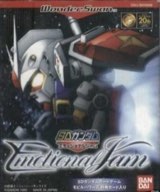
An early WonderSwan Gundam strategy game from Bandai that retells the anime series in order, with stacked battles of up to five against five and over 200 mobile suits.
Screenshots
Title screen 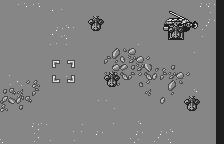
In play 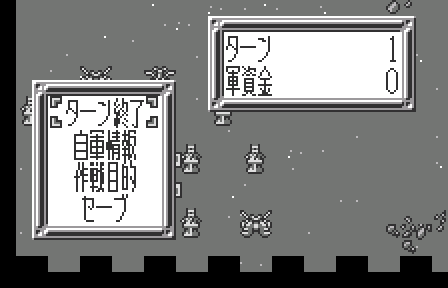
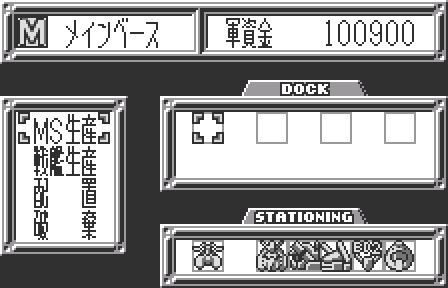
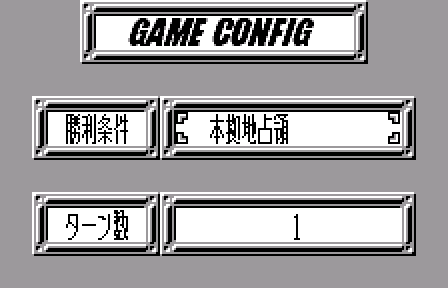
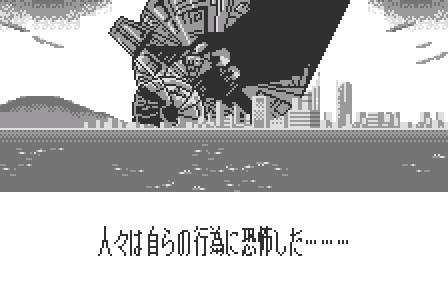
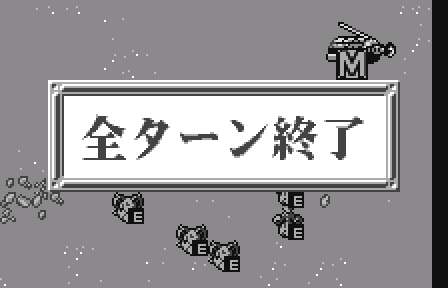
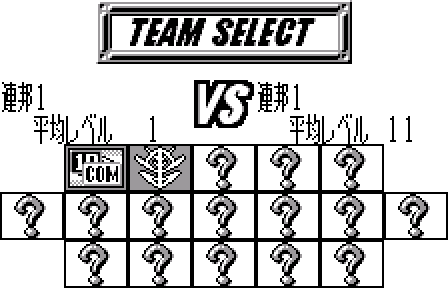
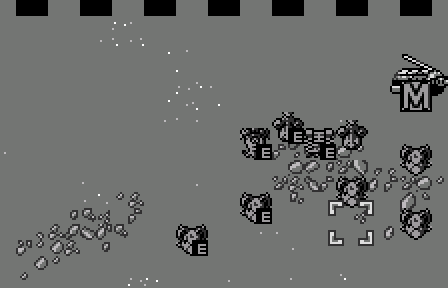
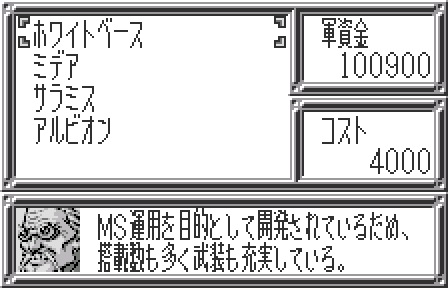
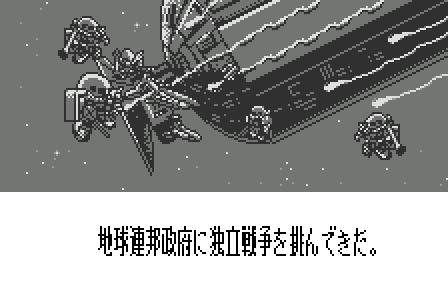
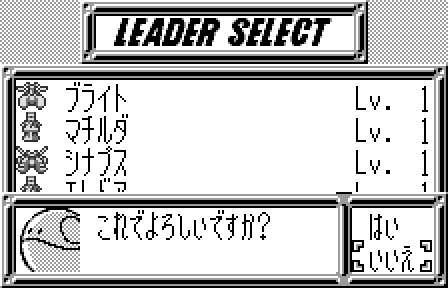
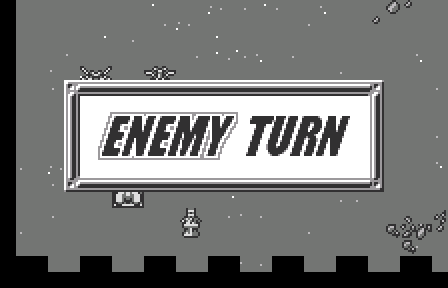
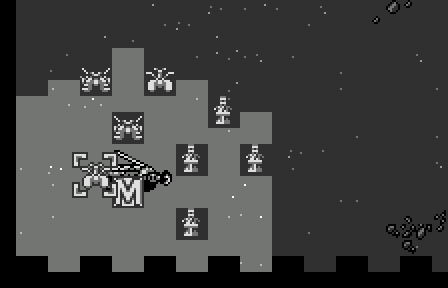
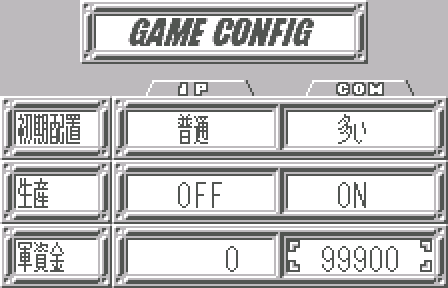
SD Gundam: Emotional Jam is a strategy game for the original WonderSwan, published by Bandai in Japan on 27 May 1999, less than three months after the console went on sale. It draws its cast from many different Gundam series, drawn in the small, big-headed SD style, and was presented as a celebration of the twentieth anniversary of the first Gundam television series, which began in 1979. It was developed by Tom Create.
The game gathers more than two hundred mobile suits and more than two hundred characters. Battles are fought by choosing commands, and teams of up to five units can face each other at once, with large mobile armours and battleships also taking part. Around the battles sit a story and a system for raising and developing the characters.
Emotional Jam is regarded as the prototype of the G Generation games that Vanguard later made, and it holds a great deal of content. Two consoles can also be joined with the link cable, so that two players can take part.
The story
Emotional Jam has no original hero and no character creation. Its whole cast comes from the anime, and the campaign retells the events of the Gundam series one after another, beginning with the One Year War of the first Mobile Suit Gundam. Characters and machines are drawn from the Universal Century series up to Victory Gundam, including the side stories 0080, 0083, The 08th MS Team and F91, and from G Gundam, Gundam Wing and Gundam X. A few machines come only from earlier games, such as Blue Destiny and SD Gundam G Generation.
The player starts with Bright and the crew of the first series, while Dr. J sits at the factory and comments on what is being built. Stages are numbered by part and episode, so the campaign moves through labels such as 1-4, 2-5 and 3-10. Each stage opens with a short text setting out the situation, some characters trade a few lines before the battle, and single illustrations mark the major points of the story. Most of the dialogue recreates lines from the original shows.
Because the series are strung together, characters from different shows end up on the same battlefield. Fighters from G Gundam can turn up alongside the One Year War cast, Domon can come to the aid of the AEUG in stage 2-4, and stage 2-5 has the player fighting on a joint front with the Freeden. Conversations between characters of different series are few, though. The enemies include the Devil Gundam, the White Fang and the Frost brothers, and the player’s roster grows and changes as the story goes on, with some pilots leaving the force and others staying with it.
How it plays
The WonderSwan is held horizontally. Each stage is played on a strategy map on which battleships move; when a ship ends up next to an enemy the game asks whether to fight, and contact with an enemy battleship opens a separate local battle map on which mobile suits sortie for ten turns. Capturing bases brings in funds and lets the player produce units, and the list of what can be built grows with the story, but funds are reset at every stage and produced units do not carry over. The cursor moves slowly unless B is held with the direction pad, and the buttons at the upper left jump straight between units. A sortie cannot be cancelled once it is chosen.
In battle a unit can make a close attack or fire a volley, and pilots have their own special moves, such as Domon’s Shining Finger. Some pairs of characters in the same stack have joint moves, like the attack shared by Puru and Puru Two, which is strong and easy to use. Squad orders to attack or to shoot cost SP but hit more reliably, and area attacks also cost SP, with exceptions such as the F91’s VSBR and the Wing Gundam’s Buster Rifle. Battleships can fire indirectly to wear enemies down, but stacked units cannot use indirect attacks. The command value of the character leading a stack raises or lowers its accuracy and evasion; Sayla’s is high, while Amuro’s and Kou’s are low.
A stack holds up to five units and its order can be changed. Experience is earned by shooting enemies down and is split across the stack, and the share drops sharply from four units upward, so stacks of three are the usual advice. Each level raises every statistic by one, the level cap is 99 and statistics can go past 100. Characters grow at about five different speeds: Domon, Sai Saici, Heero, Trowa and Garrod are among the fastest, Shiro and Chris among the slowest. Nameless soldiers have hidden levels and no SP. Levels carry over from stage to stage, but each pilot is tied to a set machine, there is no swapping, and pilots move to their successor machines between stages without any notice.
The campaign has 37 stages. Clear conditions include shooting down a named enemy such as Garma or Char, and there are hidden conditions too: defeating Char early in one stage can make the whole enemy force withdraw. There are more conversation events than one run can show, and some only appear under conditions such as leaving units unstacked. After the ending, loading the save returns only to the last stage, and there is no second playthrough.
The opening stages are the hardest, with few allies and attacks that do little damage, and the game eases off around the Zeta Gundam period. A full run takes about 25 to 30 hours, partly because battle scenes cannot be skipped, and wiping out every enemy in a stage can take an hour and a half or more, though doing so keeps the later stages steadier. Common advice is to go straight for the target character early on, to surround enemy ships and bosses with three ships of your own, and to put a named pilot with a shield at the front, since the enemy aims for units with big stacks or high HP. Raising pilots who will later leave the force is wasted effort, and it is possible to sink Master Gundam’s mothership before it launches.
The versus mode is played over the link cable, and more maps and armies become available as story stages are cleared. Its option for trained armies does not use the story forces: these armies are raised by playing versus matches again and again, and each army keeps its own levels, generic soldiers included. When the computer runs the other side, its level is the player’s plus ten, up to 99. The same army behaves differently on the ground and in space, and Allenby and Schwarz appear as units in this mode.
Development and release
Emotional Jam was among Tom Create’s first WonderSwan projects in 1999, the same year the studio made SD Gundam G Generation Zero for the PlayStation. The director was Murakoshi. The game sold for 3,800 yen before tax as model SWJ-BAN006, on a 16-megabit cartridge with battery-backed memory, and Bandai’s preview promoted it as a showcase for what the WonderSwan’s 16-bit processor could put on its small screen. First-print copies came with a card for the Mobile Powers card game, and some copies are found without it. On 11 November 1999 Bandai also released a 20th anniversary pack that bundled the game with a skeleton blue WonderSwan for 6,800 yen, as model SWJ-77A003, so the console in that set cost only about 3,000 yen over the price of the game alone.
Modes and features
The structure resembles Bandai’s older SD Gundam World Gachapon Senshi games: the player holds bases, produces units there and works to destroy the enemy forces. Most of the unit and ship icons come from the Super Famicom game SD Gundam G Next, while the fighting itself follows the G Generation style, with stacked units, indirect fire and special-ability attacks. The game has a story campaign and a two-player versus mode, and it keeps one save shared by both modes, plus one suspend save.
Secrets and extras
Defeating the Frost brothers with Garrod makes the Gundam Double X available to him from the next stage onward. Some mobile suits can switch to another form before launching, by pressing down while the flashing triangle marker is shown.
Reception
The game is given credit for its large cast, its pixel art and the new shading on the character portraits, but it is also thought a slog: stages repeat one another, battles are slow and cannot be skipped, and the music is forgettable. It is rated low as entertainment while still valued as a record of its era.
Ports and other versions
Emotional Jam was made for the WonderSwan and was never ported, remade or re-released elsewhere; the 20th anniversary pack was the same cartridge sold with a console. The game borrows its base-building loop from the Gachapon Senshi games and most of its icons from the Super Famicom’s SD Gundam G Next, and its battles follow G Generation, but it is not a conversion of any of those games.
Later history
Although it does not carry the G Generation name, Emotional Jam is often seen as the first handheld G Generation game in practice, since many of its features reappeared in later portable entries. The WonderSwan’s own G Generation line began the next year with Gather Beat.