
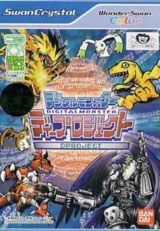
A Digimon raising game for the WonderSwan Color in which eggs are made from seven-digit codes and raised Digimon fight to restore a lost part of the Digital World.
Screenshots
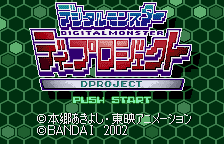
Title screen 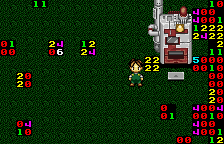
In play
Digital Monster: D-Project is a Digimon game that Bandai released for the WonderSwan Color on 3 August 2002. It belongs to the original Digital Monster line, the games that grew out of Bandai’s handheld virtual pets rather than out of the anime series, and it follows Digital Monster Ver. WonderSwan from 1999 as that line’s second WonderSwan entry. It came out late in the Color’s life, when several Digimon Tamers games were already on the system.
Raising is at the centre of the game. A new Digimon starts as an egg made from a seven-digit code, and the player feeds and trains it, sends it out to graze in the fields, and takes it into battle against a run of hostile Digimon and bosses. Bandai counted more than 150 variations among the forms they can reach.
The cartridge needs a WonderSwan Color or SwanCrystal. With the link cable, two players can set their Digimon against each other, and a separate cable mode lets it battle three other Bandai Digimon games on the Color: Digimon Medley, Brave Tamer and Battle Spirit Ver. 1.5. Through an adapter it can also connect to the Digimon Pendulum toys.
The story
The game is set in Swan World, a peaceful place until a shadow of darkness slips into it. Part of the Digital World suddenly vanishes, and Ophanimon calls the hero there to put it back as it was. Waiting for the hero are villain Digimon from the series’ past, and the adventure is a matter of beating the bosses who block the way one after another. Bandai sold it as a raising game full of mysteries, with each one leading to the next.
The hero’s home is the base of the adventure. It holds the egg generator, where eggs are made from codes, and a machine that makes food, and the hero returns there between outings. The story’s first request is a code for the generator, 111-8081, which hatches a Botamon, so every player starts with the same partner before branching out into eggs of their own.
The opponents are drawn from across the Digimon series. A Zurumon is waiting the moment the hero steps out of the house, and Pico Devimon holds the plains. Impmon guards the forest, and later places are held by Devimon, Mummymon, Devidramon, Vamdemon, Arukenimon and other villains of the anime. The four holy beasts of the Digital World have their own part in the journey, and so do Bokomon and Neemon.
The adventure runs through thirteen stages: plains, forest, cliffs, temple, dragon’s nest, the Town of Beginnings, a mysterious town, coast, shrine, snowfield, lava, the cliffs a second time, and a demon space. Every stage but the first visit to the cliffs has a boss, and beating it opens the way onward, so the story unfolds stage by stage rather than through long scenes.
How it plays
Every Digimon begins in the egg generator. The first three digits of the seven-digit code choose one of 14 egg families, such as the Agumon, Gabumon, Guilmon or Renamon egg, or the water, demon and demon lord eggs. The sum of the fourth and sixth digits trades hit points against lifespan, the fifth sets the attribute (Vaccine, Data or Virus), which also changes the Digimon’s colour, and the seventh adjusts power, defence and speed. A few codes, the opening one among them, produce eggs with better than usual stats.
An egg hatches at once into a baby, and from then on the field where it grazes decides how it evolves, with each field matched to one family and each family running through seven forms from the second baby stage to Mega. Care is measured in several values: affection from 0 to 100 per cent, battle points earned by training, sickness, hunger and disturbed sleep, and the Digimon can be praised or scolded. Power, defence and speed run from 1 to 99. Game time passes in the background, and the Start button sets its speed in three steps. A baby that has grazed ten hours in a field and earned enough battle points can skip straight to that field’s Champion.
Food is made by typing a month and day into the food machine. Each sign of the zodiac gives its own food, and other even and odd dates give two more, each with its own effect on hit points, fullness, strength, affection and sickness. Up to nine foods can be carried, and a Digimon fed the food of its own family gets an extra bonus. Some four-digit entries make spirits instead, which turn a Digimon into Agnimon, Wolfmon, Fairimon, Chackmon or Blitzmon.
Battles are three against three, and the Digimon fight on their own. Outside battle a Digimon grows only as far as Champion. The Ultimate and Mega forms appear only in battle, only when its conditions are met and its fullness is between 80 and 100 per cent, and a Mega needs to have reached Ultimate once before. The chance of a special move is half the Digimon’s affection. Each family has its own kind of special: the Agumon line throws fireballs, the Pico Devimon line drains hit points, the Terriermon line hits every enemy, the Patamon line heals the whole party, the Tailmon line cures status problems, and the Renamon line transforms. In battle, each family is 1.2 times stronger in its home field, and each attribute is 1.2 times stronger at its time of day: Vaccine from 5:00 to 10:59, Data from 11:00 to 18:59 and Virus from 19:00 to 4:59.
The bosses decide how the game has to be played. Each one is weak only to a Digimon raised in its own field, and without one in the party an attack does a single point of damage. The player therefore has to raise a new family for almost every field. The party grows as the story goes on: one Digimon at the start, two after the plains boss and three after the boss of the Town of Beginnings. Beating the boss of the dragon’s nest opens the home computer for storing more, and later victories add more storage.
The game is demanding in its own ways. A hungry Digimon cannot evolve in the middle of a run of battles, the automatic fights leave the healing and curing families wasting turns, and typing codes and walking home again soon becomes routine. Against that, a defeat costs nothing and the saves are hard to lose. The official guide book covered 128 Digimon in all.
Development and release
The game is usually credited to Sting, though this has never been confirmed. Bandai presented D-Project as a return to the series’ roots, with the weight placed once again on raising Digimon. The 32-megabit cartridge has 256 kilobits of battery-backed SRAM, stereo sound, and support for both the link cable and the Digimon Connector. The package uses the SwanCrystal-era design, which marks it as one of the system’s late releases.
Modes and features
The link options are unusually wide. There is a mode for battles between two copies of D-Project, a cable mode for battles with Digimon Medley, Brave Tamer and Battle Spirit Ver. 1.5, and an adapter mode for battles with Digital Monster Ver. WonderSwan, with the same adapter also linking to the Digimon Pendulum and Pendulum Progress toys. Only D-Project’s manual explains the cable link with the three Tamers games, which have to be put into their D-Ark battle option to make it work.
Secrets and extras
Several codes produce eggs with better than usual stats, including the code the story itself asks for at the start. A Champion that dies leaves behind a fragment of its egg. During battles, certain pairs of Mega-level Digimon can briefly combine into a Jogress form such as Omegamon or Dukemon Crimson Mode for a single attack. Completing the Digimon encyclopedia adds another storage slot to the home computer and fills a row of fourteen eggs on the title screen. After the ending, every field is repopulated with stronger enemies and bosses, some of which are needed to meet particular evolution conditions.
Reception
The link features, however generous, are generally thought to have been too tangled for their audience: a child would have needed several games, an adapter that came with only one of them, and the toys, and would have had to work out which mode did what. Few players are thought to have used them all.
Ports and other versions
D-Project was made for the WonderSwan Color, and it was never ported, remade or re-released. Its nearest relative elsewhere is Digimon World, the raising game Bandai released for the PlayStation in January 1999, and parts of D-Project resemble it. The two remain separate games, and D-Project stands apart through its code-based egg generator and its links with other Color cartridges and the Pendulum toys.