

The last of SIMS's Ryo Akiyama RPGs, in which Ryo, sent into the past with Monodramon, teams up with the anime's heroes and their partners instead of collecting Digimon.
Screenshots
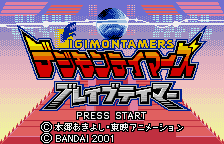
Title screen 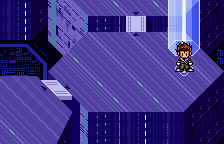
In play 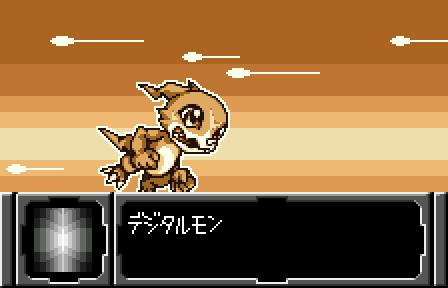


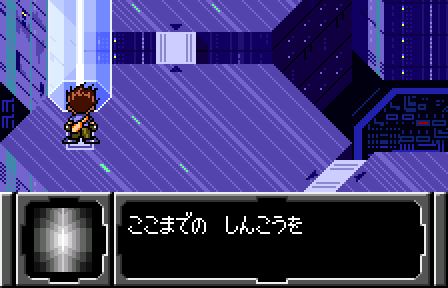

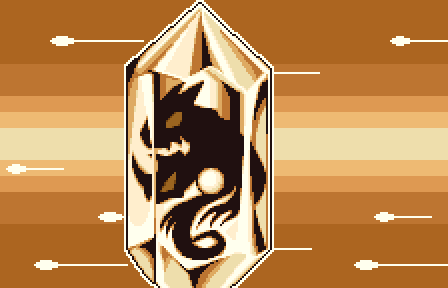

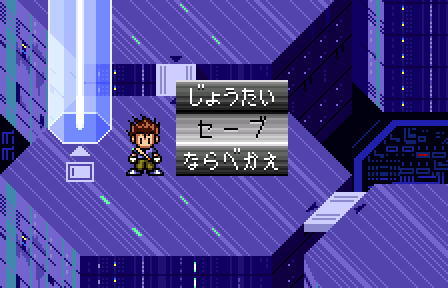
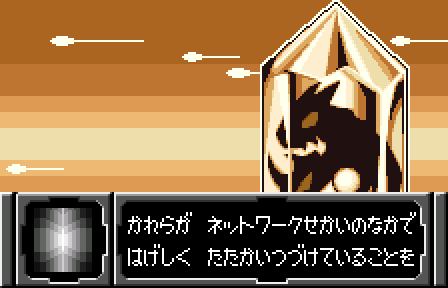
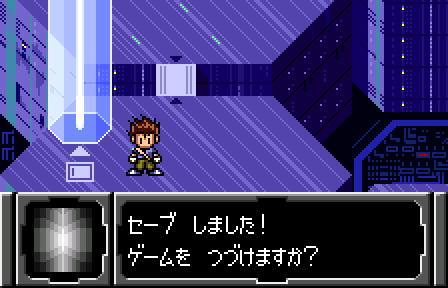
Brave Tamer is the final chapter of the series of Digimon role-playing games that SIMS made for Bandai on the WonderSwan, which began with Anode Tamer and Cathode Tamer and continued through Tag Tamers and D1 Tamers. It was released on 29 December 2001 and it is made for the WonderSwan Color only. During development it was called Net Tamer.
The game follows Ryo Akiyama, without his memories, into the past, where he teams up with Tamers and Chosen Children from the anime against Millenniumon. Instead of collecting a team out of every Digimon met, the player fights with set partners, mostly the anime’s popular characters, and the Digimon caught along the way become cards that strengthen them. The cartridge also supports the link cable.
The story
The game opens where D1 Tamers left off. Ryo’s last fight with Millenniumon on the moon ended when Millenniumon blew itself up and took Ryo with it, throwing the boy into the past and Millenniumon into the future. Ryo comes round after the blast with no memory of who he is, and a young Digimon, Monodramon, comes to find him and leads him to ENIAC.
ENIAC is a computer, and in the game’s history it is close to a god. The Digital Worlds were first made by Atanasoff, the first computer, built in the 1940s, with ENIAC’s help, and over time they split into many alternate realities. ENIAC now watches over these worlds from its own, and it was ENIAC that sent Monodramon to fetch Ryo and that moves him through time and between dimensions. It serves as the player’s home base and gives hints on where to go.
Millenniumon wants to reach ENIAC’s world, seize the main computer at the heart of the Digital World and so control every reality at once. To get there it sends Digimon, some of them clones, to change history, and they go after the children of the anime: the Chosen Children of Digimon Adventure and Adventure 02 and the Tamers of Digimon Tamers. Ryo’s job is to rescue them, and each child he saves lends him a partner Digimon. Among them are Takato with Guilmon, Taichi with Agumon and Daisuke with V-mon, and sixteen children and partners appear in all.
The story is told as a run of broken dungeons called crevasses, and between them Ryo is sent into one of several parallel Digital Worlds. Later the worlds of the earlier cartridges open up again, so the game doubles as a tour of Ryo’s whole saga. Bandai billed it as the final battle between Ryo and Millenniumon, and alongside the fight runs the question of who the two of them really are.
How it plays
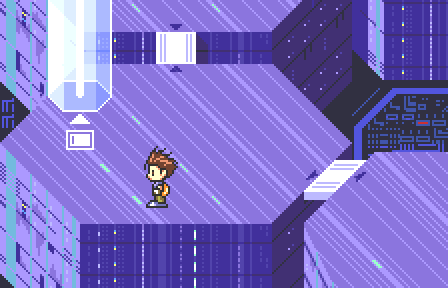
The game is played from an overhead map and the hub at ENIAC, from which Ryo sets out into dungeons. Enemies appear while he walks around a dungeon rather than once per floor, and battles switch to anime-style pictures with animated attacks. The first dungeon is the destroyed crevasse, whose boss is Kuwagamon, and the crevasses that follow are Chinden, Bunkatsu, Futatsu no Tsume, Kuroi Tamago and Wana; after each one the player picks one of several parallel Digital Worlds, fifteen in all. Some dungeons have gimmicks: in Kuroi Tamago the boss changes with the time taken to reach it, and in Wana three bosses keep coming back unless all three are beaten together. Three later crevasses, for Taichi, Daisuke and Takato, add trap areas with poison, slippery floors, leaking current and scorching ground. Clearing crevasses also opens the worlds named after the earlier games: the Anode world after Bunkatsu, the Cathode world after Futatsu no Tsume, the Tag world after Kuroi Tamago and the D-1 world after Wana.
Monodramon stays with Ryo throughout, and at each stage further partners are chosen from the Digimon on offer. During the story Monodramon, Guilmon and five more join, one picked from each of five groups of anime partners (for example Agumon or V-mon, and Piyomon, Hawkmon or Renamon); the others can only be recruited after the ending. Battles are three against three and turn-based. Partners gain levels up to 50 and evolve at levels 11, 21 and 31, and armour evolution works by equipping a digimental, so V-mon with the courage digimental becomes Flamedramon. Each partner also has a YP value that falls with age: at zero it reverts to its baby stage, and YP stays at zero until it climbs back past its old level, when it returns to 99. A partner that falls in battle can be injured, which halves all its values until it has rested in the cloakroom for a while.
Bandai presented two new systems. The first is cards: caught Digimon are converted into technique cards and plugged into a partner at the D-Ark shop, and plug-ins and P-factor cards can be taken off again and reused. Rare cards make special moves stronger. Cards can also be fused there by jogress for 1,000 BIT a time, and Nanimon says what will come out before the player pays. Two identical cards cannot be fused, and the result depends on each card’s rank, from 0 to 7, its series and its attribute: a second card of the same or higher rank and the same attribute gives a card one rank up, a lower-ranked one drops a rank, and fusing at rank 7 always gives Numemon.
The second system is parameter tuning at Jijimon’s lab, where a partner’s values can be adjusted to suit the next opponent. The number of values that can be set grows with the evolution stage, from 6 at the baby and rookie stages to 8, 10 and finally 12 at the mega stage. They cover HP; DP, which techniques spend; AP for attack and PP for defence; separate evasion against attacks on the whole party and on one target; the EXP rate; resistance to ageing; resistance to injury; evasion of normal attacks; and resistance to stat changes and to status effects. The settings are lost when the partner is stored in the cloakroom. For levelling, the common advice is to max out the EXP rate and AP.
The rest of ENIAC’s facilities are Nanimon’s shop, which buys and sells cards and shows and saves the album, and the cloakroom, which stores Digimon and heals injuries. In dungeons, PF items add field abilities: one always lets the party flee, one gives a counter for one and a half times the damage when the button is pressed at the right moment during an enemy’s normal attack, others cancel the leaking-current, frozen and scorching areas, one lets B dash, one shows the map on Start, one opens locked chests, one shows the D-Ark scan data, and one lets two equipped partners of rookie stage or above jogress in battle.
Penmon’s trading house links by cable to Tag Tamers and D1 Tamers for trades and battles. Two colosseums handle link play with other machines: the portable colosseum runs one-on-one battles with Digimon handhelds other than the D-3, and the D-3 colosseum runs D-3 battles and digimental trades. The game can also communicate with the D-Ark, and trading items with it gives special cards. Link battles raise a star rank up to eight stars, reached after 20 opponents and a run of ten or more wins, and each rank adds to HP, DP, AP and PP. Two minigames give rare cards: Minomon’s quiz asks 20 questions drawn from a pool of 100 and awards Four Holy Beast cards by score, and Gennai’s word-chain game uses names from the encyclopedia and gives cards for chains of 5 or more and of 15 or more.
Summon cards are strong early on, so buying plenty of Veedramon cards is common advice, and Kunemon with EL Thread gives a cheap attack on every enemy. Moves that seal enemy techniques are very effective, but Flymon’s paralysis comes late, bosses resist it, and a battle won by paralysis gives no EXP or BIT. Piyomon, Tentomon, Patamon and Hawkmon can fly over to press the switches in rotating-floor rooms. Millenniumon’s world, where cards are spent as exploration time and saving is not possible, is best left until late in the game.
Development and release
Bandai billed the game as the last battle between Ryo and Millenniummon, fought across time and across the worlds of the three anime series. The game has 280 kinds of Digimon, covering every Digimon shown on television up to March 2002, and 16 of them can be chosen as partners, with three taken on an adventure at a time. Every copy came with a Carddass card of Zeed Millenniummon; swiping it through the D-Ark Ultimate Version toy, released in December, made Zeed Millenniummon appear in the toy. First-run copies also carried a specially made Cyberdramon tag.
Secrets and extras
After the ending the player can carry on from the save. Millenniummon’s world can then be entered again with new enemies, three earlier areas reopen, and partner Digimon that could not be recruited during the story can now join. An item equipped on a Cyberdramon of level 40 or above after the ending lets it evolve into Zeed Millenniummon.
Reception
Long-time fans of the series recommend it to players who followed Ryo’s story from the start, as a fitting close to it, but found the new systems hard to learn without a guide, felt that evolution came slowly, and missed the descriptions that earlier encyclopedias gave each Digimon. At least one player lost a save near the end of a first run, though a second playthrough had no such trouble.
Ports and other versions
Brave Tamer was made for the WonderSwan Color, and it was never ported, re-released or published outside Japan. Unlike Anode Tamer and Cathode Tamer, which Bandai later reissued in English on one WonderSwan Color cartridge, the closing chapter of Ryo Akiyama’s story stayed a Japanese cartridge. The Digimon Tamers games released on the PlayStation in 2001, Pocket Culumon and the fighting game Battle Evolution, are separate games and do not continue Ryo’s story.