

The second version of the Digimon Adventure grid-battle role-playing game begun in Anode Tamer, with the same story of Ryo Akiyama against Millenniummon but other Digimon.
Screenshots
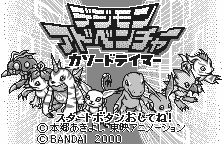
Title screen 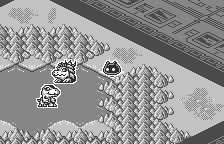
In play 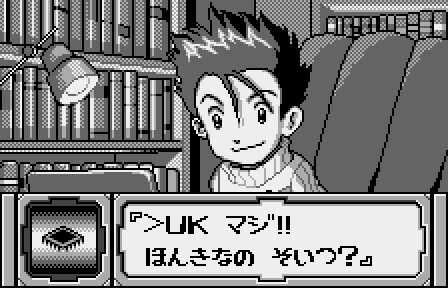

Digimon Adventure: Cathode Tamer is the companion version of Anode Tamer, made by SIMS and published by Bandai on 20 January 2000, about a month after the first. The two are set in parallel worlds and share one story: after the first Digimon Adventure series, Millenniummon revives old enemies and imprisons the Chosen Children, and Ryo Akiyama is called into the Digital World by Agumon on New Year’s Eve to set things right.
The game plays like Anode Tamer: dungeon floors, grid battles of up to three against three, recruiting beaten enemies and Variable attacks learned from teams of particular Digimon. What changes is the cast, which leans towards sea Digimon, and some of the strongest Variable attacks need team members from both versions.
The link cable joins it to Anode Tamer or to another Cathode Tamer to trade Digimon, lend them for a dungeon or battle. Cathode Tamer adds one link the first version lacks: it can exchange data with the Digimon Analyzer toy.
The story
The game is set in the Digital World after the first Digimon Adventure series, on File Island and the Server Continent. Cathode Tamer and Anode Tamer take place in two parallel worlds that tell the same tale. In Cathode’s world most of the Digimon met are water Digimon, and the villain’s lieutenant is Machinedramon rather than Kimeramon.
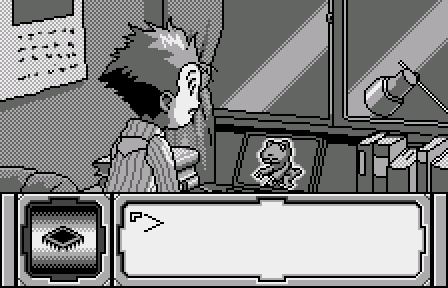
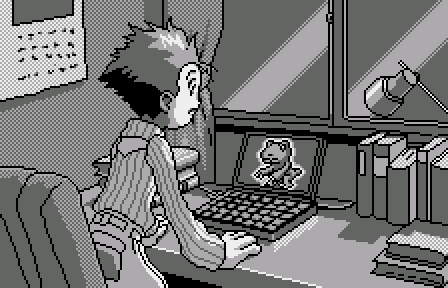
The hero is Ryo Akiyama, a boy of about eleven who has no part in the anime. On New Year’s Eve 1999 a blackout cuts off his online chat, and his mother sends him to look at the fuse box. A voice from a computer screen showing a device he does not know asks him to touch it, and he wakes in a forest facing Agumon, sure that he is dreaming. Here the first enemies are a Shellmon and a Botamon, where Anode Tamer has a Kuwagamon.
Agumon and Gennai explain the danger. Millenniummon, made from Kimeramon and Machinedramon, has broken the flow of time, brought back Devimon, Etemon, Vamdemon and Piemon, and captured all eight Chosen Children. Only Agumon escaped, helped by Gennai, and only Ryo answered its call. Gennai gives him Taichi’s Digivice; since Ryo is not its owner it cannot make Digimon evolve, but its holy power can turn enemies into allies.
The adventure goes from dungeon to dungeon, each held by one of the revived villains, first on File Island and then on the Server Continent. Each victory frees some of the captured children, who lend Ryo their partner Digimon and go home ahead of him. Leomon, Andromon and Piximon help on the way, and in Ryo’s own world only minutes go by.
How it plays
The rules are those of Anode Tamer. Gennai’s house in the village gives the next goal, and each floor of a dungeon is one battle on a map picked at random, with the choice to go on, retreat or save between floors. Clearing a dungeon or losing a battle returns the party to Gennai’s house, and DP and VP refill on the way out. The story runs through 13 main dungeons with 58 floors, and four hidden dungeons of seven floors each follow; the third of them lies behind Gennai’s house, and the fourth is reached through a hole in the village square once the Analyzer is complete. The anime partners join after the fourth, sixth and ninth dungeons.
Battles are fought on a grid by up to three Digimon a side, in an order set by each Digimon’s SP. An ordinary attack needs the attacker next to its target and can miss or be countered, and critical hits come at random. Using an item uses up the turn. Land Digimon lose a point of movement on water, sea Digimon hit harder on water but lose a point on land, and sky Digimon cross anything and move furthest. Sea Digimon move the shortest distance on the grid, so the sea-heavy cast makes a Cathode Tamer team slower than an Anode Tamer one. Wins pay Bits and up to three random items.
Digimon have no levels. Their attack (AP) grows by attacking, defence (PP) by being hit and Variable power (VP) by using Variables, up to twice the starting value or three times for the rare Digimon that joins with hidden great power. Two needs count up to 8: EP for hunger, which leaves a Digimon weaker at 0 until it eats meat, and UP for droppings, which at the limit stops it countering and makes it hungry faster until a toilet item clears it. Players came to build some of the strongest tactics around filling enemies’ UP.
Variable attacks take the place of evolution. When the team meets the conditions, which depend on species, generation, version, trait or the anime’s story, a Digimon may learn one at the start of a turn; Agumon beside another anime partner learns Greymon, then MetalGreymon and WarGreymon. Watching a Variable used five times, or ten for a Digimon that does not suit it, also teaches it. Each Digimon holds up to five. A Variable replaces the move for that turn, reaches anywhere on the map, never misses and costs VP, with the first use free. A Digimon whose EP is too low cannot learn any. Variables that need Anode Tamer’s Digimon, and so a trade, include MetalSeadramon, Mammon, SkullMammon, Digitamamon, Hangyomon, Jyagamon, Griffomon and Jyureimon.
Recruiting starts after the first dungeon. The Digivice, used from the item menu, spends holy-power points earned by beating enemies: about 20 to 30 for a baby Digimon, 40 to 50 for a child, 80 to 90 for an adult and much more for a boss. Recruits wait in Nanomon’s Server Room, where they can be renamed or released. The stock of ten slots grows to thirty with HD upgrades from Nanimon’s shop, which also sells floppies for DP and plugins for VP. Otamamon, Numemon and Bakemon change into Gekomon, Scumon and Soulmon when traded, and Koushiro’s Digimon Analyzer, with 186 entries for 113 Digimon and 73 Variables, can only be filled by trading. Mojyamon, Gottsumon, Coelamon, Octmon, Woodmon, Red Vegimon and Machinedramon are found only in this version, and Devidramon can be recruited only here.
The opening dungeons are easy and the post-game ones much harder, and Cathode Tamer’s hidden dungeons are the harder of the two versions’. Players use the terrain to surround a lone enemy and avoid being surrounded, and wear enemies down with Variables from range before closing in. Plugins help against Vamdemon, who drains VP, and toilet items against Piemon, who can stop counter-attacks. Rare items the shop does not sell can drop, so item space is worth keeping free, and holy points are worth saving because some bosses can be recruited.
Development and release
Cathode Tamer arrived in January 2000, too late for Jump Festa 2000, where Bandai’s booth gave Veedramon only to owners of Anode Tamer. First-run copies of Cathode Tamer carried a promotional Carddass card of Millenniummon. The shop events that Bandai held in February and March 2000 came after its release, and a limited edition of this version, with Veedramon included, was the WonderSwan prize in Bandai’s Digimon Adventure 2000 Campaign, a postcard sweepstakes that closed three days before Cathode Tamer went on sale.
Modes and features
Cathode Tamer has the same hub village as Anode Tamer, with practice battles, a colosseum for link battles, a trading house for swapping and lending Digimon, and an ancient colosseum that links to Bandai’s Digital Monster virtual pets through an adapter. A new option there lets the player pick a Digimon species already registered in the game’s own Analyzer and send its profile to the Digimon Analyzer toy, although species the toy does not know cannot be sent.
Secrets and extras
Four hidden dungeons can be opened. The first two open after the ending; in Cathode Tamer one is filled with Child-level Digimon and the other with sea Digimon. The third appears after more than twenty hours of play past the ending, and Machinedramon can be recruited there. The fourth opens once every Digimon usable in battle has been collected, and in it the player meets the Chosen Children’s partners in battle.
Reception
The two versions together sold roughly 210,000 copies, the third-best result for a WonderSwan game. The versions are nearly the same before the ending; after it, Cathode Tamer makes some rare Variable attacks easier to learn but has the harder hidden dungeons. Players saw the Analyzer link as the main reason to choose this version, and only for owners of the toy.
Ports and other versions
Cathode Tamer was made for the WonderSwan as the second half of a pair, and it never appeared on another system, before or after. The game was reissued once, inside the WonderSwan family: Bandai Asia combined it with Anode Tamer on a single English-language WonderSwan Color cartridge, Digimon Adventure: Anode/Cathode Tamer – Veedramon Version, released in Hong Kong on 18 September 2001. A South Korean edition from the same month had the same changes except Veedramon.
The combined edition adds colour to the formerly monochrome graphics, gives Diaboromon the battle sprite from D1 Tamers and replaces the music heard on the title screen and when a Variable attack is learned. The menus were adjusted to fit English, with characters named as in the English dub and Digimon as on Bandai’s English-language toys, but attack names unchanged. Veedramon joins after the first dungeon without any event, and the Analyzer link that only Cathode Tamer had in Japan is offered in both halves.
Later history
Ryo Akiyama’s story went on in the later WonderSwan games Tag Tamers, D1 Tamers and Brave Tamer. Outside Japan the game is known mostly through the combined English edition.