
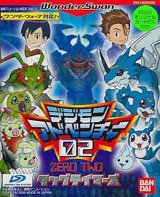
The sequel to Anode Tamer and Cathode Tamer, a Digimon collecting RPG by SIMS in which Ryo Akiyama and Ken Ichijouji of Digimon Adventure 02 each go on their own adventure.
Screenshots
Title screen 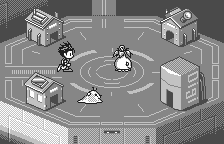
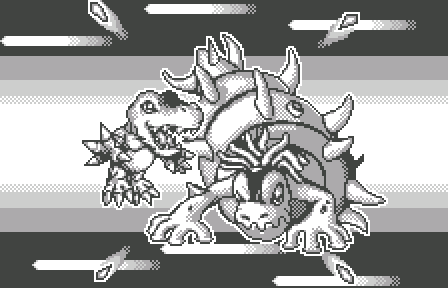
In play 
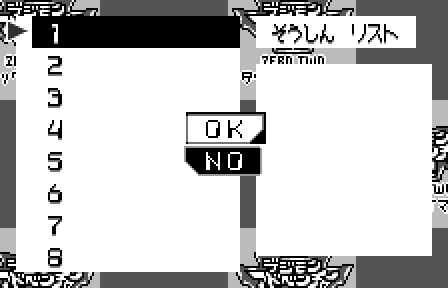
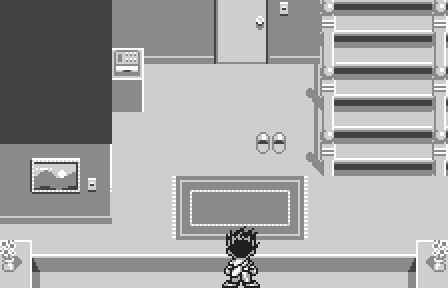
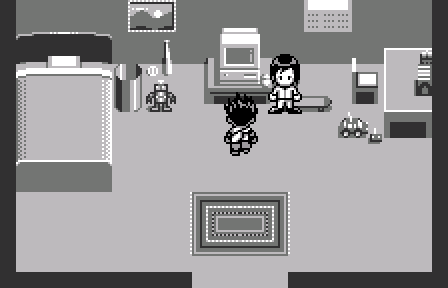
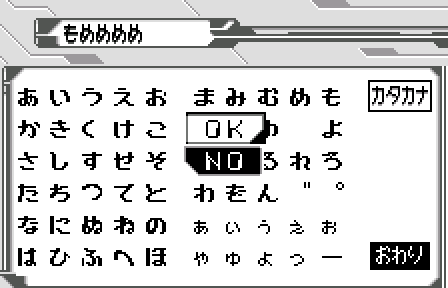
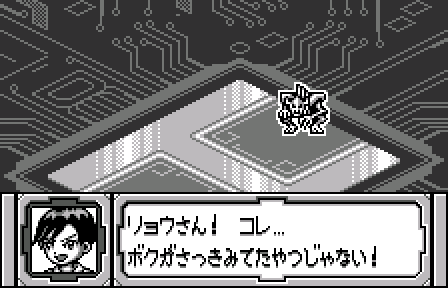
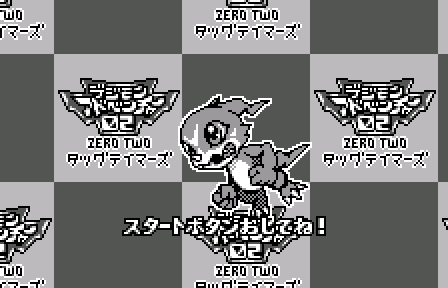
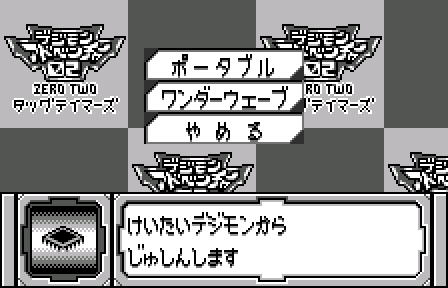
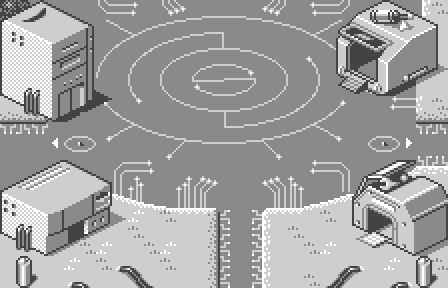
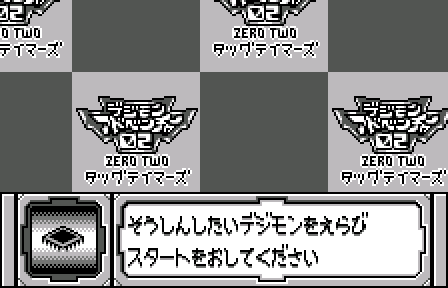
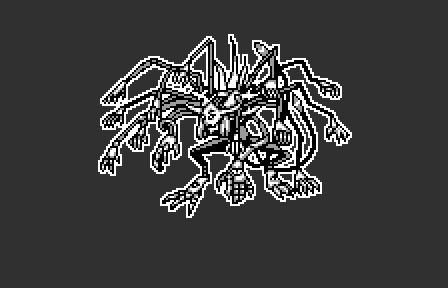
Tag Tamers is the follow-up to Digimon Adventure: Anode Tamer and Cathode Tamer, the pair of role-playing games that SIMS developed for Bandai on the WonderSwan. It was released in Japan on 3 August 2000 and ties its story to the Digimon Adventure 02 anime.
The game has two leads, Ryo Akiyama, the hero of the earlier cartridges, and Ken Ichijouji from the anime, and the player takes turns with them through two separate worlds. Its story is written to fill in parts of the 02 story that the anime does not show.
The movement on a grid that the earlier games used in battle is gone, and fights are now plain turn-based affairs. Digimon grow through what they do in battle and change form through Jogress fusion and armour evolution. D1 Tamers, released in December 2000, continues the story on the same system.
The story
The game is set some months after Anode Tamer and Cathode Tamer, in which Ryo beat Millenniummon at the end of 1999. In the summer of 2000 Ryo and Ken follow the anime’s battle against Diablomon online, as Taichi’s and Yamato’s Digimon fight it across the network. A few days later Veemon comes out of Ken’s computer asking for help and takes the two boys into the Digital World.
There Piccolomon has called in Taichi and Agumon, and Gennai sends Ryo and Veemon after what looks like a copy of Diablomon. Millenniummon, the enemy Ryo defeated before, has survived and is behind the trouble. It splits the boys between two mirror sites, worlds that look alike but differ in their details, and holds Taichi prisoner. Ryo goes on with Veemon and Piccolomon at his side, while Ken, guided by Gennai, finds the partner who will stay with him, Wormmon. Each sets out to rebuild the Digimentals in his own world, since Millenniummon can only be weakened by striking in the original world and its copy at the same time.
Ryo comes back as the experienced tamer of the earlier games, with his history with Millenniummon at the centre of the plot. Ken is the more important figure for fans of the anime. Here he is still an ordinary boy, well before he becomes the Digimon Kaiser, and the game sets out to show how he met Wormmon and why he later turned to evil.
The story is told continent by continent, switching between the two boys, and runs alongside the events of the anime as a side story. It fits the anime’s timeline only loosely, and the aim from the start is plain: rescue Taichi and defeat Millenniummon.
How it plays
The cartridge is a black-and-white WonderSwan game for one player, played with the console held horizontally and with stereo sound. The adventure moves across a chain of continents, and each is played first with one lead and then with the other. Ryo starts on File Island and Ken on a remote island, where he meets Wormmon. The ocean continent follows, first Ken’s version and then Ryo’s, then the mountain continent with Ryo first, the machine continent with Ken first, and Millenniummon’s continent with Ryo first, and in the last stretch beyond it the two boys take turns. Each continent ends in a boss fight against three Digimon, and the two leads face different trios.
Battles are command fights between teams of up to three Digimon, set out in front and rear rows, with a preferred position for each species and no movement on the field. A battle is won by bringing every enemy’s hit points to zero or by paralysing the whole enemy side. Attack techniques belong to about thirteen elements, and each Digimon has its own resistances to them; status and stat-changing techniques cannot be resisted, though they can simply fail.
Digimon grow through what they do. Hit points rise by winning, DP, the energy techniques cost, rises when a Digimon spends it three or more times in one battle, attack rises with single-target attacks, defence with taking single-target hits, and SP, the chance to dodge single attacks, by trying to run away. Speed is hidden and generally falls as a Digimon evolves. Every Digimon also has an age; when it reaches ten, the Digimon is forced back to its previous form. Some enemy techniques lower maximum stats for good.
A species learns only its own signature technique by itself, and other techniques come through Jogress, passed down from the two parents. An inherited signature technique can be used only once the new Digimon is of the same generation as its original owner or higher, and a forgotten technique cannot be learned again. Jogress itself is done in Digitamamon’s shop and is unlocked partway through, on Ken’s half of the mountain continent, which is also where the D-3 comes into use. The D-3 recruits enemy Digimon by spending points won in battle, and stronger Digimon cost more. The result of a merge depends on Jogress points, the parents’ rank and the evolution line; some lines open only by merging two particular Digimon, and tablets in Digimoji found during the story name the pairs. Reaching Perfect and Ultimate takes repeated merges, and Ultimates are hard to raise without link play, so Perfect-level Digimon are enough to finish the story. More than 220 Digimon appear.
Armour evolution replaces the variable evolution of the earlier games. Digimentals are built from three fragments at Centalmon’s Digimental Room, and fourteen kinds appear. They give resistance to an element, let a Digimon use extra techniques, and allow armour evolution, which five Digimon from the anime can use to change form in the middle of a battle; Wormmon is not one of them. Ken receives the Digimental of Light from Gennai on the ocean continent but cannot use armour evolution at that point. Some enemies destroy Digimentals, so it is safest to take them off when they are not needed. The D-Terminal holds the Digimon encyclopedia and the dungeon maps.
A few spots are known as hard. On Ryo’s side of the machine continent, groups of Penmon, Shellmon and Monochromon keep raising their defence, Flymon’s paralysing attack is dangerous wherever it appears, and Clockmon can reset a battle, bringing back every enemy already beaten. Paralysis is the strongest weapon on the player’s side too: Deadly Sting paralyses the entire enemy side, and techniques that knock out the target three turns after they hit are close behind. A Flymon can be had early by merging a Kunemon from the mountain or machine continent with any Digimon that carries no Digimental. After the ending, Veemon and Wormmon can be merged, and the last dungeon changes, filled with earlier bosses and the anime partners at Champion level.
Development and release
Bandai presented the game as the Digimon games moving up to Digimon Adventure 02, with a story built around the mystery of why Ken, the Digimon Kaiser of the anime, turned to evil. It explained the title as coming from the way the player takes turns with Ryo and Ken, the tag team, working through two parallel Digital Worlds. The cast grew to more than 220 Digimon. The pair are split between mirrored worlds by Millenniummon, the final boss of the earlier games, and the goal is to defeat it and rescue Taichi Yagami, who has been taken prisoner.
Modes and features
The game connects to a wide range of other Digimon products. It offers battles with the earlier Digimon toys through a dedicated connector, the use of Digimon raised in the D-1 mode of the PlayStation game Pocket Digimon World over the WonderWave infrared adapter, and Jogress and Digimental trading battles with the new D-3 Digivice toy. The different link battles take place in arenas inside the game, one of them for battles between two WonderSwans, and a rare-item shop on the machine continent takes a currency earned only from link battles.
Secrets and extras
The game has several hidden parts. There is a hidden continent, a world resembling a town seen somewhere before, and a hidden dungeon that opens after the game is cleared has bosses who use their own signature techniques. On the machine continent an item can open a hidden route where Ultimate-level enemies appear. Millenniummon has to be beaten in the same number of turns with Ryo and with Ken, or it revives and the last dungeon stays closed, and some later bosses copy tactics the player used against earlier ones.
Ports and other versions
Tag Tamers was made for the WonderSwan, and it was never ported, remade or re-released on another system. It belongs to a run of SIMS role-playing games about Ryo Akiyama that was published only on Bandai’s handheld, from Anode Tamer and Cathode Tamer to D1 Tamers and Brave Tamer. Its ties to other systems are link features, such as using Digimon raised in the PlayStation game Pocket Digimon World, rather than versions of the game itself; among its WonderSwan relatives it stands out as the one where the player alternates between two leads in mirrored worlds.
Notes
Players have lost save data when the power was switched off or the cartridge was pulled out. Fans have also pointed out low hit rates for single-target attacks, a weak Wormmon, and some points where the plot does not fit the timeline of the anime.