

A Digimon collecting RPG by SIMS in which Ryo Akiyama fights through the D-1 tournaments, released on the WonderSwan Color's launch day and also playable on the original model.
Screenshots

Title screen 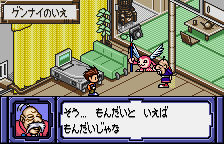
In play 
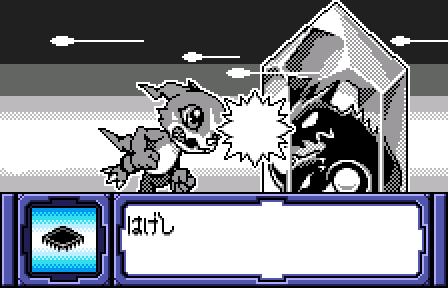
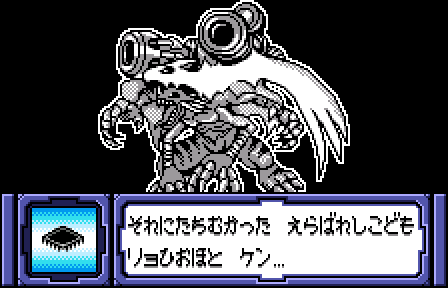
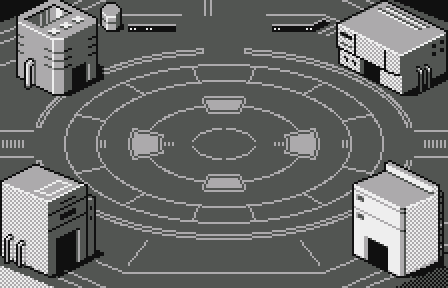

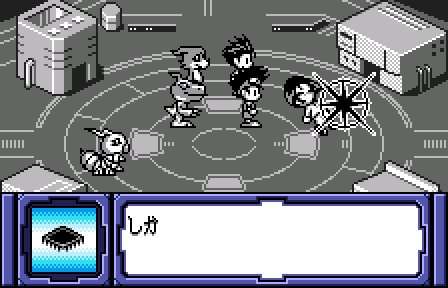
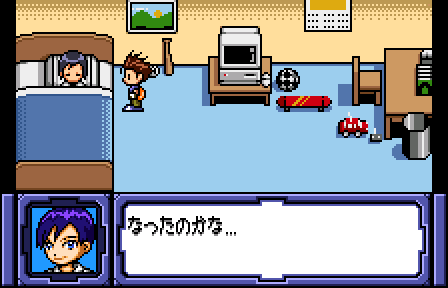
D1 Tamers is the third of the Digimon role-playing games that SIMS made for Bandai’s handhelds, following Anode Tamer, Cathode Tamer and Tag Tamers. It came out on 9 December 2000, the same day as the WonderSwan Color, and the cartridge works on both the Color and the original black-and-white WonderSwan.
It continues the story of Tag Tamers and keeps that game’s systems for raising, battling and merging Digimon, with quicker levelling and an easier route to Jogress.
It is a game for one player, but two consoles can be joined with the link cable to battle and trade. The game also had WonderGate features, which no longer work now that the service has ended.
The story
The game is set a short time after Tag Tamers. Ryo Akiyama, the hero of the earlier cartridges, goes to see Ken Ichijouji, who is ill in bed. Ken has come across a strange website on his computer, and through it a mysterious Digimon calling itself one of the Four Holy Beasts sends out a call. On the site is a questionnaire of very doubtful origin. Ryo fills it in, and depending on his answers one of the Holy Beasts carries him off to the Digital World.
The Four Holy Beasts are Qinglongmon, Zhuqiaomon, Baihumon and Xuanwumon, the guardians of the four quarters of the Digital World. Ryo finds them fighting each other for mastery of it. Gennai and Piccolomon explain that the beasts themselves have set up the D-1 Tournament, and that its winner will become the partner of the beast chosen in the questionnaire. Ryo’s own beast tells him that the other three have turned bad in their hunger for absolute power, and it has gathered tamers so that the champion can bring them back to their senses or defeat them. Ryo swears himself to that beast and enters the tournament, with Agumon, Veemon or Wormmon at his side.
The tournament is climbed through five grades, from the fifth up to the first, and between them Ryo travels through a string of themed fields and dungeons on quests of his own. Each grade ends in a final against one of the DigiDestined of the anime and their partners: Koushiro, Wallace, Mimi, Yamato and Taichi all stand in Ryo’s way. Ken stays at home, but he helps from there by analysing how Ryo’s Digimon can evolve.
At the start the tournament feels like a friendly competition, a chance to test Ryo against the best-known children of the series. Behind it lies the beasts’ quarrel over who will rule the Digital World, and the stakes grow as Ryo climbs the grades.
How it plays
The game is played with the console held horizontally, on either the WonderSwan Color or the black-and-white model. A new game opens with three questions. The first two are about the events of Tag Tamers and do not change anything. The third decides which Holy Beast Ryo serves, and with it which of four Holy Beast dungeons he plays: Baihumon’s is the easiest, with no enemies that resist paralysis, Zhuqiaomon’s and Xuanwumon’s are full of Perfect and Ultimate enemies, and Qinglongmon’s is the only route on which V-dramon and Tuskmon can be obtained. Ryo then picks Agumon, Veemon or Wormmon as his first partner.
Between battles Ryo talks to Digimon in their homes and out in the fields to gather information and new allies. The adventure runs through fourteen stages in a fixed order: the fire field, the fifth grade, the insect field, the fourth grade, the flower field, the third grade and the toy field, the gear field, the demon field, the second grade, the angels’ tower, the demon king’s field, the first grade, the Holy Beasts’ field and the final dungeon, which is reached from Gennai’s house and is a run of eight battles in a row. Each dungeon has its own mid-boss.
Battles are turn-based command fights between teams of up to three Digimon, set out in front and rear rows. Formation matters, because most techniques reach only the front row or only the rear one; just eight techniques in the game strike the whole enemy side. Tag Tamers’ elemental attack types are replaced by five attack categories, decided by a Digimon’s species and the Digimentals it carries. A Digimon generally gets slower as it evolves, so Champions often act before Perfect and Ultimate opponents. Paralysis remains the most powerful tool, though in this game it wears off after a few turns.
Digimon grow by doing things in battle. Hit points rise by winning, energy by using techniques, attack by ordinary attacks, defence by taking hits, and speed, which also governs hitting and dodging, by trying to run away. Each Digimon also has an age that starts at zero; at ten it falls back to its previous form. Experience drives natural evolution. In the angels’ tower every battle adds a year to each Digimon’s age, so it is best cleared in one run.
New Digimon are recruited with the D-3, which spends points won in battle, and capturing one now uses up only as many points as that Digimon needs. Two Digimon are merged in Digitamamon’s Jogress Room, and the result depends on Jogress points, the rank of the parents and the evolution line; Ken’s analysis shows where each line leads. Fewer Jogress points are needed than in Tag Tamers, and Veemon and Wormmon can be merged into Paildramon during the main story. Techniques and equipped Digimentals pass to the result, and a technique inherited this way can be learned even after a Digimon has reached its growth limit. Digimentals are sold in shops and give techniques or resistances, so a Digimon can hold up to three resistances at once: its own, its Digimental’s and one inherited through Jogress. Bomb resistance is the most useful, as all-target bombs are common, but some enemies can destroy Digimentals. Jog Plus, found in several dungeons including the toy field’s last one, adds Jogress points without a merge. More than 230 Digimon appear.
Most of the game is easy with ordinary tactics, but a few places are known for being hard. The third-grade final is the usual stopping point, and losing it opens the toy field, where beating Digitamamon unlocks Jogress and beating Etemon earns a rematch. In the gear field many enemies raise their defences or counter attacks, so all-target techniques help. The first bosses of the demon field each demand that a Digimon be given up for good. In the demon king’s field Chimeramon changes its resistances every turn and Mugendramon becomes resistant to each attack category that hits it, while Jijimon and Piemon have instant-kill techniques and should go down first. When a character asks for an item after a boss, handing it over brings help later; refusing once means the request never comes again.
The first clear changes the final dungeon. Its Perfect-level enemies, many of which appear nowhere else, are replaced by the anime partners at Champion level, so Daemon, Apocalymon and Diablomon have to be caught on the first visit, and the last boss grows stronger. Link battles with players who chose other Holy Beasts open their beasts’ dungeons as well, and the four-device links described below lead to the true ending.
Development and release
Bandai’s announcement made much of the move to colour, promising more than 230 Digimon on a colour screen and livelier battle scenes, while keeping the cartridge playable on the black-and-white model. The story opens with Ken finding a strange website through which a mysterious Digimon calling itself one of the Four Holy Beasts sends out a message; back in the Digital World, Ryo finds the four beasts fighting each other for supremacy, swears himself to one of them and enters the D-1 tournament. The player chooses Agumon, Veemon or Wormmon as Ryo’s partner at the start.
Modes and features
Digimon are recruited, arranged in a battle formation, and merged in a Jogress Room, and the game supports ordinary evolution, armour evolution and Jogress. The game has a long set of connections: with the D-3 toy for Jogress, battles and item trades, with the earlier Digimon toys through a dedicated adapter, with the PlayStation over the WonderWave infrared adapter for polygon battles using monsters raised in the PlayStation games, and through the WonderGate, which let players enter an online D-1 Grand Prix and battle tamers from all over Japan.
The connection features are tied to the end of the game: the final dungeon asks for links with four kinds of other Digimon devices before the true ending can be seen, and a link battle against a player who sided with a different Holy Beast opens the Holy Beasts’ dungeon and changes the final boss.
Secrets and extras
The questions asked at the start of a new game have correct answers: Moon Millenniummon for the first and the number of turns taken to beat Millenniummon for the second. It pays to keep D-3 points in reserve for the last dungeon, since its enemies change after the first clear.
Ports and other versions
D1 Tamers was made for the WonderSwan and has stayed on it. Its only other release is a pack issued in March 2001 that puts the same cartridge in one box with the Mobile WonderGate adapter, and it was never ported, remade or re-released on another system. It is the third of the SIMS role-playing games about Ryo Akiyama, a series that appeared only on Bandai’s handheld and closed on the WonderSwan Color with Brave Tamer a year later. The PlayStation and the Digimon toys enter the picture only as partners for its link features, not as other versions of it.