
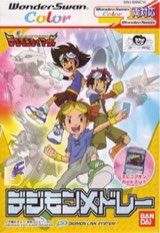
An RPG by Shade that replays scenes from Digimon Adventure, Adventure 02 and Tamers with a choice of 18 characters, using button-pressing minigames to power attacks.
Screenshots
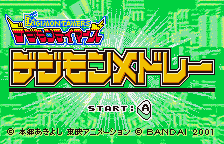
Title screen 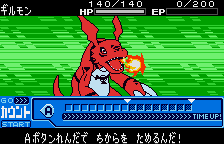
In play
Digimon Medley is a role-playing game built from the Digimon anime, developed by Shade and published by Bandai on 12 July 2001. Unlike the Ryo Akiyama games by SIMS, it does not tell a new continuing story of its own. Instead it lets the player pick from 18 characters from Digimon Adventure, Digimon Adventure 02, Digimon Tamers and the films, each with a partner Digimon, and replays episodes from the series as short chapters, some of them written for the game and not seen in the anime.
Chapters are explored from an overhead view, and fights are one against one, with the strength of each attack decided by short button-pressing minigames. The game is made for the WonderSwan Color but also runs on the original black-and-white WonderSwan, and it supports the link cable.
The story
The game opens with the Tamers. Impmon snatches Culumon, and Takato, Jenrya and Ruki chase after him, only to be caught in a magic circle and bound to crosses among a field of stalagmites. To get free, they are shown scenes from the earlier Digimon series, and the player’s choices decide which episodes those are. The first fight of the game, against Numemon, is played as one of the three Tamers.
From there the game moves into Digimon Adventure. Its chapters follow the first series in order, from the children’s arrival on the island of adventure through Devimon, the labyrinth of Etemon and Nanomon and Vamdemon’s castle to the four Dark Masters, and they are followed by chapters from Adventure 02, such as the loneliness of the Digimon Kaiser and the chimera beast Chimeramon.
Each chapter offers a choice of two to four characters, and the cast is mixed freely across the series, so Wallace can join Taichi for the revival of VenomVamdemon, and a 02 character can play through a Tamers story or a Tamers character through the first series. The story branches as it goes, sometimes into developments that the television series never had; at one point the player picks a card, Agumon or Gomamon, and the next chapter changes with it. The tone stays close to the anime, retelling its battles one at a time.
How it plays
Each chapter recreates one battle from the anime. The player chooses a character, explores a dungeon from an overhead view, fights random battles on the way and meets the chapter’s boss at the end. Every battle won against an ordinary enemy pays EP, and each chapter also holds a few items to pick up. Which chapter comes next depends on the player’s choices and, in places, on how a fight goes: beating the boss of the Digimon Kaiser chapter within five turns changes both the cast and the boss of the chapter after it. Some battles are forced, and a few are scripted losses in which the enemy’s attack on the third turn always wins. Late in the 02 section the story moves on only after one of five overseas stages, set in China, Paris, Russia, New York and Mexico, has been cleared.
Battles are one against one, and both sides attack at the same moment. On the player’s turn an attack is powered by a minigame: either hammering the A button within a time limit to fill a gauge, or pressing at the right instant. Hammering attacks come in two speeds, one in which every press adds a notch to the gauge and a harder one that needs two presses per notch. When two attacks meet they collide and the stronger one wins, but both sides can also land their hits. Each basic form has two attacks, one free and one costing 10 to 12 EP; Agumon, for example, starts with 140 HP, a free hammering attack of 30 and a timing attack of 55 that costs 10 EP.
Partners start in their basic form and evolve by spending EP, points that winning battles and eating food replenish. The first evolution costs 50 EP, the next 70 and the one after that 80, and the later forms have more HP and stronger attacks, so Agumon can rise through Greymon and MetalGreymon to WarGreymon and Omegamon, whose attack is worth 150. Some attacks change type in particular chapters; MetalGreymon’s main attack, for instance, becomes the easier hammering kind in the Nanomon labyrinth.
Items are used to keep a partner going. Floppy disks restore 50 HP, the Neo Floppy 100 and the MAX Floppy all of it. Some nineteen kinds of food, from doughnuts to marbled beef, restore between 5 and 30 EP, and the holy drop restores all of it. ATK accelerators add 10, 30 or 50 to attack for one battle and DEF accelerators cut damage by 10, 20 or 30, an escape chip guarantees a getaway from anything but a boss, and two proteins, usable only in battle, raise maximum EP by 40 or maximum HP by 50.
Clearing stages adds to an anime encyclopedia of 104 entries covering every episode of Digimon Adventure and Adventure 02. The matching menu is a Digimon Theatre, which fills up as the main story is cleared and in which chosen scenes from each episode can be watched again. A special menu collects hidden stories unlocked by linking with the D-Ark toy, each one a short chapter of its own with a fixed choice of characters.
Development and release
Bandai sold the idea as the television series served up as a medley: the stories of the three anime series, played with whichever character the player likes, so that a Digimon Adventure 02 character can live through a Tamers story or a Tamers character through the first series. Bandai also announced that every Digimon game released that year would come with an original Carddass card. Read by the D-Ark toy and then passed to the WonderSwan, the card was to add a new episode to the game and a new field to the toy.
Secrets and extras
Linking with a D-Ark and battling it through the D-Link adds hidden stories to the special menu: one about Diaboromon after the first battle, one about Cherubimon after ten and one about Armagemon after twenty. In the chapters of the first series, the four Dark Masters can be fought in any order, but only beating them in the order MetalSeadramon, Pinocchimon, Machinedramon and Piemon opens the route to the final dark Digimon.
Ports and other versions
Digimon Medley was made for the WonderSwan Color, and it was never ported, re-released or published outside Japan. Among the games drawn from the Digimon Tamers anime, the ones on other systems in 2001 were the PlayStation titles Pocket Culumon and Battle Evolution, a fighting game. Neither is a version of this one, which stands apart by letting the player relive episodes of three anime series with a character of their choice.