
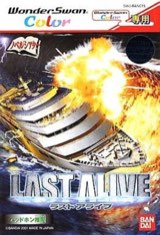
A novel-style adventure for the WonderSwan Color in which the player tries to escape a hijacked cruise liner that has capsized in a storm, released by Bandai in 2001.
Screenshots
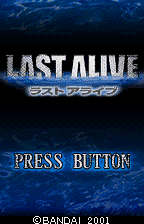
Title screen 
In play 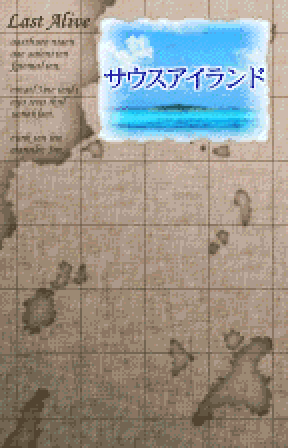





Last Alive is an adventure game for the WonderSwan Color, released by Bandai on 26 July 2001. It is told in the manner of a novel: the story runs as text over pictures, and the player steers it at points where a choice has to be made. The cartridge was made for the Color and does not run on the original black-and-white WonderSwan, and it uses that colour throughout, with around 300 full-colour images and three-dimensional sound.
The game follows two survivors, a young man and a schoolgirl, through the same disaster: a luxury liner bound for Japan is seized by terrorists, strays off course and capsizes in a storm. What the player chooses decides who gets out alive.
The story
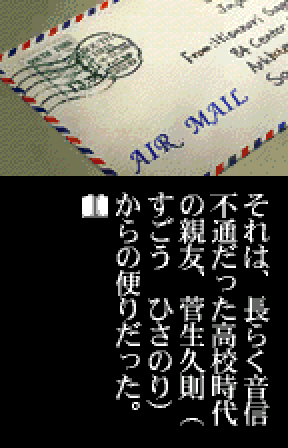
Yōsuke Arabe is a young man in the middle of hunting for a job when a letter and a plane ticket arrive from Hisanori Sugō, his best friend from high school, with whom he has lost touch. Hisanori is getting married, and the wedding party is to be held on board the Blue Silence, a luxury cruise liner that sails for Japan from South Island in the South Pacific. Yōsuke flies out to the island, a region once troubled by unrest that has become a holiday spot since a ceasefire, and finds a paradise of blue sea and sky that has nothing to do with his round of job interviews.
On the island Yōsuke tours a temple listed as a World Heritage Site with Hisanori, his fiancée Tomoyo Kamitsuma, and two other guests at the wedding, Kōhei Ushioda and Ryōko Watase. There an incident brings him together with Hikaru Amano and Mahiro Odori, two girls on a school trip from Japan. Their school is an exclusive one whose pupils are the daughters of leading company executives and senior government officials, and the whole class, among them Shizuka Nanao, Mio Okuhira and Takami Sonozaki, is going home on the same ship.
Hidden among the passengers are terrorists who are after the girls. Soon after the Blue Silence leaves port they seize the ship and take it far off its course, and then it runs into a storm and turns over. From that point the story is about survival. Yōsuke, Hikaru and the people around them wander a capsized ship that is dark, burning and taking on water, with the hijackers still on board, and the fate of the passengers rests on whether the two of them fight their way out or look for a way to slip past.
The story is told in parts. A prologue on South Island is played as Yōsuke. The main story then splits into two scenarios on the Blue Silence, one for Yōsuke and one for Hikaru, which cover the same hours on the same ship from two points of view and cross at certain moments. A further Another Story tells events differently again. Bandai called it a maritime panic adventure, and where the earlier Novel Theater games were horror, this one is a suspense story about a disaster at sea and the people caught in it.
How it plays
The WonderSwan Color is held upright, and the text fills the screen in vertical lines over the pictures, most of them photographs of the real cast rather than drawings, with a few illustrated scenes mixed in. When a book icon appears, X3 or Y2 turns the page. At a branch point Y1 and Y3 move between the actions or lines on offer and X3 or Y2 confirms. B opens a reading-back mode that shows the earlier pages as text only, paged with Y1 and Y3, and Start opens the settings, where the text speed and the hint system are set. The game is for one player and is built around sound: a headphone adapter for the WonderSwan was recommended with it.
At first only the South Island prologue can be chosen. Clearing it and saving opens the two main scenarios, Yōsuke’s and Hikaru’s, and clearing both of those and saving opens Another Story. The title menu offers reading from the start, continuing, Another Story, and erasing the saved data, which wipes every clear and sends the player back to South Island. The game is saved by placing a bookmark from the settings screen, which also ends the session; there is one bookmark, so placing a new one replaces the old.
Every choice is scored on two hidden measures, leadership points and active points. Leadership points move with how the hero treats the other survivors, and active points rise when the hero takes a bold, active stance. Their totals change which choices, actions and lines appear later. With the hint system switched on, a blue ripple spreads across the screen whenever a choice has just raised leadership points.
Two gauges add pressure in the ship scenes. Some branch points have a time meter, and if it runs out before the player picks, the choice is made automatically: either one of the options or an entirely different action. A flooding meter shows the ship’s eleven decks, from the ballast tanks at the bottom to the observation deck at the top, with the hero’s current deck and the height of the water, so it is clear how close the sea is.
Bandai called the link between the two main scenarios the Double Link System. The two heroes’ actions affect each other: a note written by a character in one scenario, for instance, can be found by another character in the other. Each hero can save only certain people, and the two scenarios together decide who survives. The aim is to bring every one of them out alive by playing both, which leads to the true good ending, Episode 1. Another Story works the same way with its own pair of scenarios and its own set of people to save.
Choices made in the South Island prologue carry over into the main story, and the game is hard to finish well. The manual’s own advice for a player who keeps missing the good ending is to replay the prologue, especially the moment when Mahiro and the others can be helped, to switch the hint system on and choose so as to build up leadership points, and to work with the other survivors, since the whole group cannot get out alive unless they pull together. Every replay starts again from the same opening, which cannot be skipped.
Development and release
Last Alive is the fourth game in Bandai’s Novel Theater line for the WonderSwan, after Terrors, Ring Infinity and Terrors 2. Bandai billed it as a maritime panic adventure and stressed that both pictures and sound had been raised well above the earlier entries, with every image now in full colour. As in the previous games, Bandai cast a number of popular idols, who appear in photographs: Nozomi Ando plays Hikaru and Kasumi Nakane plays Mahiro. The game shares its title with a TV Tokyo drama shown from April to June 2001, and Ando’s single PLACE, the drama’s theme song, is advertised in the game’s manual.
Modes and features
The game is played alone and has no link-cable features, and its sound is in stereo. The cartridge holds 32 megabits of data and a small EEPROM chip.
Ports and other versions
Last Alive was made for the WonderSwan Color and was never released on another system or re-released later. It belongs to the Novel Theater line, whose other entries, Terrors, Ring Infinity and Terrors 2, were also WonderSwan games, and it differs from them mainly in its sea-disaster setting and in having every picture in full colour.