
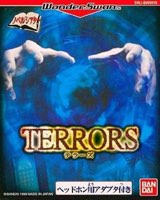
A horror text adventure with five frightening stories whose branches and endings depend on the player's choices, the first of Bandai's Novel Theater series.
Screenshots
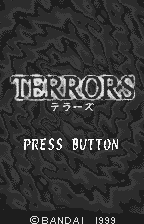
Title screen 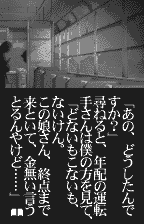
In play 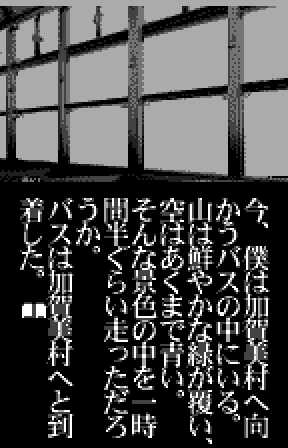
Terrors is a horror adventure for the WonderSwan, published by Bandai on 5 August 1999. It was the first game in Bandai’s Novel Theater series, a genre the company presented as new to handheld consoles, and it was followed on the WonderSwan by Ring Infinity and Terrors 2.
The game holds five separate horror stories and a hidden sixth. The player reads text that goes with pictures on the screen and makes a choice at set points, and those choices, together with a measure of how frightened the main character is, send each story towards one of several endings. Idols play the heroines, and the game was designed to get as much as possible out of the console’s graphics and sound. It is played with the console held upright and is for one player only.
The game came in a standard edition and a first-run limited edition that included an adapter for headphones. Bandai then announced that the limited edition would also contain an original trading card showing one of the idols who appeared in the game, from a range of cards that were not sold anywhere else.
The story
Terrors is not one tale but an anthology. Each of the five stories has its own hero, its own setting and its own kind of fear, from a vengeful ghost in a country inn to a menacing neighbour in a city flat, and none of them depends on another. The tone is closer to a television series of strange tales than to splatter horror, and much of the dread comes from ordinary situations that slowly turn wrong. The stakes are personal: the hero’s nerve, the safety of the people beside them, and whether they find out what is really going on before fear gets the better of them.
Onryō Ryokan follows Naoki, a high-school boy on an aimless trip alone to a small village he once saw on television. On the bus he helps a girl named Reiko who cannot pay her fare, and she too has run away from her everyday life. Rain drives the two of them to an inn that turns out to be empty and dark. Itoshiki Tomo is set in an apartment, where Fumina lives with her cousin Mika while her parents are away travelling; a neighbour who plays loud music late at night begins to harass them, and Fumina sets down what happens in a letter.
Chiisana Obakeyashiki sends three high-school girls into a haunted house that stands beside an amusement park, a place rumoured to keep the people who go in. One of the three hates horror of any kind. In Kishimu Oto a university student and his girlfriend Madoka travel into the mountains to visit his sick grandfather, a man from a family of puppet makers, who leaves him the family chronicle and speaks of a treasure kept in the storehouse.
The fifth story, Mother Table, belongs to Yōko, a high-school girl with no parents or relatives who has had an unhappy upbringing. It is her birthday, and her boyfriend Kaoru has grown distant enough that she begins to distrust him. When all five stories are finished, a final scenario opens in which someone is lost in a mysterious mansion, and what happens there depends on how each of the five stories ended.
How it plays
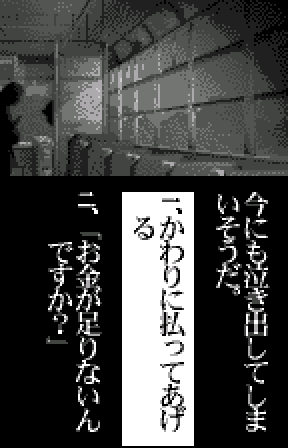
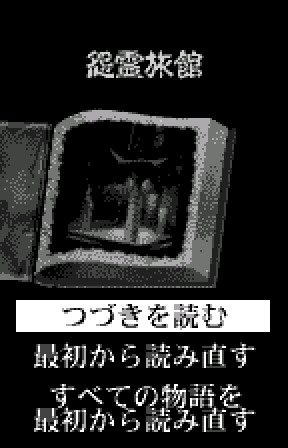
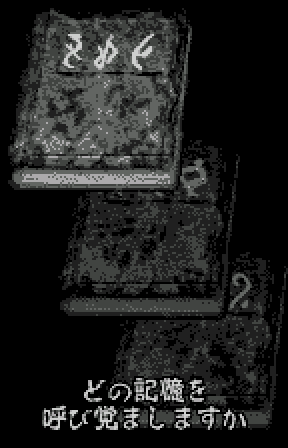
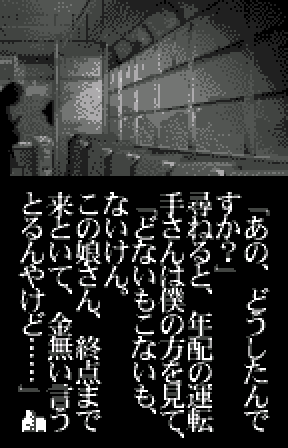
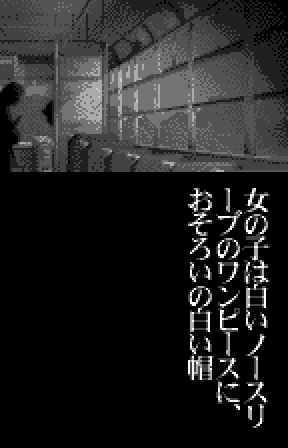
The WonderSwan is held upright, like a paperback, and the game opens on five books, one for each story, which can be read in any order. Picture and text are shown separately rather than one laid over the other. Choices appear as numbered options. The game cannot be played one-handed with the Y buttons alone; that option arrived with Ring Infinity.
The terror points are the heart of the game. As a choice comes up, a wave on the screen, with a heartbeat on the sound, shows how frightening each option is, and the bigger the wave the more scared the hero becomes. Fear builds up over the story. In Onryō Ryokan a hero who is scared past a certain point screams and runs, refusing the brave action the player picked, which can lead straight to a bad ending. In the other stories the running total of terror points splits the story into two to four branches, and some of the points are hidden.
Each story has many endings: five in Onryō Ryokan, six in Itoshiki Tomo, eleven each in Chiisana Obakeyashiki and Kishimu Oto, and ten in Mother Table, forty-three in all, of which sixteen count as good. Avoiding fear at every turn rarely reaches the good ending, and the truth behind a story is often found in the frightening bad endings. Mother Table branches at random near the start, and an unlucky early branch can close off its best ending. Changing a few choices often leads back to an ending already seen, so collecting them all takes patience.
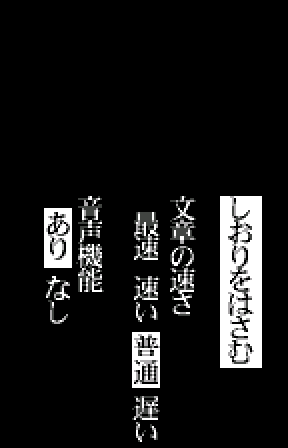
A story lasts twenty to thirty minutes, and a single run can be over in ten to twenty. Progress is saved automatically, so the game can be put down and picked up again like a book. There is a backlog for rereading earlier text, and the message speed can be changed, but even the fastest setting still types the text out, and text already read cannot be skipped. The good endings play the theme song.
The hidden final scenario opens after all five stories are cleared. It reuses pictures from the five stories and branches according to whether each of them ended well or badly, so a player who wants every outcome has reasons to go back to the earlier stories.
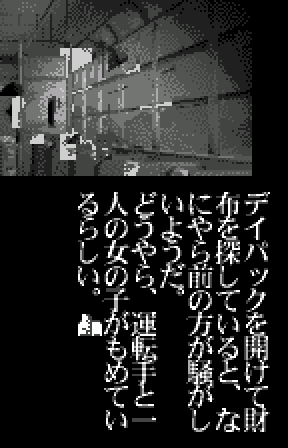
The pictures are dim, low-resolution digitised photographs, and the scenes are dark. Megas billed the game’s stereo sound as the first 3D sound on a handheld, which needs headphones to be heard; through the console’s speaker the sound is muffled and noisy, and voices are heard only at key moments. Turning the voices off in the options also silences the sound effects. Players pass on two tips: in Onryō Ryokan, keep winning Reiko over and protecting her, and in Chiisana Obakeyashiki, shield the other two girls.
Development and release
The first-run limited edition sold for 3,980 yen under its own product code, SWJ-BAN018, a thousand yen more than the standard cartridge. The headphone adapter in that box mattered more than it might seem, because the original WonderSwan has no headphone socket of its own. The publisher’s copyright line names only Bandai, but Megas developed the game alongside Bandai, and Megas’s website of the time listed the first Novel Theater title, released on 5 August 1999, as its work.
The anime artist Tomonori Kogawa directed the second episode, and the voice actor Hiroki Takahashi played characters in two of the stories. Young idols and actors took the other roles, among them the singer Reiko Omori, who also sang the ending theme, “Tsuishin”, released as a single by EMI Music Japan on 8 September 1999. SoftBank Publishing brought out a TERRORS perfect guide in its WonderSwan book series in October 1999.
Reception
Players who came back to the game years later mostly liked its writing and its range, from ghosts to ordinary fears such as a menacing neighbour or a partner who cannot be trusted, and thought it deserved to be better known. The refusing hero was the feature they talked about most, admired as an original idea and resented when it forced a long replay. They also missed the conveniences of later sound novels: there is no way to skip text already read, no flowchart and no list of endings, which makes collecting every ending slow.
Ports and other versions
Terrors was made for the WonderSwan and was never released on any other system or re-released. Its closest relatives are the two later Novel Theater games, which were also WonderSwan releases. Although Bandai sold it under the Novel Theater label, it plays much like Chunsoft’s sound novels; what sets Terrors apart is its cast of idols in digitised photographs and the fear system that can overrule the player’s choices.
Later history
Bandai carried the system into the rest of its Novel Theater line. Ring Infinity, released on 10 August 2000 and based on Kōji Suzuki’s novel, reused the TERRORS game system as the series’ second title, and TERRORS 2 followed on 21 December 2000 with a different set of performers.