
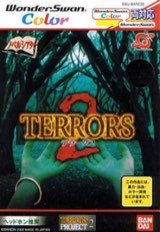
The third game in Bandai's Novel Theater horror series, with longer stories told over processed photographs and a WonderGate option that matches the plot to the real time of day.
Screenshots
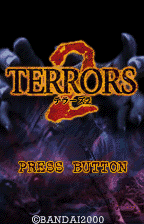
Title screen 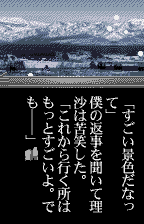
In play 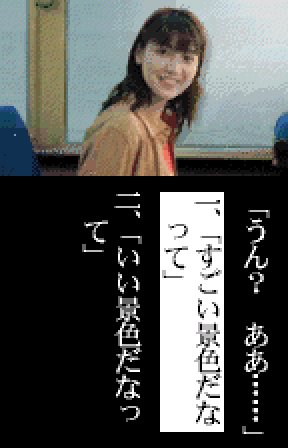
Terrors 2 is a horror adventure published by Bandai on 21 December 2000, a few weeks after the WonderSwan Color went on sale. It is the third game in Bandai’s Novel Theater series, after Terrors and Ring Infinity, and the cartridge plays both on the Color and on the original black-and-white WonderSwan.
As in the first game, the player reads the story on screen and picks from choices that change its course and its ending. There are fewer stories than before, three regular scenarios and one hidden one against the five of the first Terrors, but each was made more than three times as large, with many endings, several of them happy ones. The scenes use photographs that were captured and then reworked, and colour makes the screens easier to read. The branches set by terror points and by time return from the first game, and a new system also branches the story according to changes in the main character’s feelings.
With the WonderGate adapter connected, the game can take the real time of day into account, so that daytime and night-time play lead to different situations. Five young women well known from television star in the game, together with a large supporting cast of idols and actors. It is a one-player game, played with the console held upright, and saves to EEPROM in the cartridge. The first print run came with a trading card.
The story
Terrors 2 is again an anthology of unrelated stories, but each one is now long enough to build a cast and a mystery of its own. The characters mostly carry the given names of the actresses who play them. Much of the fear comes from people and their pasts rather than from ghosts alone, and the horror tightens as each story goes on. The stakes are higher than in the first game: some choices put characters’ lives at risk, and a careless decision late in a story can still undo everything.
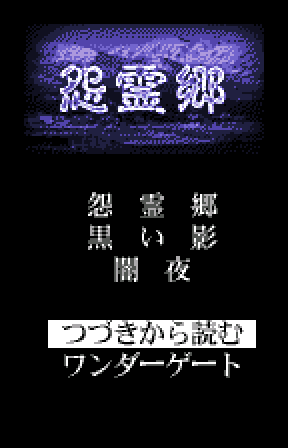
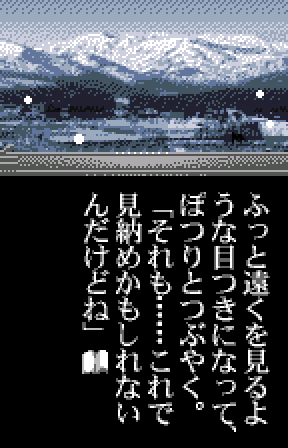
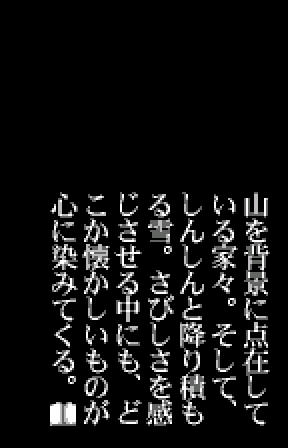
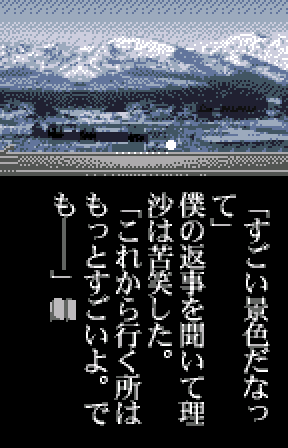
Onryōkyō takes four university students, two young men and two young women, on a winter trip to a remote village in the snow. There they are drawn into the grudge of the people who died in an incident in the village fifty years earlier. It plays out as a murder story among a small group of friends far from home.
Kuroi Kage centres on a high-school girl who is one of the three members of an idol group. Someone is stalking her: photographs of her taken in secret, pictures of the inside of her room, a bug planted in her home. Her troubles become tangled with an urban legend about a mysterious man called X and an idol who took her own life.
Yamiyo begins with news that the heroine’s grandfather has died. She starts to see the ghosts of him and his old friends, and the story leads her back into his past and an old tale of a strange disease.
The bonus story, X Night, is set on Christmas Eve in a dormitory, where three girls decide to test the dorm’s ghost stories for themselves: a room where screams are heard, a lift said to lead to another dimension, and the roof.
How it plays
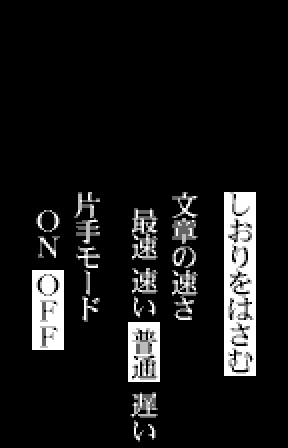
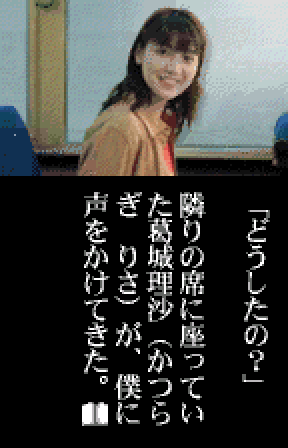
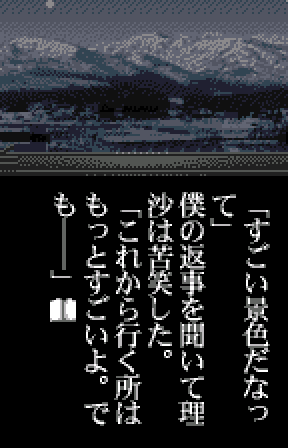
The WonderSwan is held upright, with a picture in the top third of the screen and the text below it. The game runs on the original black-and-white WonderSwan as well as on the Color. A few pictures, mostly at the start of a story, are full-colour photographs; most scenes use dithered images, and landscape pictures are only 144 by 88 pixels. The whole game can be played with the Y buttons alone, holding the console in one hand.
The three main scenarios are open from the start and can be played in any order. Choices offer two or three options, and some of them have a time limit, so hesitating is itself a decision. Terror points return from the first game and show on screen as a red, wavy effect when a frightening option comes up. Out of sight, the game also tracks how much other characters like the hero and how frightened the hero is, and these hidden values decide which routes open.
Each scenario has up to nine endings, a mix of good and bad ones with a single best ending, and happy endings are hard to reach. A wrong choice near the end can still send a story to a bad ending. When a story is replayed, the game does not mark choices already taken, and there is no skip or auto mode for text already read.
A scenario takes about two to three hours to play through. The game can be saved at any point to a single save slot. After all three scenarios have been cleared and the game saved, X Night opens as a short bonus scenario; a good ending in each story is not needed to unlock it.
The WonderGate link is optional and needs a mobile phone with online access. In practice it changes only Kuroi Kage: with the adapter connected between six in the morning and six in the evening, the story’s default night-time setting is replaced by daytime, which alters some of the text. The sound is in stereo, voices are kept to screams and groans, and through headphones on the Color the sound is fuller than on the original console.
Development and release
Terrors 2 was developed by Megas Entertainment Station, a small Tokyo studio founded in June 1998 that counted all three Novel Theater games, Terrors, Ring Infinity and Terrors 2, as its own work. Megas presented the game, then due in the winter of 2000, as a fiercer return of the first Terrors, with three longer stories in which some choices could cost a character’s life, and said that it inherited the graphics and sound know-how built up on Ring Infinity and, like that game, supported the WonderGate. Bandai published it.
The five leading women are Risa Goto, Kaori Manabe, Erika Yamakawa, Nami Ichinohe and Mayumi Uehara, and the further cast includes Wakana Sakai, Rio Hirai and the actor Rikiya Yasuoka. The game came on a 32-megabit cartridge with 16 kilobits of EEPROM, played upright, with stereo sound, no link-cable play and a price of 3,980 yen before tax. The box notes that the WonderGate feature needs a mobile phone with online access.
Reception
Players who had been hard on the first Terrors found the sequel a clear step forward. The smaller number of stories was welcomed as more substantial than the five thin ones before, the endings were felt to leave an aftertaste that invites replaying, and players were relieved that the voices were now kept to screams and groans rather than the full spoken lines of the first game, which had seemed to turn its horror into a school play. On the Color the photographs look good for so few colours, though some preferred the black-and-white screens as scarier, and through headphones the sound is noticeably fuller on the Color than on the original console. The lack of a fast-forward or skip function was missed, but the game can be played with the Y buttons alone in one hand, which made it a well-liked companion for a journey.
Ports and other versions
Terrors 2 was made for the WonderSwan Color and was never ported to another system or re-released; Megas presented all three Novel Theater games purely as WonderSwan software. Its relatives are the other two Novel Theater games on the same console, the black-and-white Terrors of 1999 and Ring Infinity of 2000. It differs from the first Terrors in having fewer but much longer stories, colour photographs, voices cut down to screams and groans, a new branch driven by the hero’s feelings and, like Ring Infinity, WonderGate support that ties the story to the real time of day.
Notes
Bandai’s catalogue page for the game misspelled the first game’s title as TERROS in its headline, and Megas’s page made the same slip. The first Terrors had been sold with a limited first edition, but Terrors 2 had no special edition.