
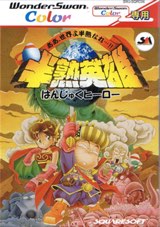
A WonderSwan Color version of Square's 1992 Super Famicom comedy strategy game, in which generals take castles and hatch Egg Monsters to fight for them.
Screenshots
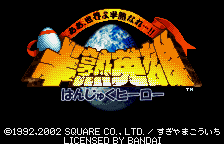
Title screen 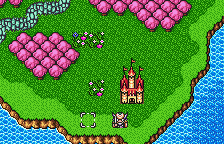
In play 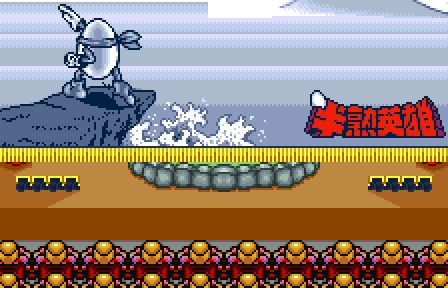


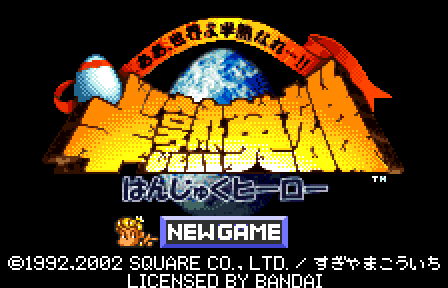
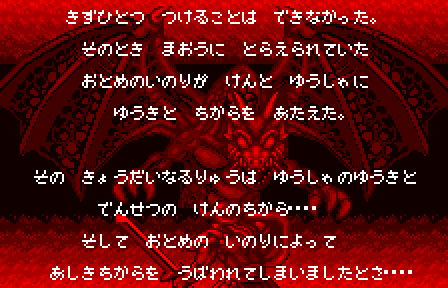
Hanjuku Hero: Aa, Sekai yo Hanjuku Nare…!! is the second game in Square’s Hanjuku Hero series, first released on the Super Famicom in December 1992. Square brought it to the WonderSwan Color on 14 February 2002 as one of its “Square Masterpiece” releases. The series began on the Famicom in 1988 and is known for mixing a real-time war game with a great deal of slapstick humour and parody.
The player rules a small kingdom from its home castle and sends generals across a field map to capture enemy castles, stopping once a month to manage the army. Troops clash in real time, but a general can crack open an egg to summon an Egg Monster, and the fight then turns into a turn-based battle. The game is lighter in difficulty than the first, with the jokes pushed to the front.
The WonderSwan Color edition adds twelve new Egg Monsters chosen from designs sent in by the public, among other changes from the original. The cartridge is a Color-only game that does not run on the original black-and-white WonderSwan.
The story
The game is set in the kingdom of Almamoon. In the first game its prince pacified the whole land with the power of a mysterious egg handed down in his family, and he has since married Princess Iris. Peace has not been good for him. He still keeps up his sword practice, but the rest of his life has gone soft: he behaves like a small child, cannot write his own name and has his minister read him picture books at bedtime.
The kingdom is falling apart around him. Iris has lost patience and left, the minister has taken over the running of the country and is struggling with a budget deep in the red, and behind all this a new enemy is closing in. They are the Kanjuku, the fully cooked ones, a pun set against the half-boiled hero, and they carry a black egg of their own. Their vanguard, the Kanjuku Queen, has already won castles over to her side, and the lord has to take them back before he can go after the Kanjuku army’s leaders.
The cast around him is as silly as he is. The minister Sebastian plays the straight man to the lord’s foolishness. Three generals serve from the start, Zeus, Venus and Kokotto, and more come and go as the war goes on. Egg Man has a strong sense of justice and is the weakest fighter in the game, and he is what hatches when a general uses up an egg. Lampkin refills eggs for a fee, a woman who calls herself Atashi mends broken ones, and the composer Koichi Sugiyama turns up in person to run the sound test.
The war is told in twelve chapters, each on its own field map with a melodramatic title, the first being “Black Eggs Have a Dangerous Scent”. Each chapter ends when the player takes the castle of its boss, which only appears once the other castles have fallen; in the first it is the Tower of Thorns. The humour is slapstick and parody, much of it aimed at Final Fantasy: one group of enemies spoofs the four fiends of Final Fantasy IV, and one Egg Monster is a castle mage modelled on the white mage. Most of the jokes about other companies’ games were cut from this version.
How it plays
The field map runs in real time, with the months ticking by on a clock whose speed is set in the options. The player points a general at a destination and he marches there in a straight line, entering any cave or other place on his path. Each chapter starts with the lord and three vanguard generals at the home castle, and each month three more generals arrive, taken in order from the list of those who have not yet joined. Capturing every enemy castle brings out the boss’s castle, and beating the boss clears the chapter. If the lord himself is defeated the game is over, with no continue.
At the start of each month the game pauses for the monthly commands. A merchant sells trump cards; an audition offers three candidate generals, one of whom can be hired for 50 gold, up to 32 in all; soldiers cost 1 gold each, up to 999; a general can be dismissed when money runs short; one level can be built onto each castle per month, up to level 5; and Lampkin restores a general’s egg for 50 gold. The treasury starts at 100 gold and is filled by the income of the castles held. Random events come before the commands, among them harvests that change the income, a wandering swordsman’s challenge, and the risk of a general rising in revolt and duelling the lord, where losing ends the game.
A battle starts when a general touches an enemy, attacks a castle or is attacked in his own. Each side’s soldiers, ten hit points apiece, push against each other, and pushing the enemy into the edge of the screen does extra damage. On the Super Famicom the player hammered a button to push harder; on the WonderSwan Color the button is held down instead. A menu lets the general use his egg, play a trump card or retreat, which halves his hit points and soldiers and is not allowed when defending a castle. A castle’s level strengthens its defenders, and a general defending without an egg can try a secret move, picked at random and sometimes one that backfires.
Cracking an egg brings out an Egg Monster, and the battle becomes a turn-based fight in which both sides choose commands each turn. There are several kinds of egg, among them Colorful, Evil, Super, Slot, Mimic and the renamed Nandaa Egg, plus single-use eggs that give a strong monster once and then break. A normal egg has four uses and can hold five. Which monster hatches depends on the uses left and on the half-boiled level, an experience score that rises with battles and events, adjusted by each general’s own bonus; with no uses left, Egg Man hatches instead. Trump cards are single-use items, from cards that destroy enemy eggs to the sword Balmung, which a December visit from Santa can bring.
Away from the castles there is more to find. Generals sent into caves meet random events at the start of each month: they may get lost, die, fight a treasure chest that is really a monster, or come back with money, cards or a merchant. Hot springs heal a general or raise the half-boiled value, Atashi’s house repairs broken eggs for the price of a gift, and buying a beauty a house is worth a large jump in the half-boiled value.
The advice players pass on is mostly about using the system. Hire generals early in each chapter, since only four are on hand at the start, and hire the strong ones, because generals left unhired can turn up on the enemy’s side. Generals the player does not need are good for exploring caves, and for wearing down a boss, whose hit points come back each time a general retreats from it but not when one is beaten. A popular way to build money is to take every castle except the boss’s and let the months pass while the income comes in, as clearing late carries no penalty. The half-boiled level makes monsters stronger only up to level 15; at level 16 only Carry Egg hatches and at 17 only Lampkin, and since the level never drops, players retreat now and then to keep the half-boiled value from pushing it past 15. The last chapter branches, so keeping a separate save before it lets a player see more than one ending. This version is easier than the Super Famicom game in one respect, as bosses can now be hit by status effects.
Development and release
Square announced the WonderSwan Color version on 26 September 2001, as one of the first two titles in its new Square Masterpiece line of remakes, alongside Romancing SaGa. Four titles were planned at the time, the other two being Dice de Chocobo and Makai Toushi SaGa, and this one was given a provisional price of 5,200 yen and a December release. The game slipped into the new year and came out on 14 February 2002 at that price; Dice de Chocobo never appeared on the system. The announcement said the controls had been improved and that the new Egg Monsters had been gathered from the public through Square’s PlayOnline.com service. The actor Taichiro Hirokawa worked on a television commercial for this version. The studio that carried out the conversion is unknown.
Modes and features
The most noticeable change is the hold-down button in the duels between generals. There are five save slots instead of three, story scenes can be fast-forwarded, and a bonus gallery after the ending lets the player browse the Egg Monsters and generals and listen to the music and sound effects. The composer Koichi Sugiyama still appears in the game to run the sound test, and in this version all 42 tracks and voices can be played from the start, where the Super Famicom version held some back until the game had been cleared.
The twelve added Egg Monsters include Popinko, Kami, a paper monster armed with a chainsaw, and Bahamucho!. Several jokes that leaned on outside references were rewritten. The Wonder Egg became the Nandaa Egg, and trump cards that parodied well-known figures were renamed: Ittetsun became Chabudain, Karugenjii became Roller Attack and Korobo Gundan became Minimum Gundan. Some monsters were renamed too, among them Kuchibiru Knight, which became Lip Knight. The screen flashes in two of the monsters’ attacks were toned down, and the sea in the first five chapters is drawn calm rather than with rolling waves.
Ports and other versions
The game first came out on the Super Famicom on 19 December 1992, and this cartridge is a conversion of it made nearly ten years later. The WonderSwan Color version is a graphical overhaul with added Egg Monsters, in which many of the original’s parodies were swapped out and several trump cards and monsters renamed; the changes to duels, saving, the bonus gallery and the jokes are set out under Modes and features. The music was rearranged for the handheld’s sound chip and is of lower quality than on the Super Famicom.
Square Enix came back to the game in 2017 with a remake for iOS and Android, released on 19 October. In an interview with the Japanese site Inside, its makers described it as built on the Super Famicom version, with controls redesigned for touch screens, a harder mode and optional paid items, and said that eight Egg Monsters were picked from a new public contest. The remake also has extra stages, an encyclopedia mode and guest monsters from Sega games; the twelve monsters added for the WonderSwan Color are absent from the app, which also restores the name Wonder Egg. Some names first changed on the WonderSwan Color, such as Lip Knight, were kept in the series’ later games.
The smartphone remake is regarded as the complete version, with new graphics and extra content, but its touch controls are widely found hard going, and players reviewing the app on the Japanese App Store complained about them.
Notes
The game has small oddities that look like bugs. A newly hired general’s wages are not taken from the treasury when he joins, yet are still paid back when he is dismissed, and troop counts of 1,000 or more are shown as 999. The boss battles are somewhat easier because bosses can now be hit by status effects. The game is one of the titles made only for the WonderSwan Color.