
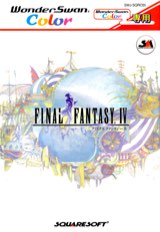
A WonderSwan Color port of Square's Super Famicom role-playing game, with renewed graphics, rearranged music and a dash added.
Screenshots
Title screen 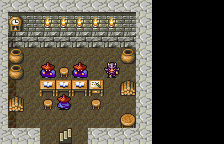
In play 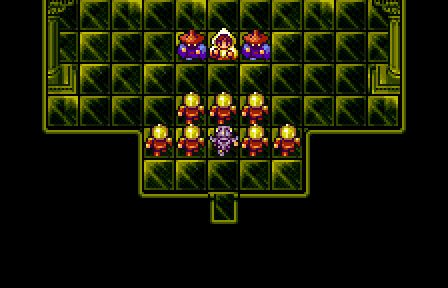
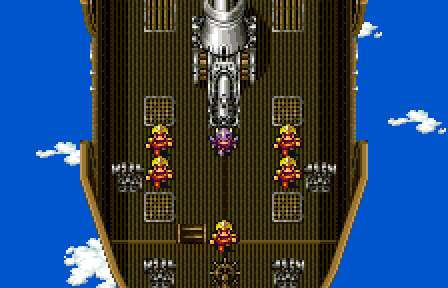
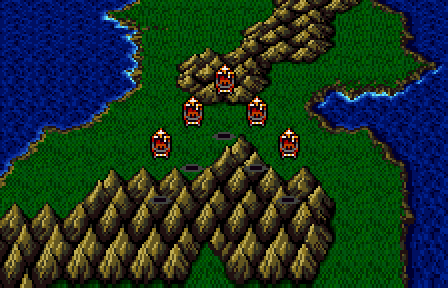
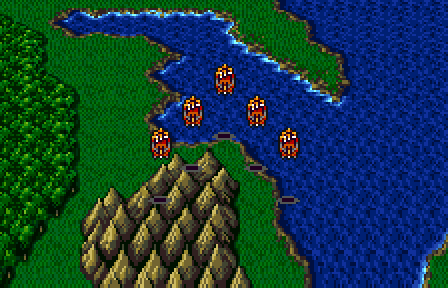
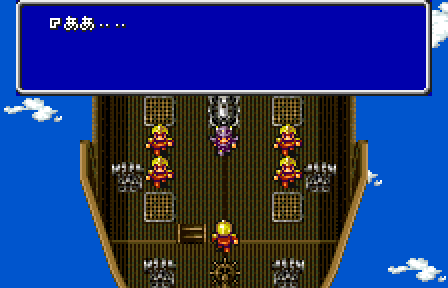
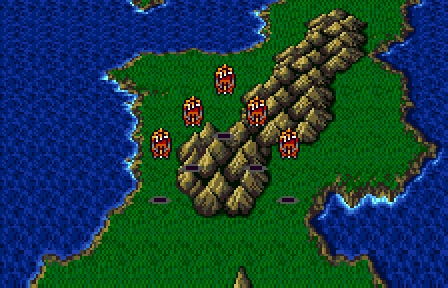
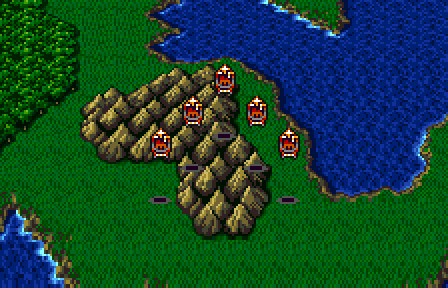
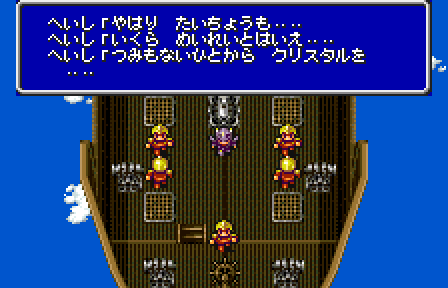
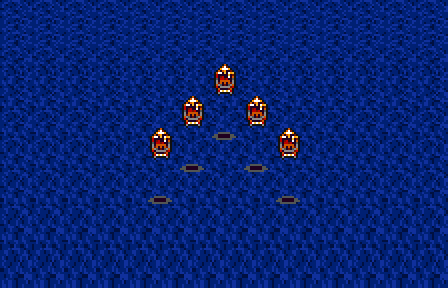
Final Fantasy IV for the WonderSwan Color is a port of the fourth game in Square’s Final Fantasy series, which first came out on the Super Famicom. It was released on 28 March 2002, almost a year after the WonderSwan Color version of Final Fantasy II, and was the fourth title in Square’s Square Masterpiece line. Square published it, and Sting developed the port. The story follows Cecil, a dark knight of the kingdom of Baron, and the game keeps the Active Time Battle system of the original.
Unlike the WonderSwan Color versions of the first two Final Fantasy games, this is a port rather than a remake. The graphics were redrawn while staying close to the look of the original, the music was arranged for the WonderSwan Color’s different sound hardware, and a dash was added so that the player can move at double speed in towns and dungeons.
The handheld has no hardware for scaling and rotating the background, which the Super Famicom used to make the map below the airship zoom so that the ship seems to float above it. The port imitates the effect in software, enlarging the background by changing its vertical scroll from line to line.
The story
The kingdom of Baron has the strongest army in the world, and its pride is the Red Wings, a fleet of airships. Their captain is Cecil, an orphan raised under the king’s protection who became a dark knight. The game opens as the Red Wings fly home from the town of Mysidia with its Water Crystal, taken by force from people who did not fight back. Cecil is troubled by what his men have done and by the change in a king who used to be gentle, and when he asks the king what the crystal is for, he is stripped of his command.
As punishment Cecil is sent with his closest friend Kain, captain of the dragoons, to slay a monster that haunts the area around the village of Mist and to deliver a ring to the village. The errand turns out to be a trap set by the king, and the village is engulfed in fire. Cecil takes with him a girl from Mist, Rydia, a young summoner who can call up monsters, and in the chaos he and Kain are separated.
Cecil awakes in the desert village of Kaipo and learns that Rosa, a white mage of Baron who loves him, has followed him and fallen ill with a fever. The search for a cure brings in Tellah, an old sage on his way to Damcyan Castle in search of his daughter, and the prince of Damcyan, Edward, a bard. A dark figure named Golbez now commands the Red Wings, and Baron’s airships are attacking kingdom after kingdom to seize their crystals. Cecil turns against the country he served and sets out to stop it.
The story is told in a long chain of events across the surface world and beyond, with characters joining and leaving the party as it unfolds, and a central theme is Cecil’s struggle to leave the darkness of his past behind. Twelve characters can be played over the course of the game, among them the monk Yang of Fabul and the twin mages Palom and Porom of Mysidia, each with a fixed role in battle.
How it plays
The game is played with the WonderSwan held horizontally. The party walks a world map between towns, castles and dungeons, fights monsters in random battles, rests at inns, buys weapons, armour and items in shops and picks up clues about where to go next. A dash added in this version lets the party move at double speed in towns and dungeons. Besides saving on the world map, the party can save at save points inside dungeons, where tents and cottages can also be used to restore HP and MP.
Battles use the Active Time Battle system, which this game introduced to the series. Every character and monster has a waiting time that counts down in real time, and when it runs out that character can be given a command, which is carried out after a further delay. Time keeps running while the player chooses, so enemies act in the meantime, but a Wait setting stops the clock while a spell or item is being picked. Speed and the party’s formation affect the order of turns, strong spells take longer to come out, and some monsters strike back when hit or change form as time passes.
The party holds up to five characters, more than any earlier Final Fantasy, set out as one row of three and one of two, and the player chooses which row stands at the front. Each character has a fixed class with its own command: Cecil’s Darkness hits all enemies at a cost in his own HP, Kain can Jump out of reach and come down on a monster, Rydia summons and others cast white or black magic or ninjutsu. Party members come and go with the story, and characters who will rejoin still earn experience while they are away, so they do not fall behind.
Characters gain levels through experience, and spells are not bought in shops: each magic user learns them at set levels or in story events. Each spell costs a fixed amount of MP, which is restored with items such as Ethers or a night at an inn. Every character has a dominant hand, which decides where weapons and shields go: characters who use both hands equally carry a weapon in each, and a bow works properly only with the arrows in the dominant hand. Running from a battle can cost a quarter of the money the enemies would have dropped, a few hidden summons and pieces of equipment are very rare drops from particular monsters, and a man called Namingway can rename the characters.
This version is close to the PlayStation port of 1997 without its computer-generated films. The screen is smaller and the music and sound effects were down-sampled and rearranged for the handheld. The sprites and backgrounds were redrawn with more detail and shading, the menu portraits were replaced with new, smaller ones, and some bosses use the sprites of the Super Famicom Easy Type edition. The balance was also adjusted, though exactly how it differs from both earlier editions is not well documented.
Development and release
The port was made by Sting, a developer that also made Wizardry and Riviera for the WonderSwan. Square announced the release in March 2002 at a price of 5,200 yen, and the news reports singled out the airship scenes, with their sense of depth, as the part worth seeing. Square Masterpiece was Square’s label for bringing its older games to the WonderSwan Color, and players who pre-ordered this game got a soft carrying pouch printed with the label’s logo while stocks lasted.
Reception
It sold about 64,000 copies, thirteenth among WonderSwan games, a modest figure put down to the rise of the Game Boy Advance and the decline of the WonderSwan by 2002. It is an easily overlooked version next to the game’s many other releases, since it adds nothing to the original, and its music is felt to sound thin on the handheld’s sound chip.
Ports and other versions
Final Fantasy IV first came out on the Super Famicom on 19 July 1991, followed that October by an Easy Type edition with simpler commands, and in North America it was sold that year as Final Fantasy II. Its first port was for the PlayStation, as a single disc in 1997 and in the Final Fantasy Collection of 1999, and it is almost identical to the Super Famicom game apart from computer-generated films at the start and end, a quick save and a dash. That port reached English-speaking players in Final Fantasy Chronicles in 2001 and, in Europe, Final Fantasy Anthology in 2002. The WonderSwan Color version changes little from the PlayStation one beyond its more detailed and shaded sprites and backgrounds.
The WonderSwan Color graphics were the starting point for Tose’s Final Fantasy IV Advance on the Game Boy Advance in 2005, which refined them further and went well beyond this port in content, with redrawn portraits, two new dungeons and a free choice of party for the final dungeon. A full 3D remake for the Nintendo DS followed in 2007 with voiced scenes and new abilities, and was later carried to iOS in 2012, Android in 2013 and Windows in 2014. Japanese mobile phones received a version in 2009 and 2010 built on the Game Boy Advance content, and the PSP’s Complete Collection of 2011 redrew the 2D graphics again and added the sequel The After Years and a new story linking the two. The Pixel Remaster came out for Windows, iOS and Android in 2021 and for the Nintendo Switch and PlayStation 4 in 2023, and for the Xbox Series X and S in 2024.
Older versions have also been sold as downloads. The Super Famicom game came to the Virtual Console on the Wii in 2009, the Wii U in 2014 and the New Nintendo 3DS in 2017, the Game Boy Advance version to the Wii U in 2016, and the PlayStation version to the PlayStation 3 and PSP through Game Archives in 2012.
Notes
The port was aimed at faithfulness rather than additions, and many bugs of the Super Famicom original were fixed. It brought new ones of its own: Cecil’s automatic cover for weakened allies already triggers while he is still a dark knight, and weapons meant for the back row do not work as they should, a fault later carried into the Game Boy Advance version. Some other bugs are also shared between the two versions. The airship view looks more like a stretching of the top and bottom of the screen than a true zoom.