
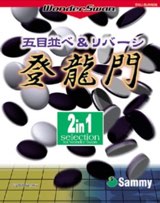
Sammy's WonderSwan pairing of gomoku, with renju rules and 24 openings, and reversi, each with a nine-opponent knockout ladder, free play and link-cable matches.
Screenshots
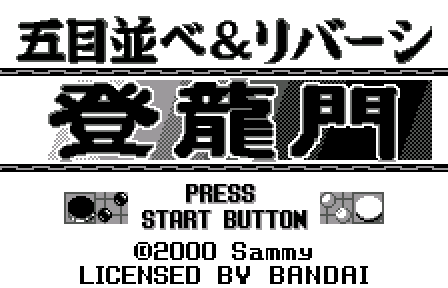
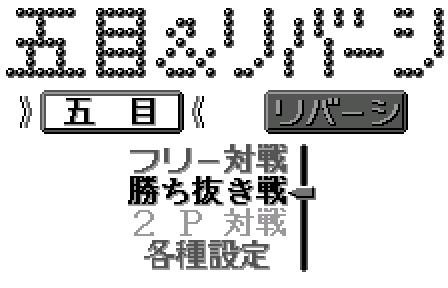
Title screen 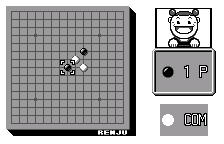
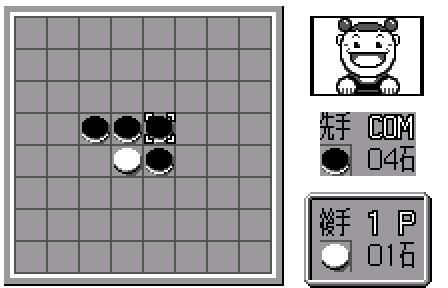
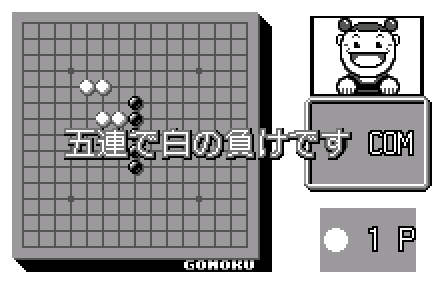
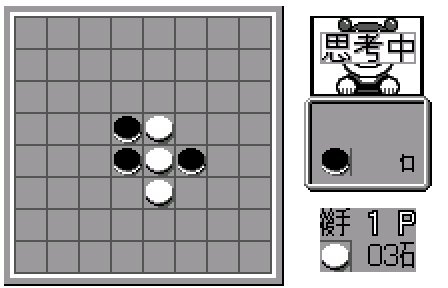
In play 
Gomoku Narabe & Reversi: Touryuumon is a board game collection for the original WonderSwan, made and published by Sammy and released on 13 January 2000. It was the third WonderSwan title in Sammy’s Touryuumon line, following Mahjong Touryuumon in March 1999 and Shogi Touryuumon in October 1999. Each game in the line is built around classic tabletop games.
This cartridge holds two of them. Gomoku Narabe is the game of lining up five stones in a row, played here on a 14 by 14 grid, and Reversi, the game also known as Othello, uses the usual 8 by 8 board where discs are flipped by trapping them between the player’s own.
Each game can be played against the computer, either up a ladder of nine opponents or in free play at a chosen strength, or against a friend on two consoles joined by the link cable.
The story
The cartridge has no story. What frames it is the knockout mode, in which the player works up a ladder of nine computer opponents, one at a time, and beating the last of them brings the game’s ending. Every opponent who has been beaten is crossed off on the ladder screen, so the run reads as a climb through a line-up of challengers.
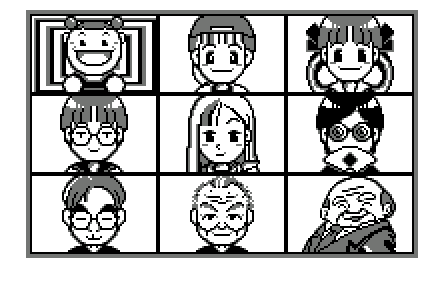
The opponents have faces but, in the manual at least, no names. They come in three ranks of three. The beginners are a grinning, round-faced cartoon figure and two youngsters; the intermediate players are a man in glasses, a long-haired young woman and an odd character with spiral glasses and a beard; the advanced players are a serious man in glasses and two elderly men, the last of them bald and smiling. Whichever mode is being played, the opponent’s portrait sits beside the board for the whole game.
The rest of the presentation is plain and board-like. The manual introduces the two games with a line of history each: gomoku is simple enough for anyone, and its offshoot renju is deep enough to have world championships, while reversi was invented in England about two hundred years ago and reached Japan in the Meiji era. The cartridge was sold as a two-in-one selection for the WonderSwan, and its cover shows nothing but black and white stones.
How it plays
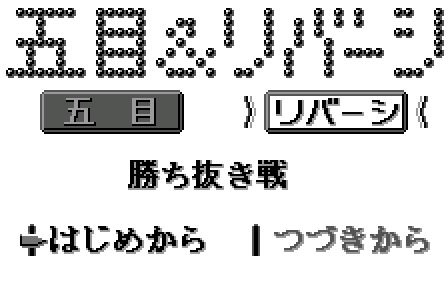
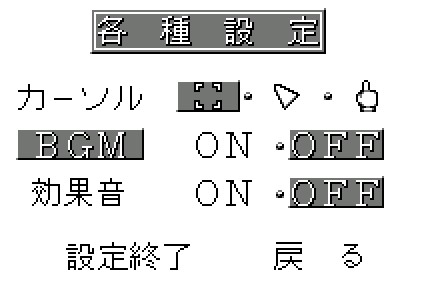
The WonderSwan is held horizontally. The X buttons move the cursor, A confirms and moves on to the next screen, and B cancels and goes back. Start opens a menu during a game, the Sound button sets the speaker volume to one of three levels, and the Y buttons are not used. On the game menu, left and right on the X buttons choose between gomoku and reversi, and up and down choose free play, the knockout mode or two-player play. A settings entry changes the shape of the cursor and turns the music and sound effects on or off.
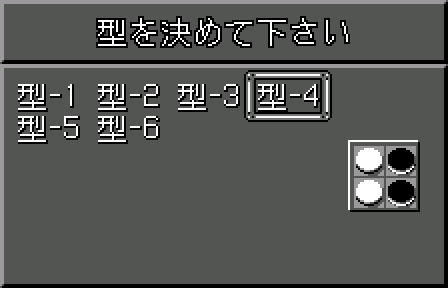
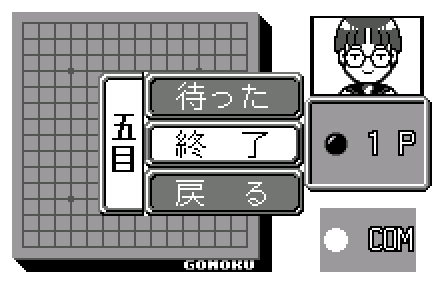
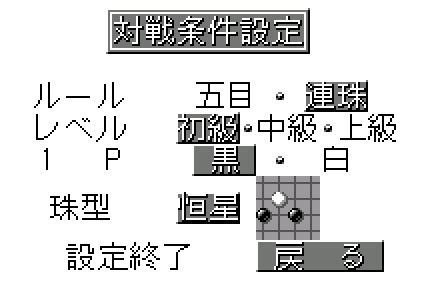
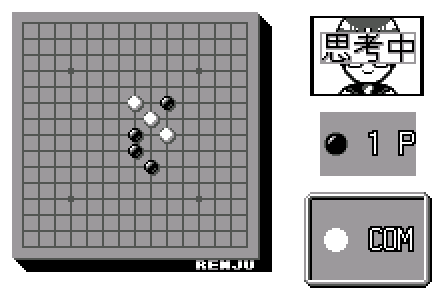
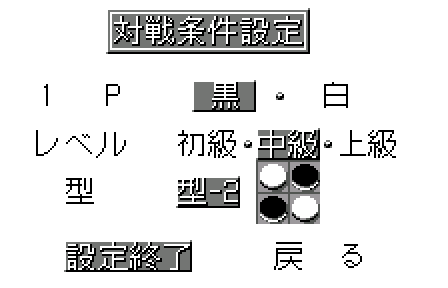
Games against the computer start from a setup screen. The computer’s strength is set to beginner, intermediate or advanced, and the player picks black or white; black always moves first. Gomoku adds the choice of rules, and reversi a choice of starting position. While the computer thinks, the word for thinking flashes on screen, and its last stone keeps blinking until the player presses a button. The in-game menu offers a take-back that removes the last two moves and returns to the player’s previous turn, a quit option that ends the game and discards it, and a way back to the board. Take-backs are allowed only in free play.
Gomoku is won by making a line of five in any direction, across, down or diagonally, and a full board with no line is a draw. Under the plain gomoku rules of this cartridge both sides are barred from three forbidden moves: making two open threes at once, making two fours at once, and making a line of six or more. Playing one loses on the spot, even when it is the only way to block the opponent’s five. Under renju only black, the first player, has forbidden moves, and a line of six or more counts as a win for white. Renju also fixes the opening: when the player takes white, they set the first three stones from 24 named standard openings, twelve of the direct kind and twelve of the indirect kind, with a preview of each. Renju exists because in plain gomoku the first player has a strong advantage, and these extra rules even it out.
The manual’s advice for gomoku is to build several open threes, since a three becomes a four with one more stone, and to aim for winning shapes such as a four and a three made with the same stone. It also tells the player to learn the forbidden moves so as never to be caught by them, and to play so that the opponent is pushed into one. In renju, where white has no forbidden moves, the gap between first and second player largely disappears.
Reversi is played on an 8 by 8 board with black moving first. A disc placed so that it traps a line of the opponent’s discs, in any direction, turns them all over, and a player with no such move must pass but may not pass otherwise. The game ends when one side has no discs left or the board is full, and the side with more discs wins; the panel beside the board keeps a running count for each side. The manual’s tips are the classic ones: take the corners and edges, which can turn many discs at once and swing the endgame, and plan towards the corners rather than chasing the most discs on each move.
The knockout mode sets the nine opponents in order from weakest to strongest, picked automatically, with no take-backs. Each win is saved on the cartridge, and an autosave keeps the game in progress too, so the power can be switched off at any point and the game resumed from just before. Choosing to start afresh while a save exists erases it.
Two-player play needs two WonderSwans, two copies of the cartridge and a link cable, which Sammy also sold for 1,450 yen before tax; the consoles are connected before they are switched on. Only one console is used until the game begins, and the player who chose two-player play sets the rules. The controls and rules are the same as against the computer, but link games are not saved.
Development and release
Bandai introduced the cartridge as the next Touryuumon game after Shogi Touryuumon and called it the series’ second, even though Mahjong Touryuumon, also a Sammy game, had come out in March 1999. It coyly described reversi as a certain famous game played with discs that are black on one side and white on the other, rather than naming Othello. It sold at a planned price of 3,800 yen before tax, on a 4-megabit cartridge with 256 kilobits of SRAM, played with the console held horizontally and with stereo sound.
Modes and features
Each of the two games offers the same three modes: a knockout run against nine opponents in turn, free play at a difficulty of the player’s choosing, and link-cable matches. Gomoku can be played under ordinary five-in-a-row rules or under renju, the competition form of the game, with 24 standard openings, and an automatic save lets a game be stopped at any point and picked up later.
Reception
The two games look alike at first sight but play very differently, and gomoku has a good many detailed rules.
Ports and other versions
Touryuumon’s gomoku and reversi collection was made for the WonderSwan and was never ported, remade or re-released on another system. Its closest relatives are its two companions in Sammy’s Touryuumon line on the same console, the mahjong and shogi cartridges of 1999. It stands apart from them by pairing two quick games on one cartridge, with renju rules and standard openings for the more serious gomoku player.