
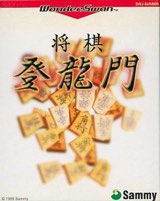
Four-player mahjong from Sammy with twelve rule settings, a tournament circuit, eight computer opponents and link-cable play, out a week after the WonderSwan launched.
Screenshots
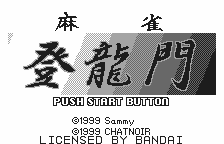
Title screen 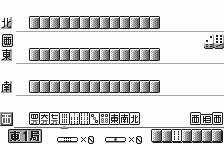
In play 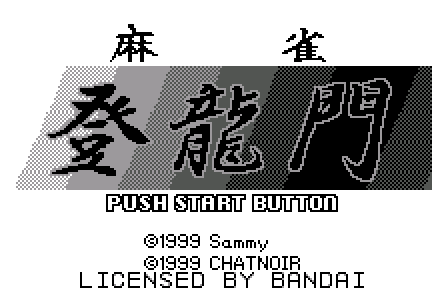
Mahjong Touryuumon is a mahjong game for the original WonderSwan, published by Sammy on 11 March 1999, one week after the console went on sale in Japan. That made it one of the first games on the system. It was made by Chatnoir, a Japanese studio whose work centred on mahjong games. The title was the first of three Touryuumon releases from Sammy on the WonderSwan; Shogi Touryuumon followed in October 1999 and Gomoku Narabe & Reversi Touryuumon in January 2000.
The game is aimed at everyone from newcomers to experienced players. Twelve of its rules can be set to suit the player, and the computer side is made up of eight regular opponents, each with a personality and a way of playing of their own, with further hidden opponents unlocked through play. Two WonderSwans joined by the link cable can also play against each other, so two people can sit at the same table rather than only facing the computer.
The story
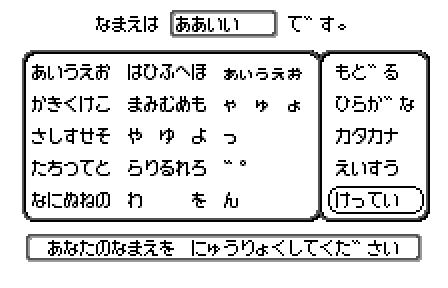
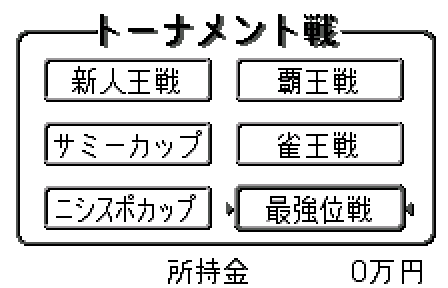
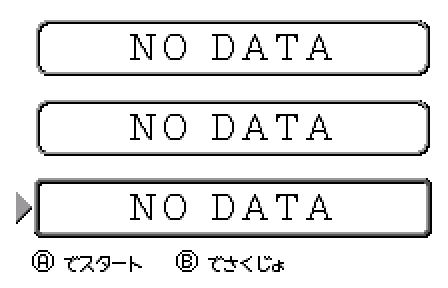
Mahjong Touryuumon has no story. It is a straight game of four-player mahjong, and the only framing is a small career for the player. At the start the player opens one of three save files and enters a name of up to six characters, and that file then keeps a purse of money, a count of the half-games played and a record of results. The money is earned and spent in the tournament mode, where the player pays to enter events and is paid for finishing high enough, working through six tournaments that include the Saikyoui-sen, a title match for the strongest player.
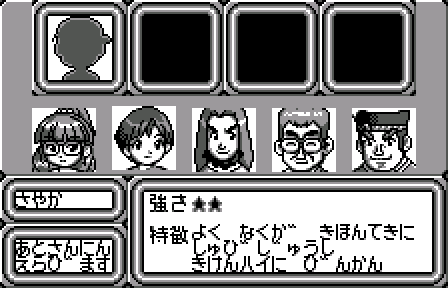
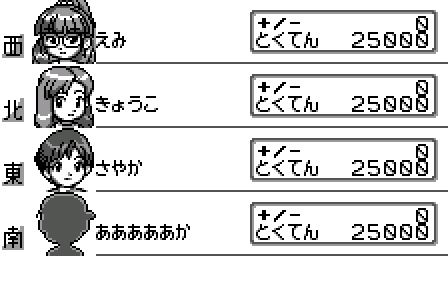
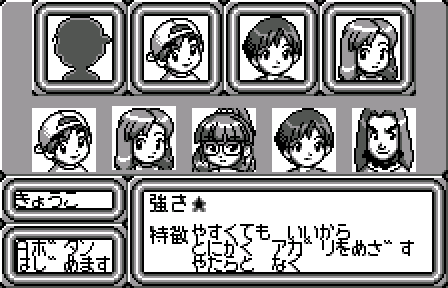
What colour the game has comes from the people across the table. The manual gives each opponent a number, a name, an age, a strength of one to four stars and a short note on how they play, and they are an unlikely crowd for a mahjong game. The first is Yusuke Hirano, an eight-year-old in the third year of primary school who almost never calls a tile and declares riichi the moment he is ready. Kyoko Hirano, an eighteen-year-old university student, will take any win however cheap and calls tiles constantly. Emi Naruse, another eight-year-old, plays a careful game, folds quickly and rarely declares riichi.
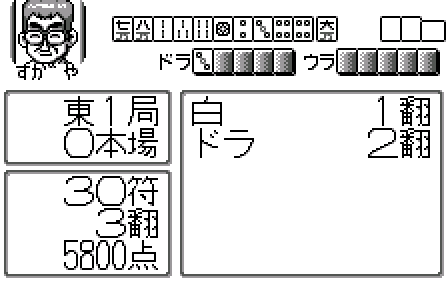
The stronger players are older. Sayaka Hyodo, fifteen and in her first year of high school, calls often but plays mainly in defence, watches for dangerous tiles and seldom deals into another player’s hand. Kenji Hosoda, an eighteen-year-old student, leans on riichi but keeps a balanced game, and Mitsuo Sugaya, fifty years old and the only one rated four stars of the six, also favours riichi, is good at bluffing and at setting trap waits, and is hard to win from. The rest of the cast stay hidden at first, shown as question marks on the opponent list until the player unlocks them.
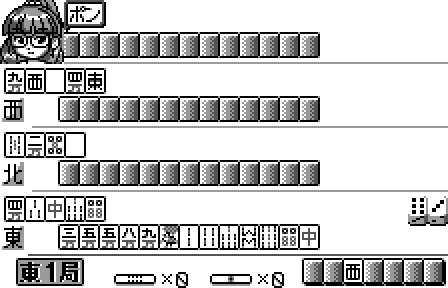
The presentation is plain. The table is drawn in a simple layout that recalls early Famicom mahjong games, much quieter than later mahjong cartridges on the system, with the four discard rows, the player’s hand and the dead wall all on one sideways screen. The sound is in stereo, and three pieces of music can be chosen for play.
How it plays
The WonderSwan is held sideways. In the menus the X buttons move between items, the Y buttons turn pages, A confirms and B cancels, and the Sound button sets the volume in three steps. At the table, X2 and X4 move the cursor along the hand and A discards the chosen tile. X1 and X3 bring up what can be done at that moment, from the count of tiles left in the wall to riichi, a win, or a pon, chi or kan, and A confirms it. When another player discards a tile that can be called or won on, the tile blinks and the game waits, and X3 opens a window in the middle of the screen to choose the call. B and Y3 show every player’s points and name, and after a win Y1 shows the winning hand and Y4 the scoring.
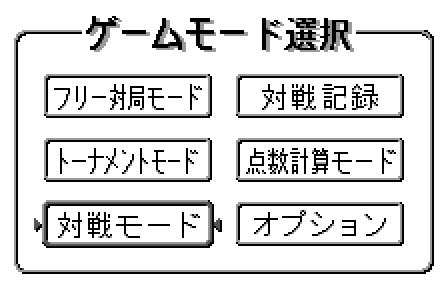
The main menu has six entries: Free Play, Tournament, Link Play, Records, Score Calculation and Options. In Free Play the player picks the rules and then any three opponents from the list, and a half-game of East and South rounds is played, with the seats and the first dealer decided automatically. When it ends, the game returns to the rules screen for another.
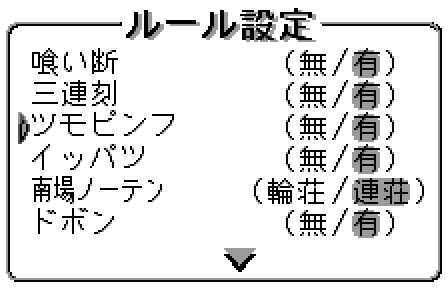
The twelve rules that can be changed, in Free Play, Link Play and Score Calculation, are open tanyao, three consecutive triplets, pinfu on a self-drawn win, ippatsu, whether the dealer keeps the deal when not ready in the South round, ending the game when a player goes below zero, playing on into a West round, a two-han minimum, ura dora, kan ura dora, the uma bonus at the end (none, 5-10, 1-2 or 1-3) and the starting points (25,000 to 30,000). Everything else is fixed: a one-han minimum, a dead wall of fourteen tiles, free swapping of called tiles, liability payments for the big dragon and wind hands, a 1,000-point riichi stake, five kinds of abortive draw, double ron, counted and double yakuman and seven pairs scored at two han and 25 fu, among others. The manual warns that mahjong rules vary by region and the house rules a player knows may differ.
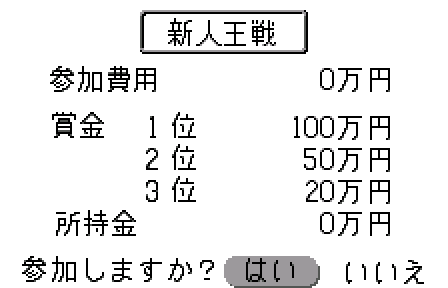
Tournament play uses a fixed set of rules. There are six tournaments, each with an entry fee that comes out of the player’s purse, so a tournament can only be entered with enough money. The three opponents are chosen by the game and differ from one tournament to the next, a set number of half-games is played, and the overall placings decide who wins prize money; the Saikyoui-sen alone pays no prize. Winning a tournament outright adds new characters to the list of opponents that can be chosen in Free Play, which is how the hidden cast is unlocked.
Link Play needs two WonderSwans, two cartridges and the link cable. Each player picks a save file, and whoever chooses Link Play first sets the rules. The two people always sit facing each other, and the other two seats go to computer players who cannot be chosen. After the half-game, both return to the main menu.
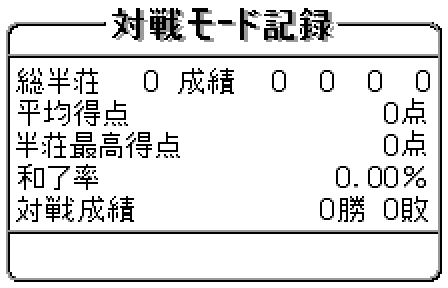
Records keeps statistics for each mode in the save file: the number of half-games, how often the player finished first to fourth, the average score, the best score at the end of a half-game and the rate of winning hands. For Link Play it also keeps the results against each opponent the player has faced and a running total.
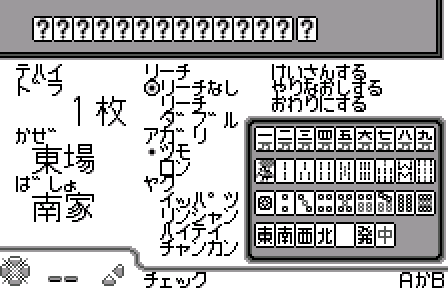
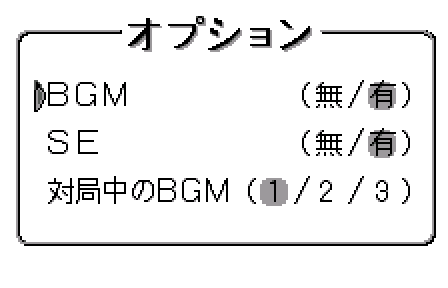
Score Calculation is a separate tool for working out the value of a hand by hand, since the score is calculated automatically during play. The player sets the rules, enters the tiles of the hand from a palette, marks any called sets, and then fills in the round wind, the seat, whether riichi or double riichi was declared, whether the win was self-drawn or on a discard, and special conditions such as ippatsu, a win after a kan or on the last tile; the game then shows the result. Options turn the music and sound effects on or off and pick one of the three tunes for play. The battery-backed memory keeps the save files, and the manual warns that switching the console on and off carelessly can wipe them.
Development and release
The game carries a 1999 copyright line for Chatnoir beside Sammy’s. Chatnoir was founded in July 1983 by Shoji Taguchi and is best known in Japan for its Mahjong Goku series, which began with Professional Mahjong Goku in 1986; it also supplied its mahjong-playing logic to other companies’ games. The cartridge sold for 3,800 yen before tax.
Modes and features
The game is full four-player mahjong, and Bandai presented it as a serious four-handed game brought to a handheld, with four modes of play and twelve rule settings. Each of the eight regular opponents is given particular habits in the way they play, and Bandai promised a large number of further characters hidden behind them. In the link-cable mode two players share one table with two computer players filling the other seats. Beside the playing modes the menu has a page of records, a scoring calculator and sound options. The cartridge has battery-backed memory, and the game has stereo sound.
Ports and other versions
Mahjong Touryuumon was made for the WonderSwan, and Bandai presented it as mahjong arriving on the new console rather than as a game brought over from elsewhere. It was never released on another system or re-released later. Its developer Chatnoir is known for its own Mahjong Goku series on home systems, but this cartridge is not part of that series; among Sammy’s games it belongs only to the small Touryuumon line on the WonderSwan, whose other two entries are shogi and gomoku with reversi rather than mahjong.