
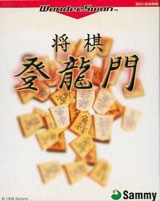
Sammy's beginner-friendly shogi game, with handicap games, a nine-opponent challenge, Hasami Shogi, an eighteen-strategy study mode and link-cable play.
Screenshots
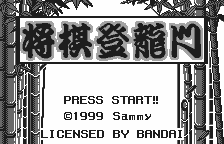
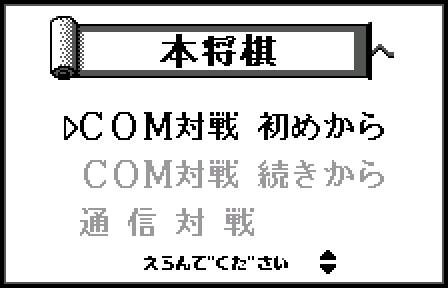
Title screen 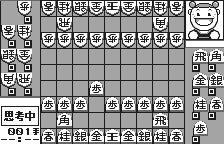
In play 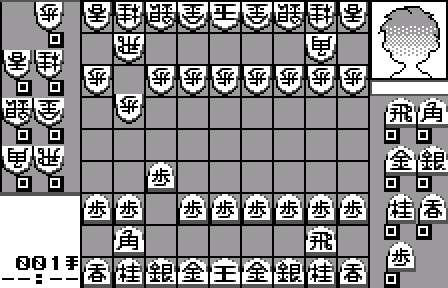
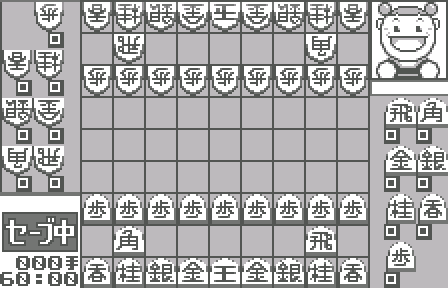

Shogi Touryuumon is a shogi game published by Sammy for the WonderSwan on 28 October 1999. It is the second of three Touryuumon titles Sammy released on the system: Mahjong Touryuumon came out in March 1999, a few days after the console, and Gomoku Narabe & Reversi Touryuumon followed in January 2000. Each of them puts a traditional table game on the handheld.
The cartridge is meant as an introduction to shogi and keeps to the basics. Besides ordinary games under the standard rules it has Kachinuki-sen, a run of matches against a series of opponents, Hasami Shogi, a lighter game played with shogi pieces that suits a few spare minutes, and a study mode that starts play from well-known strategies such as Bougin and Shikenbisha. Because it was made for a handheld, the game saves itself as it goes and can be put down and picked up again later, and two players can play each other over the link cable. Sammy is credited as both developer and publisher.
The story
Shogi Touryuumon has no story. It is a plain shogi program, and what framing it has comes from the opponents and from the Kachinuki-sen mode. The computer player is shown as a character portrait at the top right of the board, and the face changes with the state of the game, with several expressions for when that side is winning or losing.
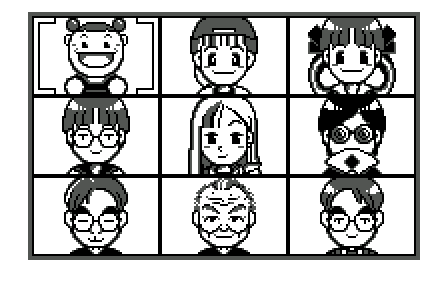
Kachinuki-sen gives the game its only goal. Nine characters of different strength are laid out as portraits in a three-by-three grid, and the player has to beat them one at a time, starting from the weakest. Each one beaten is crossed out on the grid and the progress is saved on the cartridge, and beating the last character brings up the ending. The game gives the nine no background beyond their faces and their strength.
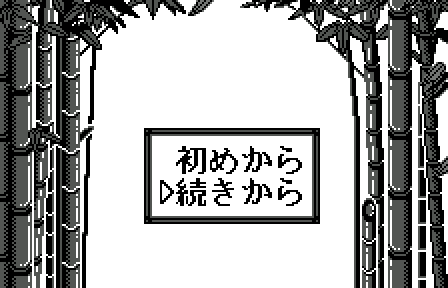
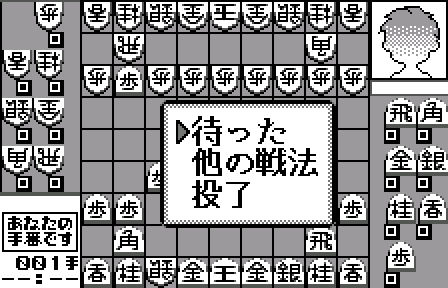
The presentation is spare. The screen for continuing a saved game is framed by a picture of a bamboo grove, and the board takes up most of the sideways screen, drawn simply and easy to read, with the pieces each side has captured always on show in a column beside it. The screen also shows whose move it is, the number of moves played and the time left. Hasami Shogi uses its own simpler board, with pawns on one side and promoted pawns on the other.
How it plays
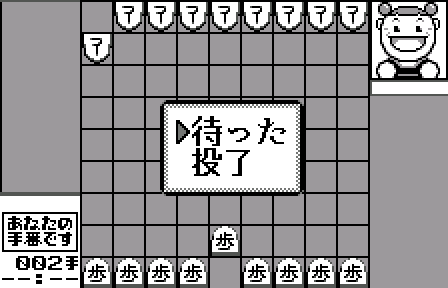
The WonderSwan is held sideways, and only part of it is used. The X buttons move a cursor over the board, A picks up and puts down a piece and confirms menu choices, B cancels, and Start begins a game and opens a menu during play. The Y buttons do nothing, and the Sound button sets the volume in three steps. The cursor turns into a cross when the player tries to move a piece somewhere it cannot go, the piece the opponent has just moved blinks, and while the computer is thinking, or during a link game, the ETC mark below the screen lights up or flashes. When a player is checkmated or resigns, the result appears in the middle of the board.
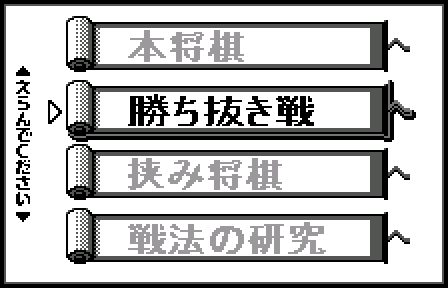
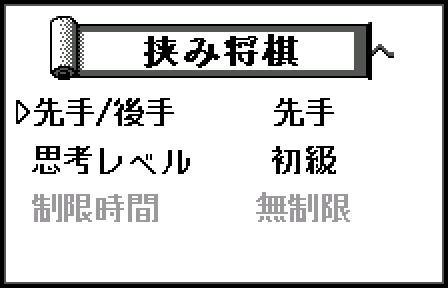
The title screen leads to a choice of four modes: Honshogi (standard shogi), Kachinuki-sen, Hasami Shogi and Senpou no Kenkyuu, the strategy study. Honshogi and Hasami Shogi each offer a new game against the computer, a continued game and a link game. Before a new Honshogi game the player chooses whether to move first or second, a computer strength of beginner, intermediate or advanced, and a handicap. Seven settings run from an even game through lance, bishop and rook handicaps up to a four-piece handicap without the rook, bishop and both lances, and the side that gives the handicap always moves first. A time limit of 30 seconds or one minute a move, 30 minutes or an hour in all, or none can be set only for link games, which have no computer strength to choose.
The in-game menu holds Matta, which takes back the last two moves so the player can try again, and resignation. Matta works in Honshogi and Hasami Shogi, up to five times in a row, or ten moves, but it cannot go back past the point where a resumed game was picked up. The game saves automatically, so it can be switched off at any moment and Continue picks up from the player’s move before the power went off. Starting a new game in a mode erases that mode’s saved game, and so does resigning.
Kachinuki-sen is the hardest test. The nine opponents are faced in order of strength, there is a time limit on the player’s thinking, and neither handicaps nor Matta can be used. The beaten characters stay crossed out between sessions, so the run can be taken in several sittings.
Hasami Shogi is played with a row of pieces each, pawns for the first player and promoted pawns for the second. Every piece moves like a rook, any distance forwards, backwards or sideways, and a piece is captured by trapping it between two enemy pieces from the front and back or from both sides; a piece cannot be taken by boxing it into a corner. The first side to capture five pieces within 500 moves wins. If neither reaches five, the side with more captures wins and an equal count is a draw, and a player left with no piece able to move loses. There are three computer strengths, and two people can play over the link cable.
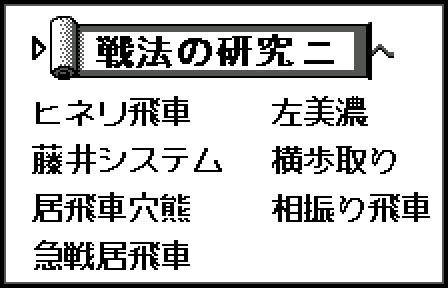
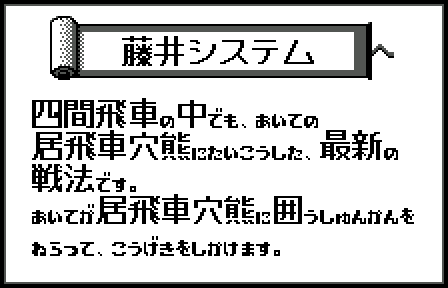
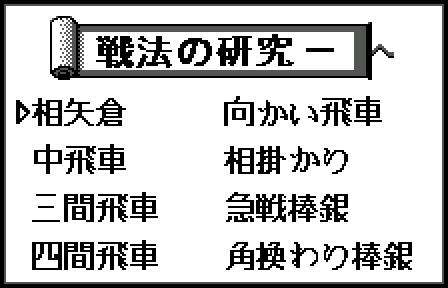
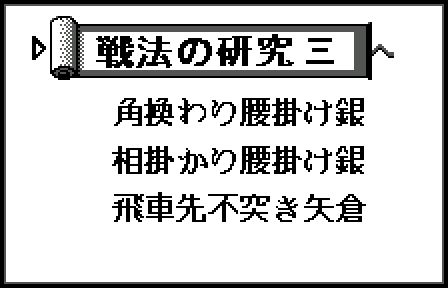
The study mode lists eighteen strategies over three pages. The first holds Ai-Yagura, Nakabisha, Sangenbisha, Shikenbisha, Mukaibisha, Aigakari, quick-attack Bougin and Bougin after a bishop exchange; the second holds Hineri-bisha, the Fujii System, Ibisha Anaguma, quick-attack Ibisha, Hidari-Mino, Yokofudori and Aifuri-bisha; the third holds Koshikake-gin, the sitting silver, after a bishop exchange and in Aigakari, and Yagura without the rook pawn push. Each opens with a short explanation of how the pieces will move, which enemy formations it works against and how it can be varied. The game then plays the moves out on the board, with the sides fixed by the strategy: A steps forward a move and B steps back, and at key points a window explains the move and the shape of the position. From the Start menu the player can switch to another strategy, or join in and take over the position against the computer at a chosen strength, from where the game goes on as in Honshogi.
Link play needs two WonderSwans, two copies of the game and the link cable, and covers Honshogi and Hasami Shogi. Whoever picks the link game first sets the rules, and both return to the main menu when the game is over; the automatic save does not work in link games. If both screens freeze during a link game, the cable has usually come loose, and the fix is to check it and switch both consoles off and on again.
Development and release
Bandai announced the game as the first shogi game for the WonderSwan, at a planned price of 3,800 yen before tax, on a 4-megabit cartridge with 256 kilobits of S-RAM, held sideways and with stereo sound, and stressed that it kept to the basics so that it could also serve as an introduction to shogi. The copyright line names only Sammy and no outside developer is known, though it has never been confirmed that Sammy programmed the game itself. Mahjong Touryuumon, the first game in the series, came out on 11 March 1999.
Reception
The plain, easy-to-read screen is liked, as is the constant display of the pieces each side has captured. Hasami Shogi is seen as an unusual extra and the strategy-study mode as useful, since few shogi programs teach the standard openings. Against that, the computer opponent is thought both slow and weak, the same faults as many earlier shogi games on handhelds.
Ports and other versions
Shogi Touryuumon was made for the WonderSwan, where Bandai announced it as the system’s first shogi game, and it was never ported or re-released on another system. Its relatives are its two WonderSwan stablemates in Sammy’s Touryuumon line, the mahjong game before it and the gomoku and reversi cartridge after it, rather than any game elsewhere. Among the many shogi programs on other handhelds of the time, the cartridge sets itself apart with Hasami Shogi and its mode for studying standard openings, both uncommon features.