
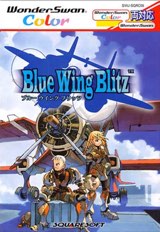
An original turn-based tactics game from Square about squadrons of warplanes, produced by Akitoshi Kawazu and playable on both the WonderSwan Color and the original WonderSwan.
Screenshots
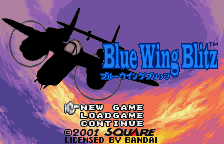
Title screen 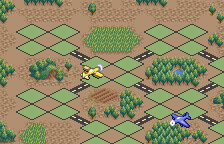
In play 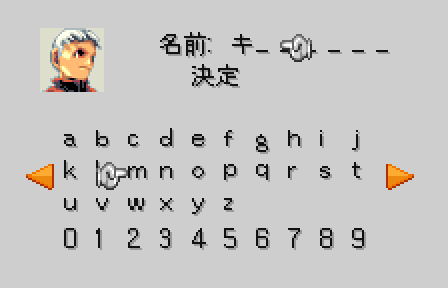
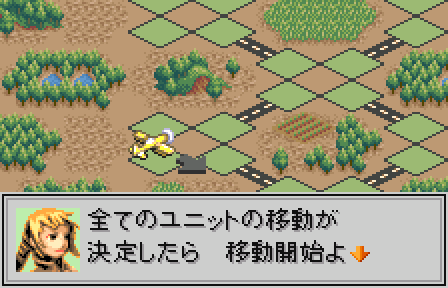
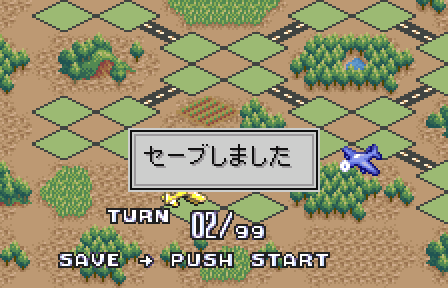
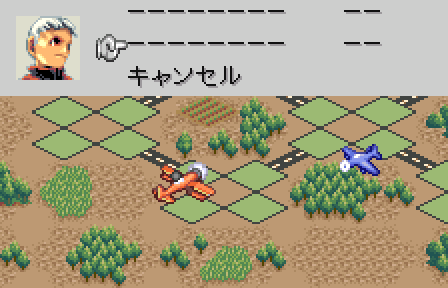
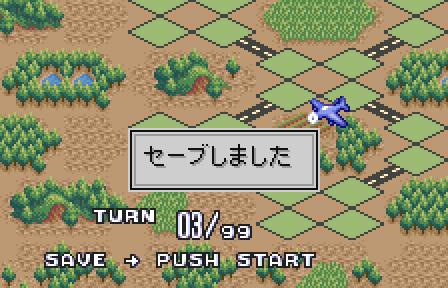
Blue Wing Blitz is a tactical role-playing game that Square made for the WonderSwan and released on 5 July 2001. After Hataraku Chocobo and Wild Card, it was the company’s third original game written for Bandai’s handheld rather than ported from another console. Akitoshi Kawazu produced it, Kumi Tanioka wrote the music, and many of the staff came from the Front Mission and SaGa teams. About twenty thousand copies were shipped.
The war takes place among floating islands, where the expanding Odia Empire rules from the sky and a rebel force sets out against it in an airship of its own. Play alternates between a factory dock, where weapons are developed and aircraft are modified, and turn-based maps on which fighters, attack planes and bombers fly from a mothership, and every meeting with the enemy becomes a short dogfight fought through menus. The cartridge plays in colour on the WonderSwan Color and also runs on the black-and-white WonderSwan.
The story
The world is made of islands floating in the sky, and aircraft are part of everyday life. The greatest power is Odia, an empire on a floating island whose air force and aircraft development are the best in the world. With its airships it holds the nations of the surface under its rule by force, and most of the islands belong to it.
The surface nations stand in different places. The Esk Republic is a rich farming country, and as its neighbours modernise and lose their farmland it has become a vital supplier of food. Its prime minister, Trund, learns that the neighbouring Kingdom of Mackai, whose royal air force is the strongest in the region, is preparing to rise against Odia, and he joins forces with it. The federation of Roggina is in practice allied with Odia, but a resistance group led by Roster, the Roggina Spirit, works against the empire in secret. The Kingdom of Peag has tried to stay neutral, until a sudden attack by a neighbour that grew powerful through its ties to Odia threatens that neutrality.
The game begins as Trund gathers a rebel force to win back the lands Odia threatens. For the first time the people of the surface have an airship of their own, and they fly it toward Odia to end the long rule and take back free skies. The hero is Keid, a sixteen-year-old trainee pilot from Tadaga Village. Payer, a senior pilot of the same age, has volunteered to defend Tadaga against the enemy, and after they meet Keid is taken into the rebel force as an officer. Havilan, a veteran, flies a gunboat, and the pilots who join include Blore, a strategist of the Mackai royal air force, his younger sister Rayetta, who flies a bomber, Poty, the fourth prince of Peag and also a bomber pilot, his guard Sersh, and Roster himself.
Square billed the game as a fantasy romance of air combat. The story is told stage by stage, each stage bringing a new mission, and event scenes show the struggle between Odia and the surface between the battles. The story is a large campaign across several nations, but the cast is small: the player’s unit has eight members counting the airship, each faction has about one named character who does not fight, and the enemy has no rival pilots, only nameless aces on some stages. The player can rename the characters.
How it plays
The game is a run of stages, each with its own mission. Between stages the factory dock is where new weapons and items are developed, aircraft are fitted out and the data on allied and enemy planes can be read. What the dock can offer next depends on how well the last mission went.
The player’s unit is the mothership Discovery with fighters, attack planes and bombers. Fighters are built for dogfights and turn well, attack planes can both fight and bomb, and bombers are heavily armoured; the same weapon carries a different amount of ammunition depending on the class of plane. Every plane except the airship burns fuel each turn and much more in combat, and it crashes when the tank runs dry. A plane that is shot down comes back a few turns later in the airship’s area, but the airship itself cannot be repaired, and losing it ends the game.
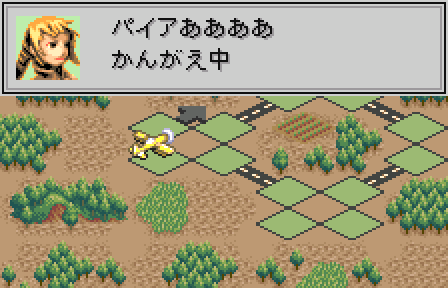
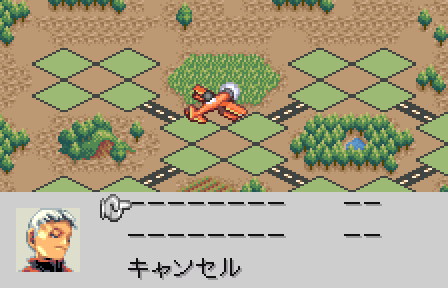
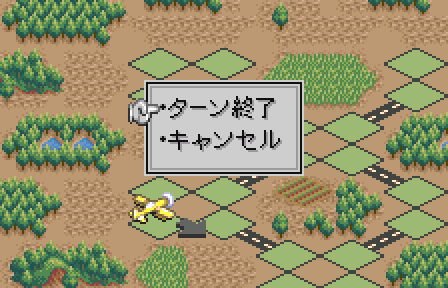
The maps are drawn in an oblique view and divided into areas. Each area has four squares of sky and one square of ground, and each side can bring at most two planes into it. A unit moves one area per turn, and the player chooses a direction rather than a destination. A turn runs in three steps: the player gives orders, the enemy decides its moves, and then everyone moves at once. A unit that enters an area the enemy reached first, or whose area the enemy enters, has its move cancelled, and the airship moves late in the order, so its moves are cancelled often. Moving this way is slow, so the maps are kept small, and enemies have to be found before they can be fought. The ground squares hold airports, supply posts and fixed guns, and ground units travel between them at half an area per turn. They cannot be controlled even when they are on the player’s side, and they take no part in fighting while they are between areas. If no enemy planes are present but enemy ground units or facilities are, the fight is a ground-to-air battle.
A friendly airport refuels and rearms the planes in its area at the start of each turn, and planes in the same area as the airship are also resupplied and repaired. Planes that share the airship’s area do not take part in battles there, so a damaged plane can be sheltered beside it while it is repaired.
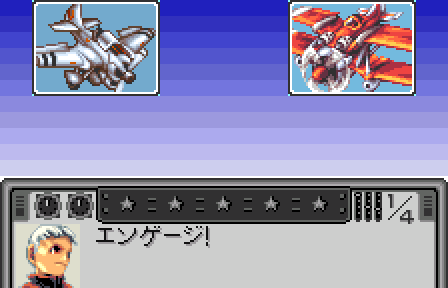
When planes meet in an area the view changes to a battle of up to two planes a side, shown in a small window at the lower left with short text messages. A battle lasts four rounds and then stops whatever the situation, with every plane attacking up to four times, and the effects cannot be skipped. Each round a pilot can attack, speed up or change altitude. A straight run attacks in passing and makes the plane harder to target, a vertical turn attacks with a large change of height, and a horizontal turn chases the target for more chances to hit at more risk. Together with the difference in altitude these give nine normal manoeuvres. Being higher and faster than the enemy is generally better, but each plane has its own best speed, and a plane that attacks while nobody is aiming at it gets a free attack with a better chance to hit. Ground targets are attacked with the same three moves, and bombing splits them into five. On the map the ammunition left is not shown, and in battle a plane’s remaining strength is not shown.
When the chosen moves, heights and speeds meet certain conditions, a super manoeuvre fires and gives bonuses to evasion or to the number of attacks. The manual does not explain the conditions, and the early pilots are too unskilled to trigger them often, but later they can be set off on purpose and in a row. Each plane is built from an engine, wings, tail and fuselage, and a part that takes enough damage weakens the plane; a hit on the fuel tank drains it at once.
Wiping out the enemy is rarely the goal, because destroyed planes return. Missions ask instead for a facility to be taken, the enemy mothership to be sunk, an item to be set down within a turn limit, a base to be scouted or friendly troops to be protected. Bombers are weak in dogfights but matter because so many goals involve ground targets, the two bomber pilots also have the best support skills, and bombers carry the most of the powerful spread rockets. The game can be saved at the start of every turn, so a stage can be forced by reloading, but meeting every goal perfectly, such as losing no plane or downing all of a fleeing enemy, takes careful tactics and luck. Turns are long, and the game is hard going until its rules are learned.
Development and release
The game had three co-directors, with character designs by Nobuyuki Ikeda and Kazuko Shibuya as graphic director. Square announced the game in March 2001 and promoted it as one of its main WonderSwan titles: a trailer was put on the bonus DVD packed with Final Fantasy X, and the advertising leaned on the Front Mission name. DigiCube published a strategy guide on the day the game came out. The planes are mostly propeller aircraft, with a single jet type as the newest model, which places the setting at roughly a Second World War level of technology.
Modes and features
The mothership is an airship of a kind that, in the story, only the Odia Empire knows how to build. A reconnaissance camera lets the flight collect weapons and aircraft from certain enemy bases, and these are usually strong for that point of the game; some can be taken only while the base still stands and others only after it is destroyed, so using the camera fully needs the strategy guide.
Super manoeuvres are named after real tactics such as the split S, the barrel roll, the high yo-yo and the Immelmann turn, while one bombing manoeuvre is named jokingly after a Japanese proverb about a hopeless long shot. Repeated encounters fill a library of enemy types that can be read between stages, and knowing more about a type makes its attacks easier to dodge. Some maps run several missions in a row, such as scouting a base, then guiding ground troops to take it, then driving off a counterattack, and ground facilities destroyed in one mission stay destroyed in the later ones.
Secrets and extras
After the ending the game shows each pilot’s record and how often their super manoeuvres were used, then offers a second playthrough that keeps the library. On that run the starting aircraft can be chosen from four sets: the normal one, a set of high-performance fighters, a set of attack planes and bombers only, and a hard set made up of the weak early planes.
Reception
The game is widely faulted for explaining itself poorly. Enemy damage is hard to read, armour makes battles drag on, the conditions for super manoeuvres are never explained and the battles show little movement on screen. It has a reputation as a bad game, though it is also thought to become rewarding once its rules are understood. Players returning to it have found the exchanges of fire monotonous and slow. The altitude system works like rock, paper, scissors and changes hit rates rather than damage, and players find that the game feels like a puzzle once that clicks. The graphics, music and character art are generally praised.
Ports and other versions
Blue Wing Blitz was written for the WonderSwan and had a single Japanese release; it was never ported, remade or re-released for download. It belongs to no series. Its nearest relatives are the Front Mission and SaGa games whose staff worked on it; what sets it apart is that its whole war is fought in the air, with fuel and ammunition to manage and a mothership that cannot be replaced.
Notes
Changing a pilot to a new aircraft deletes the old one together with any weapons fitted to it, so important equipment is best removed before a stage where a new plane is gained. Save data is easily lost, a weakness of the hardware rather than of this game alone.