
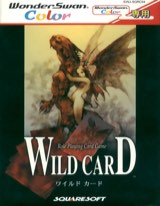
A role-playing game from Square in which the world, the party, the enemies and the quests are all shown as cards, designed by SaGa creator Akitoshi Kawazu.
Screenshots

Title screen 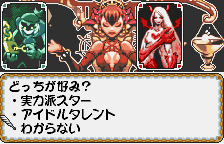
In play 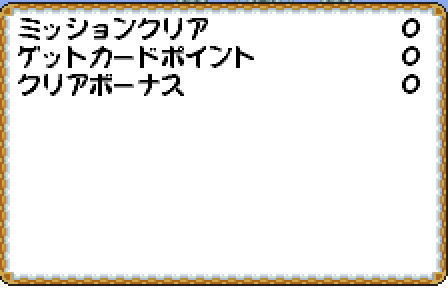
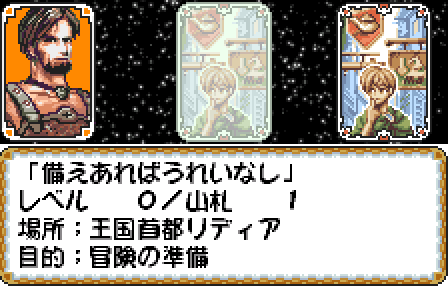
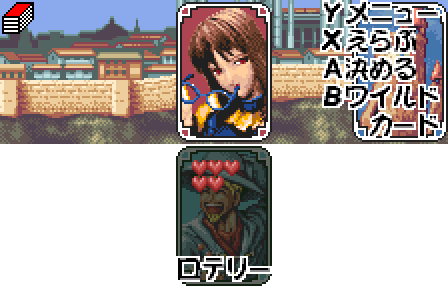
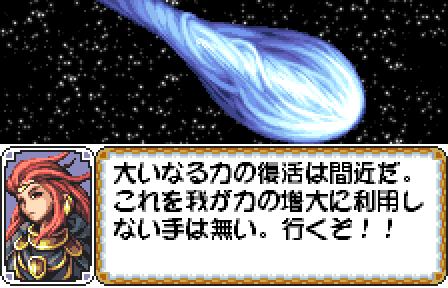
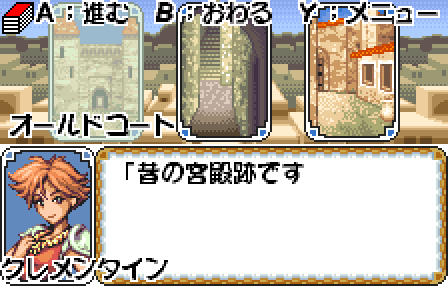
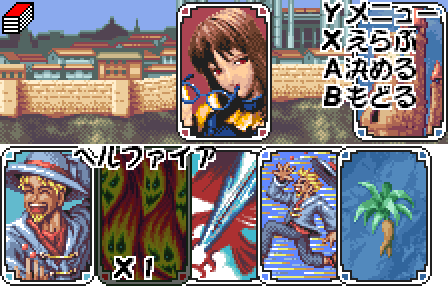
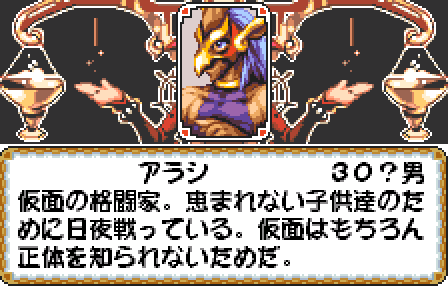
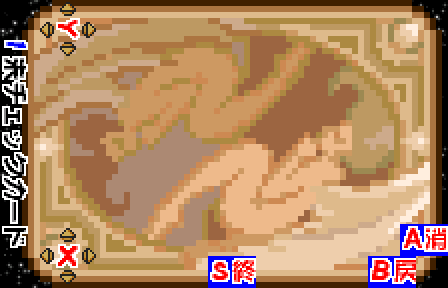
Wild Card is a role-playing game that Square made for the WonderSwan Color. Together with Hataraku Chocobo and Blue Wing Blitz, it was one of the original games Square made only for this system, as opposed to its ports of earlier titles. The design was led by Akitoshi Kawazu, the creator of the SaGa series, with music by Kenji Ito and key artwork by Akihiko Yoshida.
Nearly everything in the game takes the form of a card: the scenarios the party can undertake, the terrain, the weapons, the magic and the characters themselves. There is no overworld map to walk around and no conventional dungeon. A few questions at the start decide which of nine heroes sets out, and the hero then takes scenario cards from a town and plays them in any order, with turn-based fights on the same card field.
The game is divided into seven stages, and the choice of protagonist comes round again as later stages begin. Square reported shipments of about 40,000 copies. Kawazu’s later Unlimited Saga has been linked to the idea, tried here, that a role-playing game can do without a map.
The story
The official prologue frames the game as recorded legend. An elder of the Uban people tells the stories handed down from his ancestors, and the narrator, who has spent years writing such oral lore down before it disappears, sets out the tale of a light brighter than the sun that once crossed the sky and vanished at the edge of the world, and of how the people of that time acted. The world is a land of a kingdom, the Kingdom of Alan, a republic and an empire, and it is kept deliberately vague. Text is sparse throughout, and a character agreeing to join the party usually takes no more than a couple of lines.
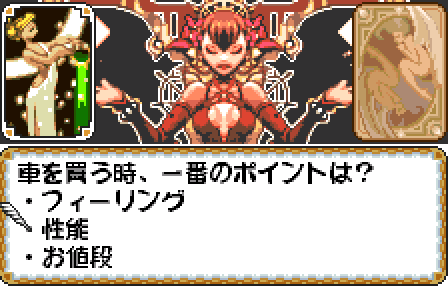
There is hardly any continuous plot. Every one of the heroes saw the falling star one day, felt something in it and left home, and the game is the sum of the many small quests they take on afterwards. Which hero sets out is decided by answering questions at the start, which picks the character closest to the player’s answers; the others can be met in the world and asked to join.
The nine heroes each have their own reason for leaving. The nameless boy from a nameless village in the Kingdom of Alan simply feels he has to start doing something, and is the only one who can be renamed. Arashi is a masked fighter who battles for children in need, Clementine Holiday a capable but modest swordswoman scarred by childhood fears of water and fire, and Solis a thief who robs only crooked merchants, gives the loot to the poor and works in a shop as Johanna. Dai Young is a gentle blacksmith in the kingdom’s capital and a former member of the republic’s dark knights, who reads the star as an ill omen and goes to meet his fate. Maria Salzburg is an alchemist whose research has stalled and who hopes to find a fragment of the star, Lottery a talentless traveller with odd charm and great luck who takes it as a lucky sign, Ekaterina Divers a great merchant’s daughter who became a priestess of the god of light against her parents’ wishes and sees in it a message from her god, and Nan Ragan an arrogant magician from the republic who reads it as a sign of gathering power he wants for himself.
How it plays
The game is played with the console held sideways and runs only on the WonderSwan Color. After the opening questions the hero begins in a town scenario, gathering information in the tavern, recruiting companions and buying equipment. Talking to people there yields scenario cards, of which there are more than a hundred: hunting a monster, finding a legendary item or travelling to some remote place. Each quest is won by defeating a particular enemy, finding a particular item or reaching a particular place. A party has up to five members including the hero, whether a character agrees to join depends on the hero’s statistics, and nobody can be dismissed once recruited.
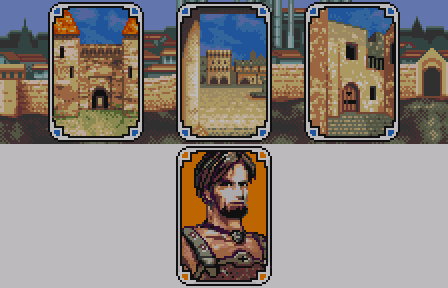
Inside a scenario there is no map. Each step turns up a few terrain cards and the player picks one, passing through transits with names such as Uneasy Stairs or Narrow Path to reach it. Three basic cards, the wild cards that give the game its name, advance, look around and act, and can be played any number of times. Every other card has a set number of uses, up to nine of each, which come back when the scenario ends. Every action takes one turn and the turn limit is shown as a deck of cards; running out usually means failure. Terrain has a danger level, and more dangerous ground brings more monsters, more chests and a better chance of meeting the card that completes the quest, a chance that also rises as the deck runs low. Obstacles block the way: boulders are broken by attacking them, lava needs water magic and rivers the Swimming skill, while locked or trapped chests need cards such as Open Lock or Disarm Trap, which only work on a high enough roll. A boss arrives with an ALERT warning and its own music.
Fights happen on the same field. The player chooses which member acts and which of that member’s cards to use. Weapon techniques come in seven lines (rapier, sword, axe, club, bare hands, bow and spear) plus linked techniques, and magic in six elements (fire, earth, water, wind, light and dark) plus combined spells. A card’s effect is rolled within a range and set against the target’s defence, an enemy’s life is shown as a stack of cards, and a critical hit adds a further roll and can happen again and again, so any card can do huge damage with luck. Enemies only ever attack one character, and the player decides who takes each blow, which makes it easy to build one sturdy member as a shield. Paralysis and petrification are very strong: if the whole party is caught the scenario is lost, and an enemy hit by them counts as defeated, which makes such spells the strongest attacks late in the game.
Characters have nine statistics, Life, Power, Body, Balance, Hand, Brain, Charm, Love and Mana, and Love falls when the party attacks ordinary people. There are fourteen skills, among them Disarm Trap, Open Lock, Examine and Flee. Money comes in copper coins, which turn into a silver coin at ten, and silver into gold the same way.
Growth happens at the results screen after a scenario. Defeated monsters and found items earn points, with a bonus for clearing the scenario, and they are not carried over. Each member’s own technique, magic and skill cards are bought from the points divided by the number in the party, while statistic cards draw on the whole total; better cards cost more, and the cards offered depend on what each member did during the scenario. Most failed scenarios can be retried by asking for the information again, and failing on purpose is a slow way to build characters up, whereas a cleared scenario is gone for good. Every clear raises the scenario level, bringing stronger monsters and better items, so clearing too fast can leave the party too weak to go on.
The game runs through seven stages, and a stage moves on after a certain time. At the start of each even-numbered stage the hero and party are lost and the questions pick a new hero from the characters not yet recruited; only the shared pool of wild cards, which also holds item and statistic cards, carries over. The odd-numbered stages return to the first hero, with growth kept and every character recruited so far available again. A character’s statistics on joining are the same in any stage, but enemies keep getting stronger, so strong characters and cards have to be saved for later. A quest takes ten to twenty minutes, and reaching the last boss takes around forty hours.
The opening quest, A Warrior’s Trial, has no goal but to survive until the deck runs out, and it is often called the hardest in the game: early parties have so few cards that they easily run out of attacks and fall back on Flee, which uses up many turns at once. A party of two or three is usually enough, since every extra member thins out the points. Animal Talk, a skill that clears away enemies and finds items in the early and middle game, rarely works near the end without a critical.
Development and release
In a Square Enix column marking the game’s 25th anniversary, Kawazu recalls that the project grew out of Bandai’s invitation to Square to publish for the WonderSwan. Most of Square’s development sections were then busy with online titles for PlayOnline, so his WonderSwan group was formed from staff outside that effort, and the plan called for around ten titles in two years, more than ports alone could supply. He describes the handheld as a place to try new ideas quickly and cheaply, and Wild Card as a game meant to be easy to pick up at a time when console games were growing ever larger. Bandai presented it as Square’s second game made only for the WonderSwan Color and the first original role-playing game on the colour system.
The game came out on 29 March 2001 at 4,300 yen before tax, on the same day as Enix’s Super Gal Deluxe Hour; Kawazu says he did not know of that game until the two companies merged in 2003. Kazuhisa Murakami handled the programming and Minoru Akao the sound programming, and Shinji Hashimoto and Hiroshi Yamaji were the producers. It was the last game Kenji Ito worked on as a Square employee before going freelance.
Modes and features
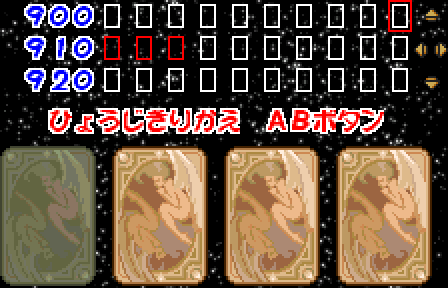
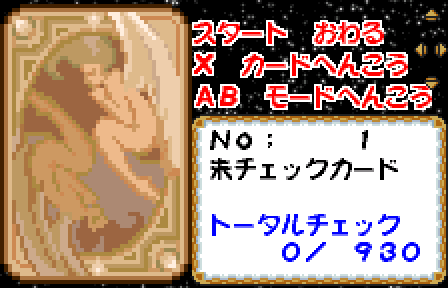
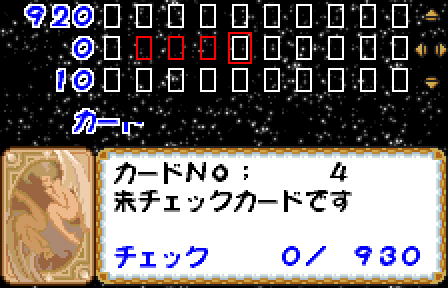
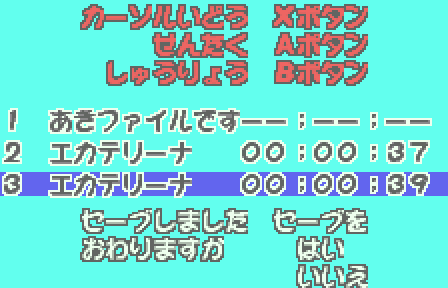
Wild Card is for one player. Play can be suspended and saved at any time, and an album reached from the title screen displays the 930 cards collected, items and techniques once obtained and enemies and places once met and examined, drawn with close to 800 different illustrations; completing it brings no reward. Cards can be traded with another player over the link cable.
Secrets and extras
The game has several possible final bosses and a hidden boss that appears only when certain conditions are met. The character Duke joins only after the Hermit’s Hideout scenario on the Milk Road has been cleared, and Maria as the hero can obtain an item called the Star Fragment. The game also has a quirk resembling a well-known trick in Final Fantasy II: cancelling partway through handing out a card still counts the card as used, and using a skill on empty terrain costs no turns, so players can repeat actions to steer which cards they are offered. Raising some statistics too far stops new cards from appearing, which the game never explains.
Reception
It is remembered as an ambitious hidden gem with a strong flavour of its staff. The finely drawn pixel art on the cards, Ito’s music, the boss alarm that signals a quest is nearly won, and the deliberately sparse, often deadpan dialogue are praised, but the play is found repetitive, the card selection slow without shortcut buttons, the opening quest the hardest of all and paralysis and petrification too strong. It is very hard to get into, and some players who took it for a dud on the first day have gone on to clear it three times in more than a hundred hours. Its resemblance to CardWirth, a free card-based role-playing game for PCs released in 1998, is often pointed out, though the two play quite differently.
Ports and other versions
Wild Card was made for the WonderSwan Color and has never left it: it needs the colour model and was never localised. Kawazu raised the subject himself in the anniversary column of March 2026. He would welcome a revival, points out that the program was written in C and so could be moved to other hardware, and says the team has discussed it, but no port has been announced.
The closest relative is Kawazu’s Unlimited Saga for the PlayStation 2, a separate game rather than a version of this one. Players sometimes call Wild Card the first Unlimited Saga, because its growth system, trap disarming and lock picking return there.
Notes
The cartridge keeps its saves in SRAM backed by a button battery, a CR1616 cell, which can be replaced.