
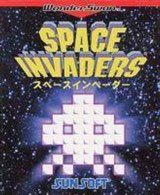
Sunsoft's WonderSwan version of Taito's 1978 arcade shooter, with the original game and a new two-player battle mode over the link cable.
Screenshots
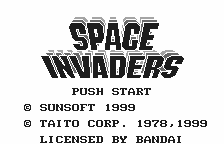
Title screen 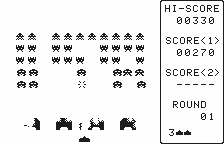
In play 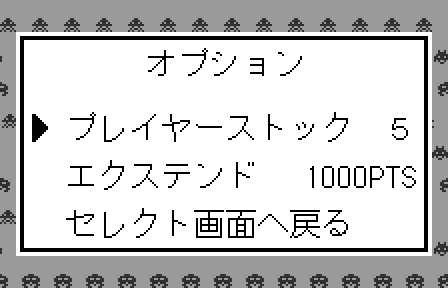
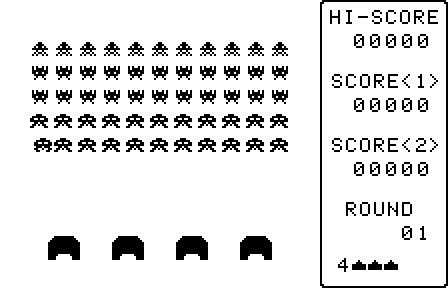
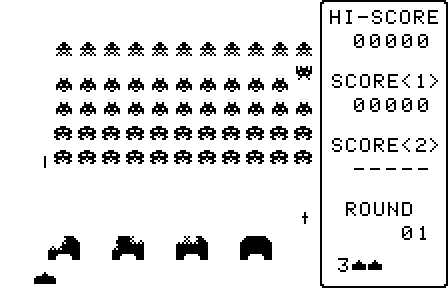
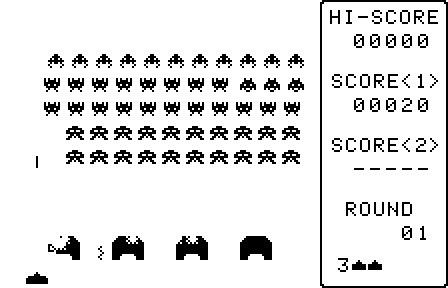
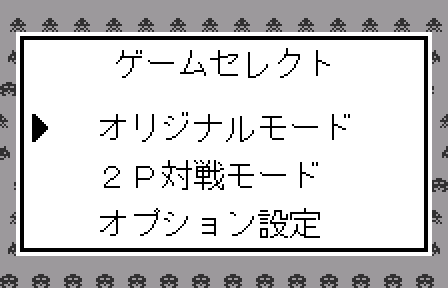
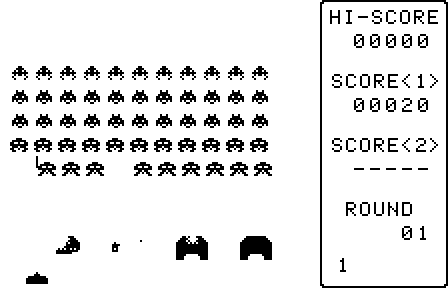
Space Invaders for the WonderSwan is a handheld version of the arcade shooter that Taito released in 1978, one of the best-known games of its era. Sunsoft brought it to the WonderSwan on 13 May 1999, a little over two months after the console went on sale, which makes it one of the system’s early titles.
The cartridge has two games. The Original Mode is the arcade game as it was, for one player or two taking turns, in which a beam cannon at the bottom of the screen shoots down ranks of invaders before they reach the ground. The 2P Battle Mode is new: two players race to clear their own invaders first, with special invaders and other tricks that push trouble onto the opponent’s screen. It is meant for two consoles joined by the link cable, though a trial version started with a button combination given in the manual lets two players share one console.
The story
Space Invaders has no story beyond its premise. Invaders from space have come to conquer the Earth, and the player, at the controls of a single beam cannon on the ground, has to shoot them down and stop the invasion. No one is named, nothing is said about where the invaders come from, and there are no scenes between rounds: a round ends when the last invader falls, and the next one begins.
The cast is the one from 1978. The invaders come in three shapes, each worth a different score, and they move in a block from side to side as they close in. A UFO crosses the top of the screen from time to time as a bonus target, and a row of shelters stands between the cannon and the invaders, wearing away under fire from both sides. On the WonderSwan all of this is drawn in black and white on a wide screen, with a panel at the right showing the high score, the scores of both players, the round number and the cannons left. The 2P Battle Mode splits the screen into two narrow fields side by side, one for each player, and adds special invaders, shaped differently from the rest.
The cartridge sells the game on nostalgia rather than on a plot. The manual calls it the game that started the video game boom and promises that it keeps the taste of the time while adding new things such as the versus mode. Its last chapter is given over to two famous tricks that players found during the craze of 1978, presented as part of the game’s history as much as advice on playing it.
How it plays
The WonderSwan is held sideways. The X4 and X2 buttons move the beam cannon left and right, and Y4 and Y2 do the same for players who prefer the other hand; A or B fires, and Start pauses and resumes the game. Holding A and B and pressing Start resets the game to the Sunsoft logo shown at power-on.
Pressing Start at the title screen opens the game select menu, where X1 and X3 move the cursor and A, B or Start confirm. It has three entries: the Original Mode, the 2P Battle Mode and the option settings. The options apply to the Original Mode only. Player Stock sets the number of cannons at the start from one to five, with three as the default, and Extend sets the score at which an extra cannon is awarded, either 1,000 or 1,500 points.
The Original Mode opens with the arcade game’s demonstration, then asks for 1 Player or 2 Players; with two, the players take turns on one console. A round is cleared when every invader has been shot down, and the game is over when the last cannon is lost or the invaders land and take over the base. The invaders at the top of the formation are worth 30 points, those in the middle 20 and those at the bottom 10, and the UFO is worth 50, 100, 150 or 300. The shelters block the invaders’ missiles but also the cannon’s own beam, and they crumble bit by bit. There is no ending: the rounds go on until the last cannon is gone, and the point is the score.
The 2P Battle Mode is played over the link cable. Both consoles are switched off, joined with the cable and switched on again, and one player picks the mode at the game select screen; a timer then counts down while the other has thirty seconds to pick the same mode, or both return to the menu. Whoever chose first becomes player 1. The players then agree on a match of one, three or five wins, and each sets a handicap for themselves: a cannon stock from one to five or unlimited, and a level of easy, normal or hard.
Each player then faces a formation of their own, and the first to shoot down all of it wins the game. A player who is overrun, or who runs out of cannons, loses. Shooting down a whole column of invaders on one’s own screen adds a new row of invaders above the opponent’s formation. Hitting the UFO clears every shot from the screen and swaps the two players’ invader formations completely, which can turn a game around. Special invaders, with a different shape from the rest, set off an effect when hit, and the effect each one carries changes as time passes: one drops the shooter’s own invaders a row, one drops the opponent’s a row, one drops both sides’ invaders two rows, one wipes out a whole column of invaders, and a question mark picks one of those four at random. Since some of the effects only hurt the shooter, a special invader is worth watching until it shows the right one.
A trial version of the versus mode works on a single console. Holding Y2 and Y4 while choosing the 2P Battle Mode starts it, with player 1 moving with X4 and X2 and firing with B, and player 2 moving with Y4 and Y2 and firing with A. It means two people holding one small console between them, and the manual treats it as a taste of the real mode rather than the way to play it.
The manual passes on the two best-known tricks from the arcade days. In the Nagoya attack, an invader that has come down to the bottom row, level with the cannon, can no longer hit it with its missiles, so a player can wait for the formation to come all the way down and then shoot the bottom row in one sweep. The rainbow appears when the player shoots down every invader except a single 10-point one from the bottom of the formation: the last invader then leaves a trail of afterimages behind it.
Development and release
Sunsoft, the games brand of Sun Electronics, released four WonderSwan cartridges, and Space Invaders was the second of them, after Shanghai Pocket in April 1999 and before Puzzle Bobble in July and Oekaki Logic in January 2000. Like Puzzle Bobble it is a Taito game under licence, and it carries a 1999 Sunsoft copyright beside Taito’s copyright dated 1978 and 1999. Sunsoft is usually named as developer as well as publisher, but Taito is sometimes credited alongside it, and whether any of the programming was done outside Sunsoft is not settled. The cartridge is a 4-megabit ROM with stereo sound, played with the console held sideways, and it sold for 3,800 yen before tax.
Modes and features
The menu offers the Original Mode, the 2P Battle Mode and the option settings. Sunsoft presented the Original Mode as a faithful copy of the arcade game, aimed at players who had honed their skills on the machines in the coffee shops and arcades of the late 1970s. The 2P Battle Mode is the new addition, and its full version needs two consoles and the link cable; Bandai suggested it as a way for a parent who had played the original to take on a child. The one-console trial of the versus mode is reached only with a button combination given in the manual, not from the menu.
Ports and other versions
The WonderSwan cartridge is one of a very long line of home versions of Taito’s 1978 arcade machine. The conversions begin with the Atari 2600 in 1980 and run through the SG-1000, MSX and Famicom in 1985, the PC Engine and Game Boy in 1990, the PC-9801 in 1992, the Super Famicom in 1994 and the PC Engine Super CD-ROM² in 1995 as Space Invaders: The Original Game, the red-screened Virtual Boy collection in 1995, and the Sega Saturn and PlayStation in 1996 and 1997. After the WonderSwan release came phone versions for i-mode and EZ-appli in 2001 and 2003, PlayStation 2 releases for the 25th anniversary and in the Taito Memories collections, the Space Invaders Invincible Collection for Nintendo Switch in 2020, and an Arcade Archives release from Hamster in December 2025 for Switch, Switch 2, PlayStation 4, PlayStation 5 and Xbox Series X and S.
Many other games carry the Space Invaders name but are reworkings rather than versions of the original, such as Space Invaders X for the PlayStation and Game Boy Color with power-ups and boss fights, and the Extreme and Infinity Gene games; they should not be mistaken for the game on this cartridge. Some versions mix the two, as the PC Engine’s Fukkatsu no Hi offers both a straight conversion and an arranged mode.
The arcade machine used an upright screen, and home versions as a rule rearranged the playfield for a wide screen; the WonderSwan cartridge, played sideways, follows that pattern. Other versions add more than the WonderSwan’s link-cable versus mode: the Super Famicom and Super CD-ROM² releases recreate the black-and-white, cellophane-overlay and colour cabinets and include a versus mode, and the Game Boy version keeps to the arcade rules within what that hardware could show.