
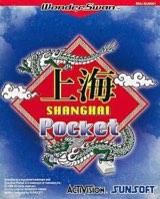
Sunsoft's WonderSwan version of Shanghai, the tile-matching puzzle played with stacked mahjong tiles, with four modes including a two-player battle mode.
Screenshots
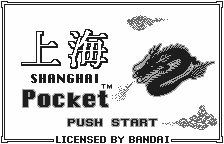
Title screen 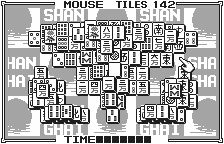
In play 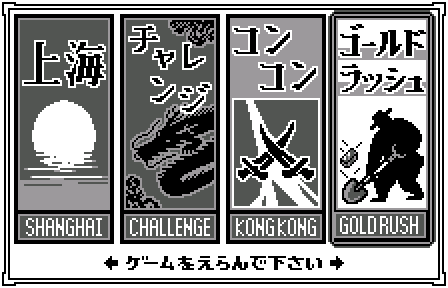
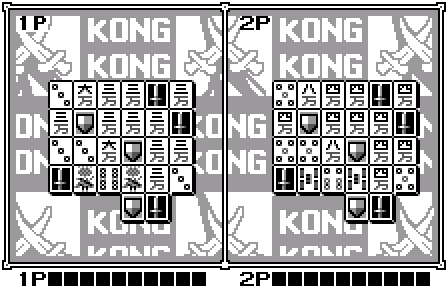
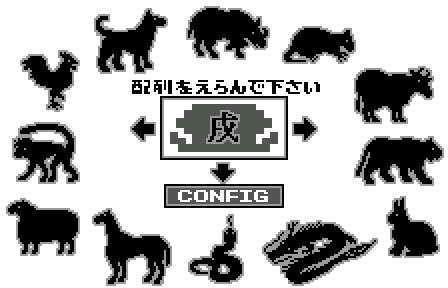
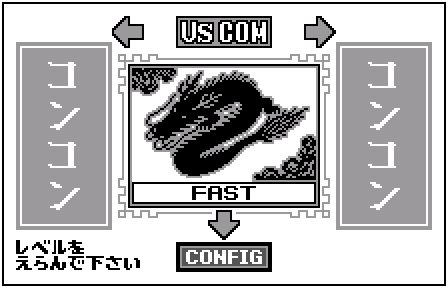
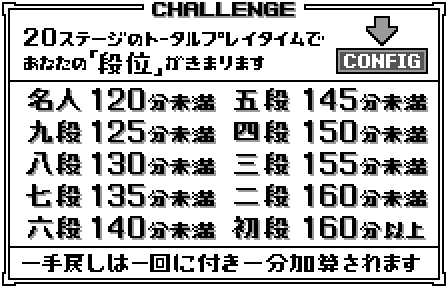
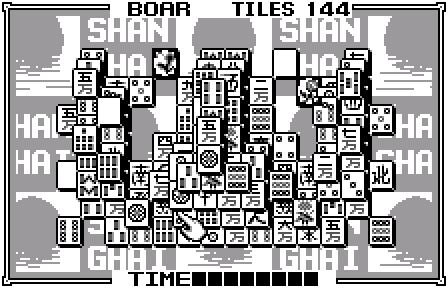
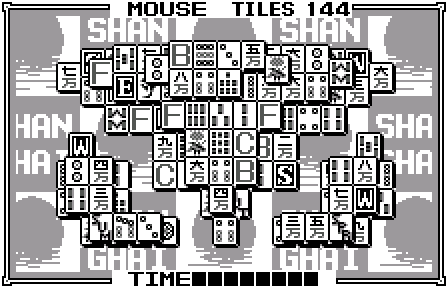
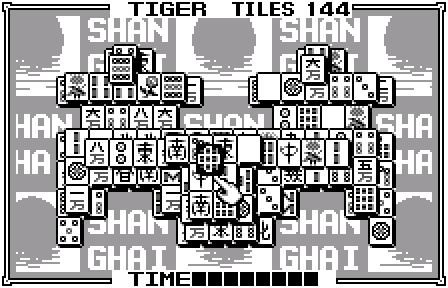
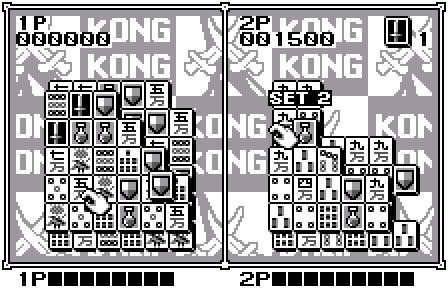
Shanghai Pocket is the WonderSwan version of Shanghai, the puzzle game first released by Activision for the Macintosh in 1986 and since adapted for a long list of computers and consoles. Sunsoft programmed the WonderSwan version and released it on 1 April 1999, less than a month after the console went on sale, which makes it one of the system’s earliest games.
The rules are those of the original. Mahjong tiles are piled up in a layered layout, and the player removes them two at a time by picking matching pairs; the board is cleared when every tile is gone. The WonderSwan cartridge offers four ways to play: the main Shanghai mode, a sequence of stages modelled on the twelve animals of the Chinese zodiac; Challenge mode, which times the player across twenty stages; Konkon, a battle mode played with special tiles for attacking and defending; and Gold Rush, a race to find gold tiles hidden among the others.
Shanghai Pocket can be played alone or by two people, and it supports the link cable that connects two WonderSwans. The cartridge has battery-backed memory and is played with the console held horizontally.
The story
Shanghai Pocket has no story. Its framing comes from the Chinese zodiac and from the look of the tiles themselves. The title screen shows a coiled dragon beside the name, and the single-player Shanghai mode is built around the twelve animals of the zodiac, from the mouse onwards, with one stage for each animal.
The stage select screen arranges the twelve animals in a ring around the stage name, and each stage carries the name of its animal. When a stage is cleared, the animal that stands for it appears in a short bonus picture before the game returns to the selection screen, so working through the mode slowly fills in the whole zodiac.
The other modes have a lighter frame. Challenge mode ends each stage with a picture of a figure planting a flag on a mountain top, and after all twenty stages it awards a rank on the scale used for board games such as go and shogi, from first dan up to master. Konkon and Gold Rush are head-to-head contests with no characters at all, against the computer or a second player, and their tiles add a sword, a shield, a medicine bottle and a gold tile to the usual mahjong set.
How it plays
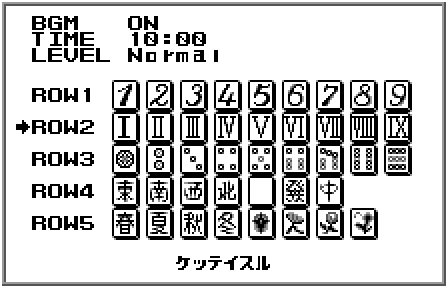
The console is held horizontally. The X buttons move a cursor over the pile, the A button picks a tile and the B button cancels a wrong choice; the Y buttons are not used. A tile can be taken only when nothing sits on top of it and it is free on its left or right side, and the player removes two identical free tiles at a time. The four season tiles count as one matching group even though their pictures differ, and so do the four flower tiles. Shanghai and Challenge use the full set of 144 tiles: the numbered characters, bamboo and circles from one to nine, the four winds and three dragons, four of each, plus the eight seasons and flowers. A configuration screen lets the player choose between tile designs.
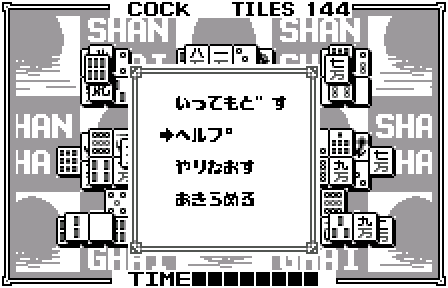
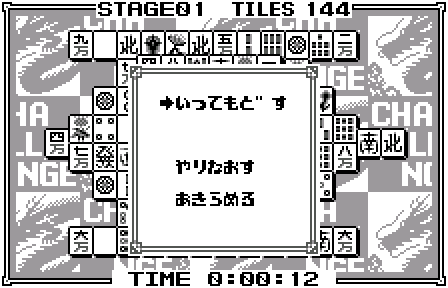
Pressing START during play opens a menu. It can take back the last move, restart the stage with the same layout, or give up and return to the stage select, and in Shanghai mode it can also show one pair that can be taken at that moment. When no more pairs can be taken the game is stuck, and the player picks one of these options to carry on. The cartridge saves automatically, keeping cleared stages, scores, rankings and settings, and on later starts it offers to continue or begin a new game.
In Shanghai mode the player can start from any of the twelve stages and must clear all of the tiles within a time limit; the screen shows the stage name, the selected tile and the time left. It is meant for players who want to take Shanghai at their own pace.
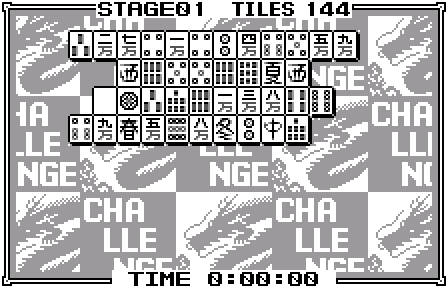
Challenge mode runs through twenty stages in a row and times them. Its layouts are harder than those of Shanghai mode and spread wider in every direction, and the clear time and running total appear after each stage. The total decides the rank given at the end: under 120 minutes earns master, 125 minutes ninth dan, 130 minutes eighth dan, and so on down one rank for every five minutes, with 160 minutes or more giving first dan. There is no hint here, and every undo adds a one-minute penalty.
Konkon is a race between two piles. Each side’s pile uses two randomly chosen kinds each of characters, bamboo and circles, plus the special tiles, and the number of tiles is not fixed. A player wins by clearing their own pile first, or when the opponent runs out of time, gets stuck, or has their pile pushed up to its maximum height. Taking a pair of sword tiles puts two pairs on the opponent’s attack counter, and they drop onto the opponent’s pile after the opponent’s next ordinary pair; taking sword pairs in a row sends three, four, six and at most eight pairs. The counter holds up to ten pairs, and anything beyond that falls at once. A pair of shield tiles wipes out the attack waiting against the player and resets the opponent’s chain. A pair of medicine tiles restores 10 of the 100 units on the player’s own clock, rising to 15 and then 20 when taken in a row, and the clock drains steadily, so a player whose time reaches zero loses.
Gold Rush hides one gold tile in each player’s pile, and whoever takes theirs first wins the round; the match ends when one side has won three. Its piles use the Shanghai tiles without the bamboo and season tiles. There are twelve layouts, and both players get the same one, picked at random. A counter shows how many tiles the opponent has left, and it flashes when the opponent is at best ten moves away from reaching the gold tile.
Both battle modes are played against the computer, whose strength can be chosen, or against a second player over the link cable, which needs two consoles and two cartridges. Ordinary pairs score 100 points in both modes, sword and shield pairs in Konkon score 200 and climb to 1,000 for a long sword chain, and a win adds 2,000. Each mode keeps a table of the player’s five best scores.
Development and release
The game was sold by Sun Electronics, the company behind the Sunsoft label, at 3,800 yen before tax, on a 4-megabit cartridge with 256 kilobits of S-RAM and stereo sound. Shanghai and Shanghai Pocket are trademarks of Activision, and the source code of the WonderSwan version was designed by Sunsoft.
Modes and features
The modes are the same as in the Game Boy version. Gold Rush hides a single gold tile, marked G, among the tiles of each pile, so the race is decided mainly by clearing speed.
Ports and other versions
The game traces back to Shanghai, which Activision released for the Macintosh in July 1986, but the WonderSwan cartridge comes more directly from Sunsoft’s own Shanghai Pocket for the Game Boy. That cartridge came out in Japan on 6 August 1998 and also supported the Super Game Boy, and its release outside Japan was a Game Boy Color-only cartridge with its on-screen text changed to English. The WonderSwan game arrived eight months after the Japanese Game Boy release, keeping the name and the four modes. It should not be mixed up with HAL Laboratory’s 1989 Game Boy Shanghai, an earlier and separate version, or with Shanghai Advance, which Sunsoft released for the Game Boy Advance in 2001. Shanghai Pocket was not released on any later system.
The two Shanghai Pocket cartridges are practically the same game. The WonderSwan game and its manual write the mode name Konkon in katakana, where the Game Boy version used hiragana, though Bandai’s own listing wrote it in hiragana. The Game Boy cartridge has no way to keep progress or records, whereas the WonderSwan cartridge carries S-RAM and saves cleared stages, scores, rankings and settings automatically.