
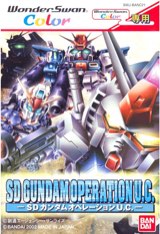
A side-scrolling SD Gundam action game for the WonderSwan Color that replays the Universal Century anime in silent scenes, with link-cable duels and a survival mode.
Screenshots
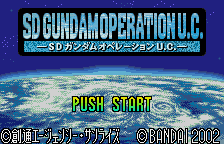
Title screen 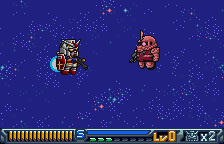
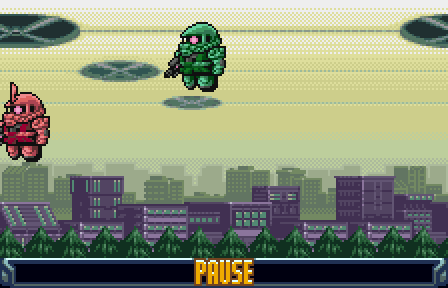
In play 
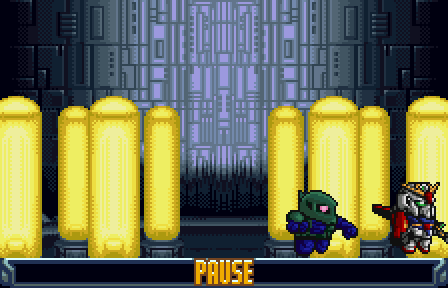
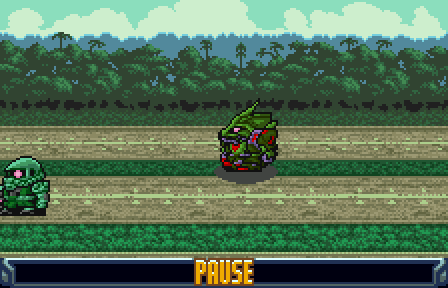
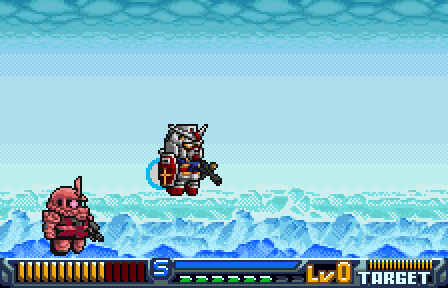
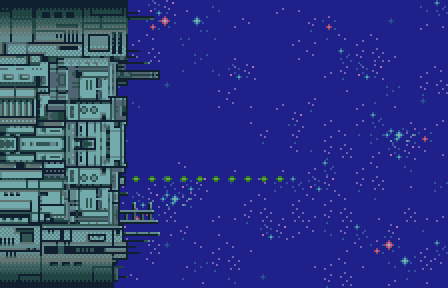
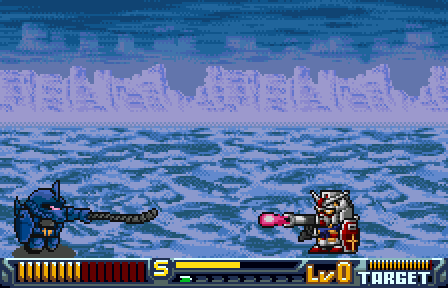
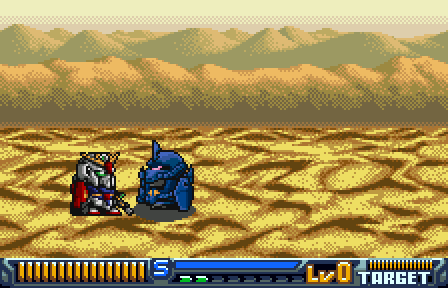
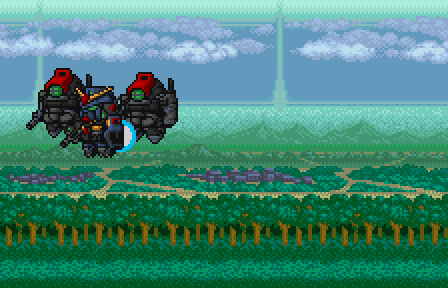
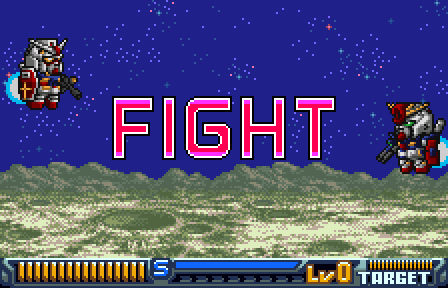
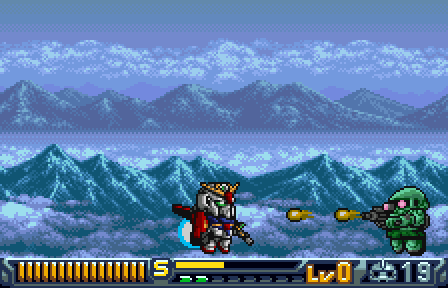
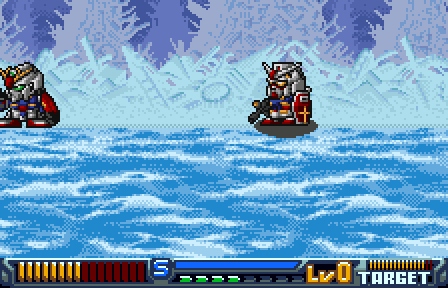
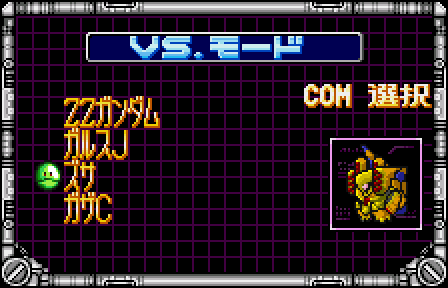
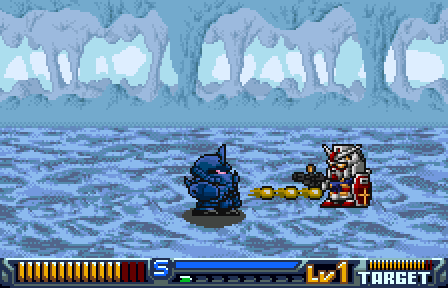
SD Gundam: Operation U.C. is an action game that Bandai released for the WonderSwan Color on 16 February 2002. It takes its story from three television series of the Universal Century timeline, Mobile Suit Gundam, Zeta Gundam and Gundam ZZ, and gives each of them its own separate campaign. The characters and mobile suits are drawn in the small, big-headed SD style.
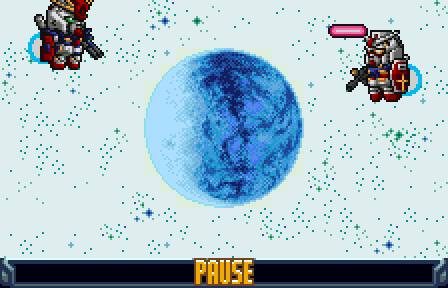
Ground stages are seen from above at an angle, so fights have some depth, while space stages let the machine move freely and run faster. Between the action, a system the game calls the Dramatic Part replays well-known moments and turning points from the anime with the SD cast, and mobile suits from Char’s Counterattack also appear.
Two players can play against each other over the link cable. One mode is a straight one-on-one duel. In the other, both players clear the same action stages and race to shoot down enemies; meeting certain conditions sends extra enemy units to the other player’s game, and the match goes on until one side runs out of health. The cartridge is made for the Color and does not run on the original black-and-white WonderSwan.
The story
Operation U.C. follows the Universal Century timeline of the Gundam anime, the long war between the Earth Federation and the Zeon forces of the space colonies, through three television series and the film Char’s Counterattack. Each series is its own campaign in the U.C. mode, told from the point of view of its hero. The first series follows Amuro Ray in the Gundam, starting with the descent through the atmosphere to Earth and the first sortie of Garma Zabi, and moving on through famous battles such as Odessa, Jaburo, Solomon and A Baoa Qu. The Zeta campaign follows Kamille Bidan from his departure through stages such as Hong Kong City and Dakar, and the ZZ campaign follows Judau Ashta, beginning with the boy from the colony of Shangri-La and the first launch of the ZZ Gundam. The Char’s Counterattack chapter, which is locked at first, is three stages long.
The story is told almost without words. The human cast hardly appears: the events of each episode are acted out by the SD mobile suits themselves, with a few lines of caption text to set the scene and no dialogue at all, so a well-known moment from the anime is shown as a silent scene of the machines moving about the field. A few people do appear as small sprites, among them Dozle Zabi, Hilda Bidan, Glemy Toto and Quess Paraya, and the battles keep close to the order and settings of the series, so that the backgrounds change and the enemies arrive as they did on television. Players who know the anime can follow each scene and fill in the missing words; to anyone who does not, the scenes explain almost nothing.
The hero’s machine changes as the series does. In the ZZ story Judau flies the Zeta for one episode before he takes over the ZZ. The pilot also changes the machine: the Zeta, the Mk-II and the Hyaku Shiki of the ZZ story, flown by Roux, Elle and Beecha, carry weaker weapons than the same suits in the Zeta story. The music mixes new tracks with themes from the anime, three from each television series and the main title of Char’s Counterattack.
How it plays
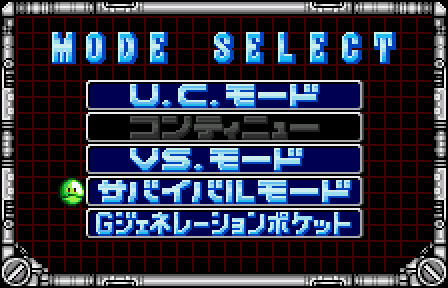
The title menu offers the U.C. mode, a continue for it, the VS mode, the survival mode and a link to the G Generation Pocket toys, and the VS and survival modes can each be played against the computer or a second player over the link cable. Each machine has a normal attack, a charged attack, close combat and a special move. The normal attack changes with distance, so a suit may swing a beam sabre up close and fire its rifle further off, and the charged attack often brings out a different weapon altogether. The special move draws on a gauge with three levels, which fills as the machine fires its normal attack and as it deals and takes damage, so it can be built up by firing at nothing. Using the special move spends every full level at once, with any part-filled level kept, and the weapon it uses can change with the number of levels spent. A machine with a shield blocks all damage while the player is not pressing anything, until the shield gauge runs out.
Shots of different kinds cancel each other in a fixed order. Missiles are the weakest, then machine guns and vulcans, then ordinary beams and bazookas, then medium beams and then the thick beams; a weaker shot is wiped out by a stronger one, and two of the same kind cancel each other. This makes the choice of machine count for a great deal. A suit whose main weapon is a missile launcher or a vulcan has its shots erased by any enemy with a beam, while a machine with a thick beam erases most enemy fire just by shooting straight at it. Special moves differ just as widely: funnels that fire beams at random from small, hard-to-hit pods, lasers that strip away a large part of an enemy’s shield, and a newtype power that slows the enemy down are strong, while a straight charge or a burst of rapid fire is easy to dodge. The ZZ Gundam, the Zaku III and the Sazabi are among the strongest machines, and transforming machines such as the Asshimar, the Gabthley and the Messala are good choices in survival mode.
A stage scrolls from side to side, usually with little room to move up and down, and two or three enemy mobile suits come on screen at a time. On the ground the field is seen from above at an angle; in space the machine can move freely in every direction. Ordinary enemies dart about and fire only when they line up with the player, so the basic tactic is to step off their line and fire a charged shot when they come back onto it. Named opponents such as Char and Jerid behave the same way, except that they shoot again the moment their invincibility after a hit runs out. Touching an enemy does no damage to either side, and pushing one off the edge of the screen keeps it from firing, since enemies do not attack from off screen; ramming an enemy also breaks up its charged shot. Battleship scenes, against ships such as the Musai and the Chivvay, stop the scrolling until the turrets are destroyed and play more like a shooting game, with the main guns and bridge to knock out and a thick beam from the thrusters at the end.
The bosses that are mobile armours or giant mobile suits are much harder than the rest. They are large and easy to hit, but they fill the screen with lasers and streams of bullets, and the Psyco Gundam Mk-II, the Quin Mantha and the Alpha Azieru are the hardest of them; enemies with funnels, such as the Qubeley, are dangerous because the small funnels are hard to shoot down and keep coming back. The Quin Mantha is fought with the weakly armed ZZ-era suits, and the last stage of the Hyaku Shiki campaign sends the Qubeley and The O against the player together. Story stages hold no items and the game keeps no score. Continues are unlimited and cost nothing, there is no difficulty setting and progress goes into a single save slot.
The U.C. mode holds 106 stages. Amuro’s story has nine, Kamille’s nine, Judau’s eight and the Char’s Counterattack chapter three, and the rest belong to shorter campaigns for other machines of each series, which open one after another as each is cleared: in the first series the Guncannon and the Guntank have seven stages each and the GM and the Ball two each. Clearing the three main stories opens the Char’s Counterattack chapter and changes the title screen, and clearing everything else in the U.C. mode opens a short Sazabi mode. The bonus campaigns are not just copies: the Guntank has to fight battleships four times with a punch as its normal attack and its cannon only on a charge, and the Methuss campaign of the ZZ series is a single stage. The first series’ story takes about an hour and the Char’s Counterattack chapter about ten minutes.
Each campaign cleared, with any machine, adds about two units to the VS and survival modes, for a total of 108 playable characters, many of them colour or weapon variants or the same suit with a different pilot. VS and survival begin with a choice of stage, then series, then machine. Survival is a run of twenty enemies, fought one after another on a single screen, drawn from eight patterns for each area; the enemies never include the player’s own machine. Ground areas have no funnel users and less room up and down, which makes them the easiest place to clear it, while space areas full of funnels are the hardest. Some machines, such as the old Zaku, the Rick Dom and the big, slow Zakrello, are close to impossible to take through it.
Items appear in survival mode at the fourth fight and every third fight after it. They are heads from the SD Gundam Full Color Theater comic, and the game does not say what they do: the Gundam restores health, the Zeta adds one more enemy to the player’s own screen, and the ZZ raises the special gauge by one level and also clears away funnels. Only these three appear against the computer, and since a machine using funnels can pick up a Zeta head by accident, the Gundam is the only one worth taking. In two-player games three more appear: Char’s Zaku sends two enemy suits to the opponent, the old Zaku lowers health and the Gyan lowers the special gauge. Clearing survival with a machine only turns its name purple. Some units can be used only after linking with Bandai’s G Generation Pocket keychain games, and the last of them needs both versions of the toy; these units can still be seen as enemies in survival mode.
Development and release
Bandai’s credits name only Bandai and the anime’s rights holders. The development is sometimes attributed to Tom Create, the studio behind SD Gundam: Emotional Jam, but this has never been confirmed. Bandai announced the price as 3,980 yen before tax and promised a limited first-run bonus, a papercraft of an SD mobile suit character.
Modes and features
The cartridge holds three modes: the U.C. mode with its four story campaigns and the shorter campaigns for other machines, the one-on-one VS mode and the survival mode. Neither the game nor the manual explains the survival items, and some players learnt what they do from the SD Gundam Full Color Theater comic.
Secrets and extras
Clearing every story opens a Sazabi mode, and clearing each story adds a short bonus stage for another machine of that series. The game links with G Generation Pocket, Bandai’s small keychain LCD games: joined to the WonderSwan Color by cable, they unlock further mobile suits, and not every character can be used without them. The only reward for finishing survival mode is that the chosen character’s name turns purple.
Reception
The game’s balance is generally judged unstable. The gap between strong and weak units is far too wide, the ordinary mobile suit fights are repetitive and easy, the mobile armour bosses are sudden walls of bullets, and the game keeps no score. The difficulty swings sharply between stages, with the Psyco Gundam Mk-II the hardest foe, but many players still enjoyed having a Gundam action game on a handheld and praised the number of mobile suits, the detailed sprites and the music.
Ports and other versions
Operation U.C. was made for the WonderSwan Color and was never ported or re-released on any other system. Its closest relative is an older game: its overall system is based on Mobile Suit SD Gundam: Psycho Salamander no Kyoui, an action game that Banpresto put into arcades in 1991, and on the arranged version of it made for the Super Famicom. Operation U.C. is not a version of that game, though. The arcade game is a single campaign against Psycho Salamander’s forces, while the WonderSwan Color game builds its stories out of the first Gundam series, Zeta and ZZ, with a fourth chapter for Char’s Counterattack.