
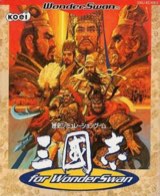
Koei's WonderSwan port of its 1992 Game Boy Sangokushi, a Three Kingdoms war game, with portraits from Sangokushi V and two-player battles over the link cable.
Screenshots
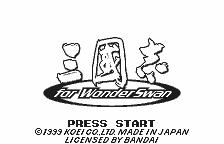
Title screen 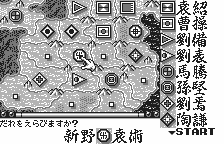
In play 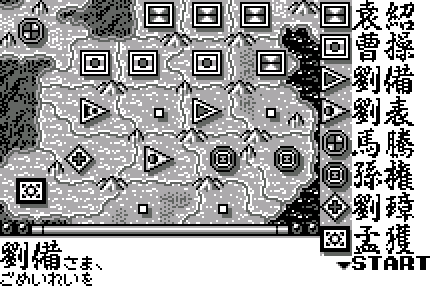
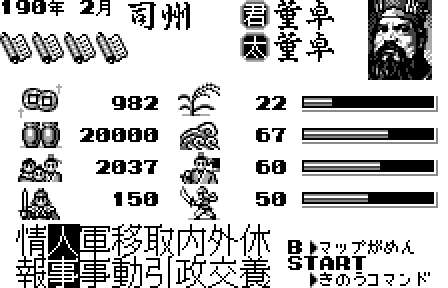
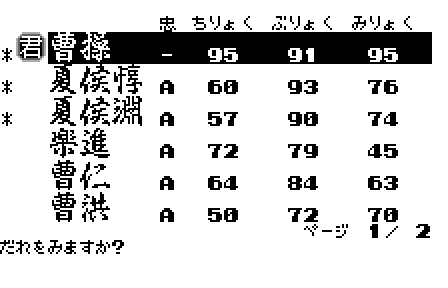
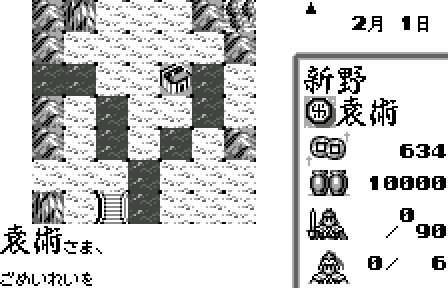
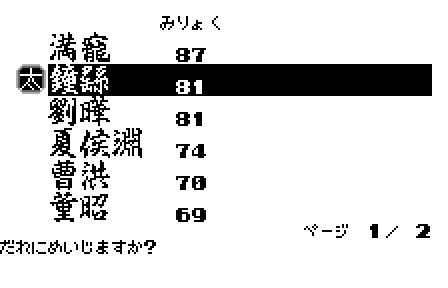
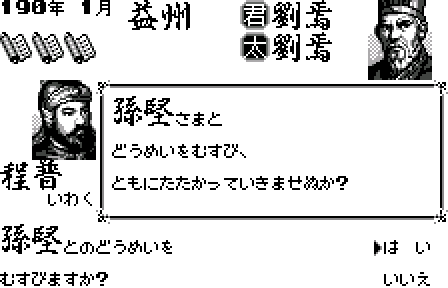
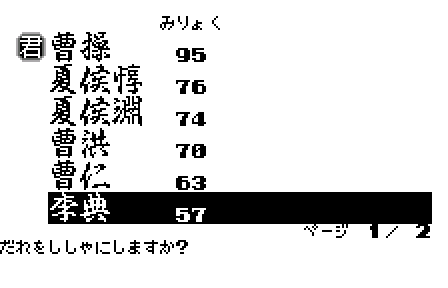
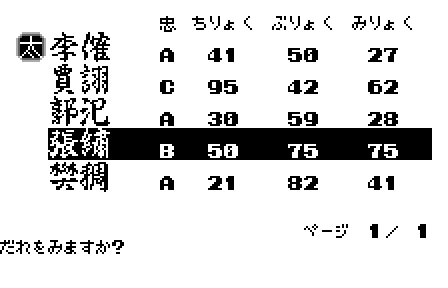
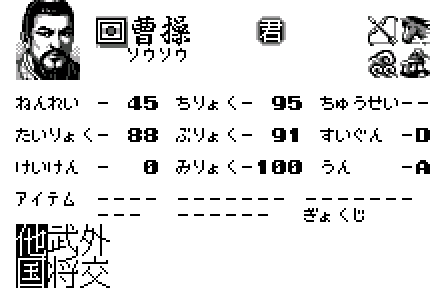
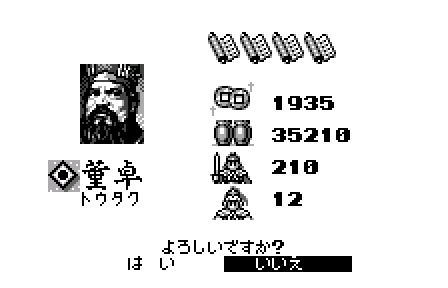
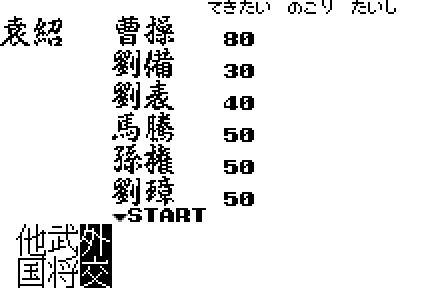
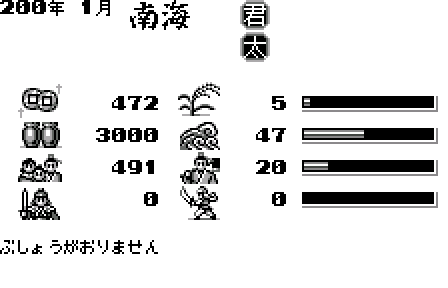
Sangokushi for WonderSwan is a historical strategy game from Koei’s Sangokushi series, known in English as Romance of the Three Kingdoms. It came out in Japan on 1 April 1999, less than a month after the WonderSwan itself went on sale, which made it one of the console’s earliest games. It is a reworked version of the Game Boy Sangokushi that Koei released in 1992.
The player takes the part of a warlord in late Han China and works to unite the land by running provinces, managing generals and going to war with rival rulers. There are two scenarios, set in 190 and 200, and about two hundred generals to command. Alliances are limited to one at a time, and wars between neighbouring states can drag other provinces in, so the map can change quickly.
The story
The game is set at the end of the Later Han dynasty, when the court has lost its grip and regional warlords carve China up between them. It follows the period covered by the Chinese historical novel Romance of the Three Kingdoms, and Koei’s product page sold it on its cast of strong-willed men such as Liu Bei, Cao Cao, Zhuge Liang (Kongming) and Lu Bu, clever strategists and fierce warriors alike, each fighting to take the whole continent. There is no storyline in the sense of a role-playing game: the history provides the starting map and the people, and what happens afterwards is up to the player and the rival rulers.
The two scenarios set the scene. Dong Zhuo’s Tyranny begins in 190, with the tyrant Dong Zhuo holding the capital region around Luoyang and the warlords of the provinces around him, among them Cao Cao, Sun Jian, Liu Bei, Yuan Shao, Yuan Shu, Liu Biao and Tao Qian, each holding a territory of their own. Liu Bei’s Hidden Years begins in 200, with Liu Bei lying low and waiting for his chance. Neither scenario reaches the later age of the three rival states of Wei, Wu and Shu; the whole game stays in the Later Han. Only some of the rulers can be chosen, and there is no option to create a ruler of your own.
Scripted history is kept to a minimum. The only historical event is Guan Yu’s thousand-li journey, which can come about in the second scenario when the player rules Cao Cao and has Guan Yu, who starts among Cao Cao’s men, at hand in a war against Liu Bei. Otherwise the story is the one the player makes: generals age and die, rulers hand power to their heirs, officers change sides, and the campaign ends when one ruler holds all nineteen provinces. Both scenarios have the same ending.
How it plays
The game is played with the WonderSwan held sideways, and it runs in turns of one month. In each turn the player gives orders to the provinces under direct rule from a command menu carried over from the Game Boy original. Information screens show any province, its generals, its diplomatic standing and the generals’ special skills. Personnel commands search for unaffiliated talent, poach generals from other rulers, dismiss officers, reward them with gold to raise their loyalty, appoint governors, set the policy for delegated provinces and name an heir. Military commands declare war, draft soldiers for gold, drill them to raise their strength and mobility, and hand out gold or rice to keep the troops loyal. Others move generals and goods between the player’s provinces, buy and sell rice with a merchant who is sometimes away, spend gold on farmland, flood control and gifts to the people, and handle diplomacy through marriage ties, alliances and trades of goods with an ally. Resting simply passes the month.
Taxes come in once a year, in January, and the amount depends on how far a province’s farmland has been developed and how loyal its people are. Provinces not under the ruler’s direct control are run by delegation, and vassal states take their orders through written instructions rather than direct commands. Vassals are always delegated, and some instructions make them play badly, so telling them to build up their wealth is the usual safe choice.
Going to war costs gold and rice in proportion to the size of the army. The battlefield is put together from the cities that take part, so its layout changes with each combination, and one campaign can draw in as many as five cities. A war can be fought out on the battle map, or settled quickly as a five-on-five team battle of generals, starting with the vanguard, in which one-on-one duels between officers decide most bouts. A strong duellist can rout a much larger army, and ambushes can be used to capture a dangerous opponent such as Lu Bu. Each of the generals has a special skill that can sway a battle. Empty provinces are not free for the taking: the player has to march into them directly, and unaffiliated generals living there may fight back.
Allies change the shape of a war. Only allied rulers can start wars that pull several neighbouring states in at once, which can topple a run of enemies quickly but can also overwhelm the player. When an adjacent ally goes to war, the player is drawn in whether they like it or not, and the same rule can be used to drag an ally into the player’s own war. Making a careless alliance with a strong neighbour is a common way to be destroyed early, and only one alliance can be held at a time.
People are the other thing to manage. Generals’ loyalty drops steadily, so officers defect to rivals or leave to become unaffiliated, and generals who have been let go can later turn up hidden in other provinces, and may resist when the player moves in. Strong ones such as Lu Bu or Zhang He are a real danger then, so it is safer to keep them as well-treated vassals or execute them than to let them go free. Searching is the way to find hidden talent, and some provinces hold many strong generals waiting to be found. Rulers and generals age and die; a ruler who dies with no heir named ends the game, so setting a successor matters, especially for a short-lived house such as Sun Jian’s. Late in the game, taking the last empty provinces can mean the ruler himself travelling across the map to gather soldiers, gold and rice for each invasion.
The game is simple and fast-paced next to most of the series, and its difficulty is low; a single run to unification can be finished in a few hours, though it still takes time. Expanding into empty land early and searching for strong generals are the standard advice. Apart from the main game, two players, each with a console and a cartridge, can connect them with the link cable and fight a versus match, a mode the one-player Game Boy original did not have.
Development and release
Bandai’s preview page introduced the game as Koei’s second big series on the WonderSwan, following the Nobunaga no Yabou cartridge that had come out in March 1999. Koei’s own product page advertised it as a Sangokushi made from the ground up for the WonderSwan and named Kou Shibusawa as producer. In fact it is a reworked version of the 1992 Game Boy game, with which it shares its scenarios and systems. It was sold as model SWJ-KEX002 for 4,200 yen before tax, on a 4-megabit cartridge with battery-backed memory for saved games.
Modes and features
The main game has two scenarios and is for one player, with the goal of unifying all nineteen provinces of China. There are about two hundred generals, each with a special skill. Allied rulers can join a war on the player’s side. The only other mode is the two-player versus match over the link cable.
Reception
Weekly Famitsu’s Cross Review gave the WonderSwan version 24 out of 40, two points more than the Game Boy original had received. Players have found it simpler and quicker to play than most entries in the series, though still a game that asks for a good deal of time to finish.
Ports and other versions
The game started out on the Game Boy, where Koei released Sangokushi on 30 September 1992. That cartridge was made for Nintendo’s handheld rather than carried over from one computer release. It mixes the first Sangokushi and Sangokushi II, using portraits from Sangokushi III and music from Sangokushi II, with two scenarios and 198 generals but no option to create a new ruler. The WonderSwan cartridge of 1999 keeps those scenarios, generals and rules.
Two things changed for the WonderSwan. The generals’ faces were swapped for the portraits drawn for Sangokushi V, which players have found more lifelike than the Game Boy art, and the link-cable versus mode was added; the Game Boy game is for one player only. The WonderSwan game was never ported or re-released.
Sangokushi Game Boy-ban 2, which Koei released for the Game Boy in July 1999, is easy to mistake for a sequel to this game, but it is a separate handheld version of Sangokushi II rather than a revision of the 1992 cartridge.