
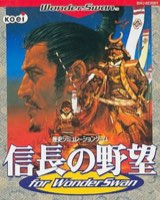
Koei's first WonderSwan game, a compact Nobunaga's Ambition in which a Sengoku warlord sets out to rule 16 provinces from Kanto to Kinki, with treasures traded by link cable.
Screenshots
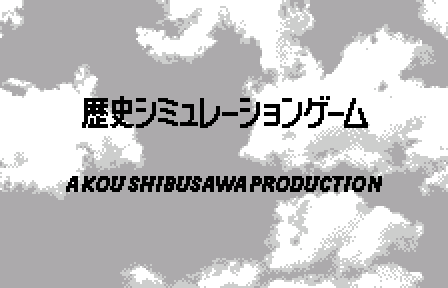
Title screen 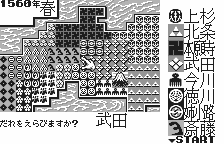
In play 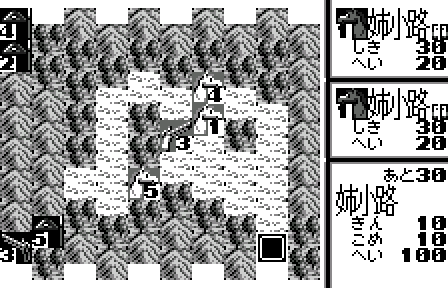
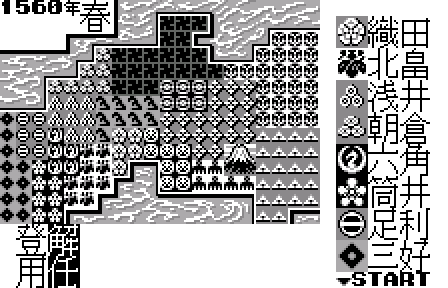

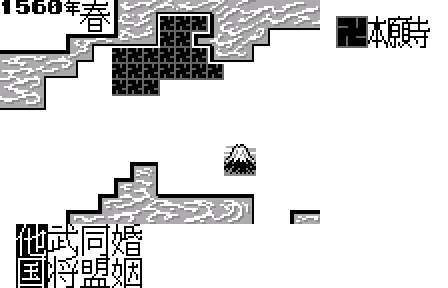
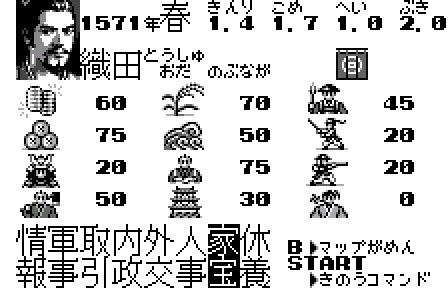
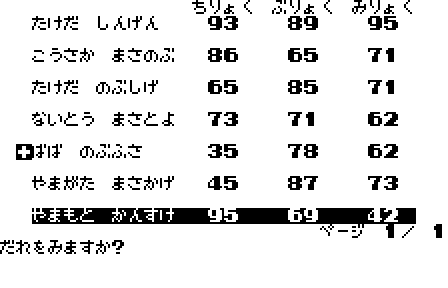

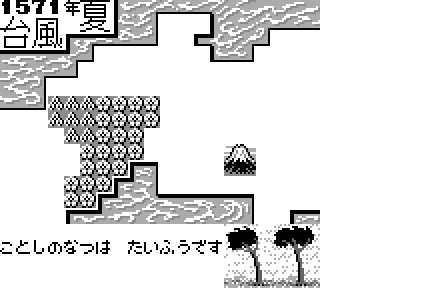
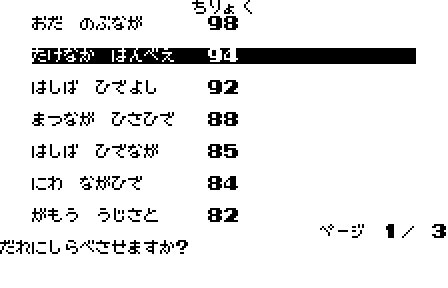
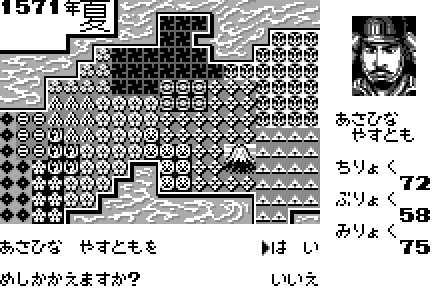
Nobunaga no Yabou for WonderSwan is a handheld entry in Koei’s Nobunaga’s Ambition series of historical strategy games, which had begun on personal computers more than ten years earlier. It went on sale on 11 March 1999, a week after the WonderSwan itself, and was Koei’s first game for the system.
The player takes charge of one of the warlords of Japan’s Sengoku period and tries to bring the land under one rule by managing domestic affairs, diplomacy and war. About a hundred officers appear. In its structure the game is close to Nobunaga no Yabou: Sengoku Gunyuuden: the map does not cover the whole of Japan, and each lord commands retainer officers.
The WonderSwan version adds family treasures, a feature Gunyuuden did not have, and two players can swap treasures between their games over the link cable.
The story
There is no written plot. The setting is the Sengoku period, and the player becomes one of the daimyo holding land in the eastern half of Japan. The map is cut down to 16 provinces running from the Kanto region to the Kinki region, and the campaign is won by ruling all of them. It is lost if the player’s own clan is destroyed, or if the daimyo dies and has no retainer left to take his place; when a daimyo dies he names a successor from among his officers, so a clan can outlive its founder.
Two scenarios set the starting position. The first, Okehazama, opens in 1560: Imagawa Yoshimoto is marching west toward Kyoto, and Oda Nobunaga of Owari is waiting for his chance. The second, the Encirclement of Nobunaga, opens in 1571: Nobunaga has entered Kyoto as the backer of the wandering shogun Ashikaga Yoshiaki, and Yoshiaki has turned against him and gathered the surrounding daimyo into an alliance to bring him down. Any of the daimyo on the map can be chosen, not only Nobunaga.
The manual introduces Nobunaga and his chief rivals with portraits: Tokugawa Ieyasu of Mikawa, Nobunaga’s ally; Uesugi Kenshin, the dragon of Echigo, a man of honour without equal on the battlefield; Takeda Shingen, the master of war and politics with his famous cavalry; and Imagawa Yoshimoto, counted the finest warrior on the Tokaido road. The rest of the story is what happens on the map, with peasant risings, rebellions by ambitious retainers, epidemics, typhoons and good and bad harvests arriving as events between turns. The background music is by Yoko Kanno.
How it plays
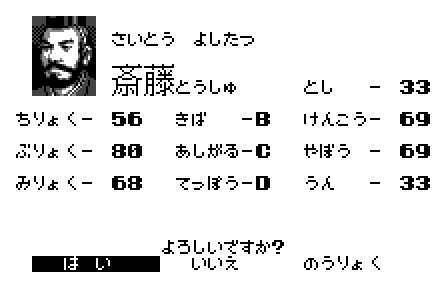
The WonderSwan is held sideways and the Y buttons are not used. The X buttons move the cursor and set numbers, one digit at a time, A confirms, B cancels and flips between the strategy screen and the map, and Start brings up officer data and a menu for message speed, animation, whether to watch other lords’ wars, and saving and loading. There are three save slots. A new game asks for a scenario, a difficulty of weak, normal or strong, and a daimyo, whose ratings can be re-rolled at random as many times as the player likes before starting.
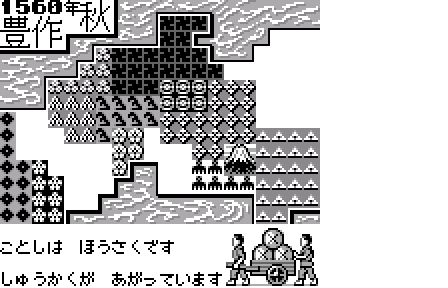
A year has four seasons and every daimyo gets one turn a season. In a turn the player gives one main command for the province: military orders (declare war, conscript troops, train them, or send a ninja to wear down an enemy daimyo’s health for 10 gold), domestic work (clearing land for rice, flood control, building up the town’s commerce, strengthening the castle, or giving alms to win the people’s loyalty), diplomacy (an alliance, or a marriage that costs more and holds more firmly; both keep the peace only until one side goes to war), personnel (recruiting officers and ronin), using a treasure, or resting to restore everyone’s health. Looking up information, trading and dismissing an officer do not use up the turn. Trading works only where a merchant is present and covers buying and selling rice, buying weapons and taking a loan that must be paid back the next spring. Gold comes in as tax in spring and rice in autumn, soldiers are paid at the same times, and rice prices move each spring.
Each officer has intelligence, martial skill and charm ratings out of 100, aptitude for leading cavalry, foot soldiers and guns graded in six steps from S down to E, as in the series since Nobunaga no Yabou: Tenshouki, plus age, health, illness, ambition and luck. There is no rating for naval combat. Charm decides how well alms and recruiting work, an ambitious officer may rebel, and luck affects the harvest. A province tracks gold and rice up to 999 each, troops up to 999, and its loyalty, flood control, castle defences, training and weapons.
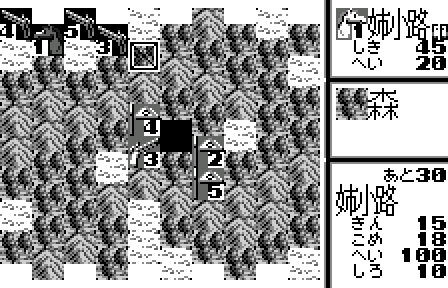
War needs gold equal to the number of troops sent, and an army that runs out of rice loses, so food has to be laid in before marching. Battles are fought on a grid of plain, forest and castle squares, with mountains and sea impassable. Each side fields up to five units, which share the troops equally. The commander leads the first, a cavalry unit that can move two squares and is strong against foot soldiers; the second is foot soldiers, strong against guns, which start hidden and hit harder from ambush; the third is guns, strong against cavalry; and the last two depend on the daimyo. Units standing next to friends get support. The defenders move first each day, then the attackers.
A battle ends when a commander’s unit is wiped out or retreats, when one side’s rice reaches zero, or when the attacker gets into the castle; after 30 days the defender wins. Retreat hands all of the army’s gold, rice and troops to the enemy. Gold can also persuade an enemy unit to change sides, at a price that rises with its size, though not the enemy commander’s own unit. Captured officers can be executed, offered a place, which some refuse, or set free. A conquered province is merged into the attacking one, adding up gold, rice and troops.
Family treasures are won by taking other provinces. There are three kinds: items an officer equips to raise his ratings, such as Onikiri, items used up when their effect fires, such as Hatsuhana, and items that work just by being owned, such as a spyglass or a copy of Sonshi. When a player wins a campaign, the treasures held are registered in a treasure house, and up to eight can be carried from it into a new game. Two players can also swap treasures from their treasure houses over the link cable, and this was probably the first game in the series to allow it.
Two consoles, each with a cartridge, can be linked for a versus game in which each player rules a clan and tries to defeat the other’s daimyo. A second player can also break into a single-player game in progress by connecting and taking over one of the computer lords. A separate war battle mode skips the strategy part: each player picks a save file, its gold, rice, troops and officers become that player’s army, and the two fight on one of three fields, plain, lakeshore or mountains, with no castle and no retreat; if 30 days pass, both players lose.
Development and release
Koei sold the cartridge under the model number SWJ-KEX001 for 4,200 yen, launching it alongside the first wave of WonderSwan software in March 1999. On 16 December 1999 Koei followed it with a limited gift package, numbered SWJ-KEX003 and listed at 9,999 yen, which paired the game with a WonderSwan console in skeleton blue.
Reception
The game drew little critical attention in Japan. Some players have found the domestic and personnel management too involved to enjoy, and the Uesugi clan is a hard start because the strong Takeda sit next door and only Kenshin himself is a standout officer.
Ports and other versions
This cartridge was made for the WonderSwan, and it is one of the series entries that only ever appeared on handhelds. It was never ported to another system or re-released. It is not a conversion of a single earlier game either: it is built from two older ones, the 1990 Game Boy edition of Nobunaga no Yabou, which itself mixed the first game with Sengoku Gunyuuden, and Sengoku Gunyuuden directly. What sets it apart from those relatives is its smaller eastern map and the family treasures that can be traded between two cartridges.