
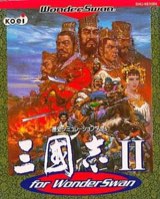
Koei's WonderSwan version of its 1989 Three Kingdoms strategy game Sangokushi II, with Sangokushi V portraits and a new biography mode for browsing the generals.
Screenshots
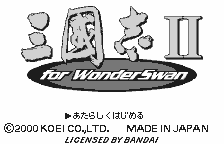
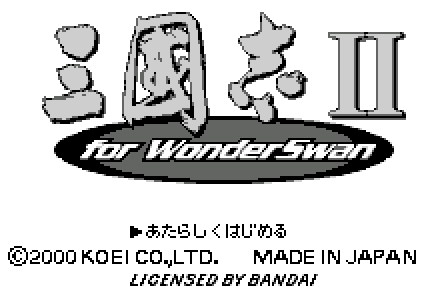
Title screen 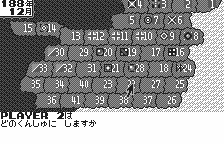
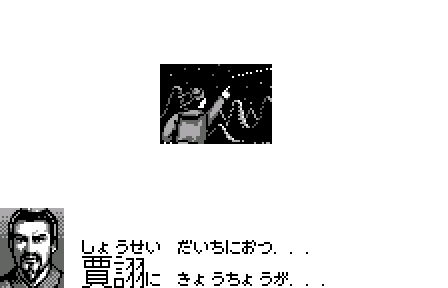
In play 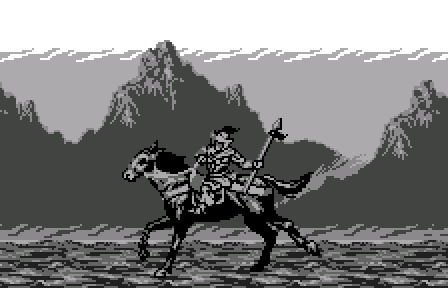
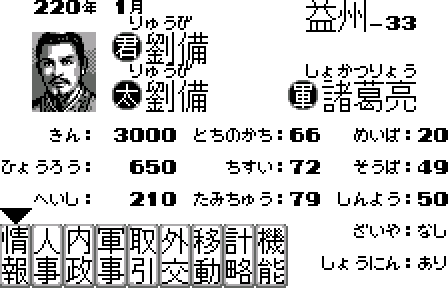
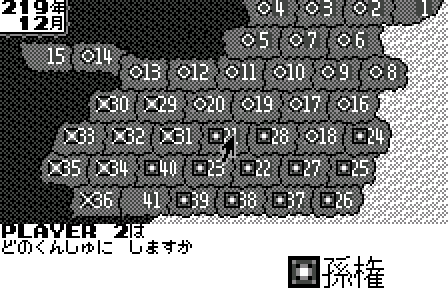
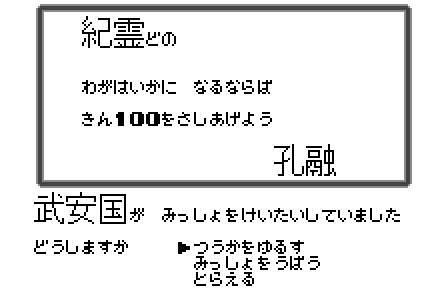
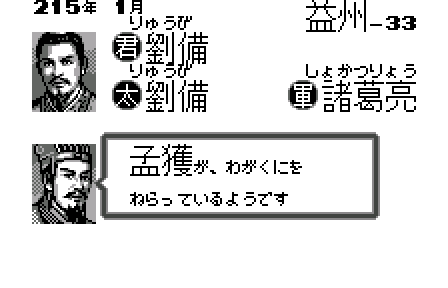

Sangokushi II for WonderSwan is Koei’s handheld version of Sangokushi II, the second game in its Three Kingdoms strategy series, first released for the PC-8801 computer in December 1989. It went on sale in Japan on 6 April 2000, a year after Koei had brought Sangokushi for WonderSwan to the console’s opening months. The WonderSwan release follows the original closely, with a handful of changes.
As in the original, the player becomes one of the warlords of the Three Kingdoms era and sets out to unite a China split into 41 provinces. Sangokushi II was built around the drama of the story more than strict simulation: a province can issue as many orders as it has generals, diplomacy depends on how far other rulers trust you, hidden values shape how each general behaves, and battles include duels between officers and ambushes.
The story
The setting is the end of the Later Han dynasty, when the court has lost its grip and regional warlords carve China up between them, the period told in the historical novel Romance of the Three Kingdoms. The player takes the part of one of those rulers. There is no written plot to follow: history supplies the starting map and the cast, and once play begins events drift away from the novel according to what the player and the rival rulers do. The aim is the same in every game, to bring all 41 provinces under one banner.
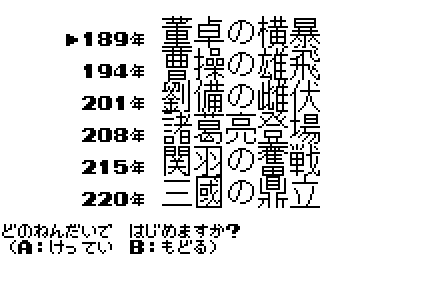
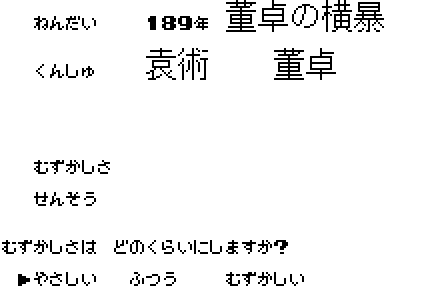
Six scenarios set the starting balance of power. Dong Zhuo’s Tyranny opens in 189, with Dong Zhuo seizing Luoyang. Cao Cao’s Rise begins in 194 as the warlords struggle for power, and Liu Bei’s Hidden Years in 201, with Liu Bei sheltering in Jing Province. Zhuge Liang Appears starts in 208, Guan Yu’s Valiant Fight in 215, and The Three Kingdoms Stand in 220, when Wei, Wu and Shu face one another. Picking a scenario and a ruler decides how large a realm the player starts with and who the neighbours are.
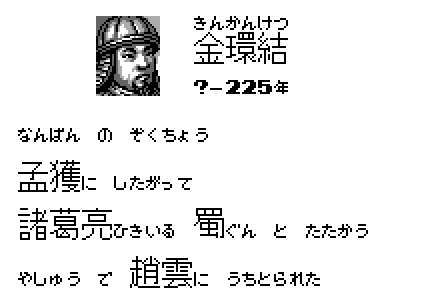
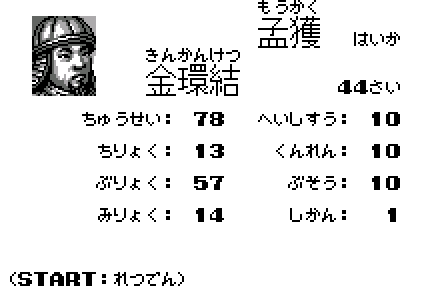
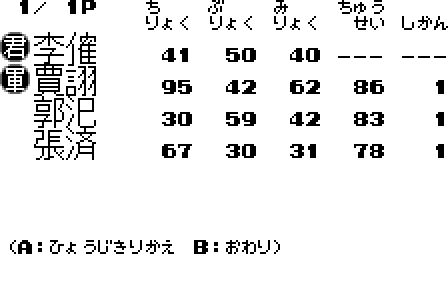
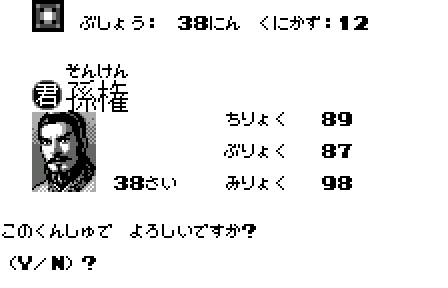
The cast numbers about 350 historical figures. Each has three open ratings for intelligence, war ability and charm, and a set of hidden values for sense of duty, virtue, ambition, compatibility with other characters and lifespan, so the same general behaves differently from another with similar numbers. The WonderSwan cartridge shows them with the portraits drawn for Sangokushi V and adds a biography mode, which turns the cartridge into a pocket reference to the Three Kingdoms cast with each figure’s profile on one screen. It does not let the player create a new ruler.
How it plays
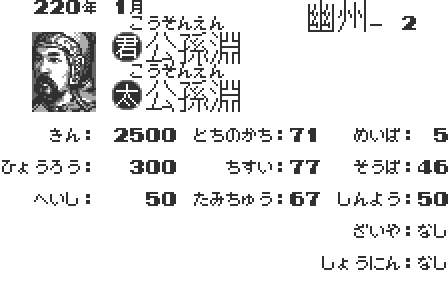
The WonderSwan is held horizontally, and the game is for one player, with progress kept in the cartridge’s battery-backed memory. Each turn, every general stationed in a province can carry out one command, so a province with a deep bench of officers gets far more done than one with a lone governor, and some commands are reserved for the ruler or the governor. Recruiting an officer from a rival or from among the unemployed depends on the recruiter’s charm and on how well the two characters get along.
Diplomacy rests on two numbers: the ruler’s trust, which rises when alliances are honoured and falls when allies are betrayed, and the other side’s hostility. Envoys travel across the map in person and can be intercepted on the way. Beyond alliances, diplomacy covers calling in reinforcements and fighting joint campaigns. Reinforcements open up tactics such as inviting an enemy attack and then catching the attacker between two armies.
Sangokushi II reworked the series’ stratagems, and the WonderSwan version keeps them. They include Hidden Poison, which plants a general in an enemy’s service who changes sides once a war starts; Two Tigers Compete, which sets two rival states fighting each other; and Driving the Tiger to Swallow the Wolf, which tempts a governor into breaking away from his ruler. Sowing an enemy within the enemy and forging letters to spread suspicion round out the set.
Battles move to a hex map. The attacker brings up to five units and the defender up to ten, and a joint force can add up to five more. Units attack, launch all-out assaults and charges, set fires, whose success turns on intelligence and which no longer wipe out a unit in one stroke, and fight duels between officers. Generals can also try to talk enemy officers into defecting mid-battle, a unit that moves into forest sets an ambush on its own, and units can lure enemies forward, while zones of control stop units slipping past each other. A battle is won by destroying the enemy, taking its base or forcing it to retreat.
Holding on to people matters as much as holding land. Because loyalty works alongside the hidden values, even a general who looks loyal can suddenly go over to a rival. Treasures such as books, swords and horses raise the stats of the officers who receive them, and characters age and die, so a ruler’s succession has to be planned.
The WonderSwan version keeps the system of the original but drops four commands: the strategist’s advice on a plan’s chances, rumours, healing and wandering. Together with the missing new-ruler option, those are the changes to the game itself, and the biography mode is the one addition. The cartridge has no link cable mode, unlike the earlier WonderSwan Sangokushi, so there is no versus play.
Development and release
Kou Shibusawa was general producer, as he had been producer of the first WonderSwan Sangokushi. Bandai’s preview presented the game as the series’ return to the WonderSwan after a year’s gap and leaned on the series’ sales on computers and home consoles to sell it. It came out as model SWJ-KEX004 at 4,200 yen before tax, on a 4-megabit cartridge with battery-backed memory for saves.
Modes and features
The cartridge holds six scenarios and about 350 historical figures, far more than the roughly two hundred of the earlier WonderSwan Sangokushi. Alongside the campaign sits the biography mode, a WonderSwan addition that presents each figure’s profile on a single screen. Unlike its predecessor on the console, this release is for one player only, with no link cable support.
Reception
Weekly Famitsu’s Cross Review scored the WonderSwan version 22 out of 40, a little below the 24 given to Sangokushi for WonderSwan the year before.
Ports and other versions
Sangokushi II was first released for the NEC PC-8801mkIISR in December 1989 and spread quickly. Versions followed in 1990 for the PC-9801, MSX2, Sharp X1turbo, FM Towns, X68000 and Famicom, then in 1991 for the Super Famicom, under the title Super Sangokushi II, and the Mega Drive, along with Amiga and DOS editions in North America. A PlayStation version followed in September 1998.
Two handheld versions came out about a year apart: Sangokushi Game Boy-ban 2 in July 1999, a Game Boy cartridge made to be played on the Game Boy Color, and this WonderSwan cartridge in April 2000. Both use the Sangokushi V portraits and drop the option to create a new ruler. The Game Boy edition cuts deeper: only well-known or highly capable officers get faces of their own, the story events are gone, and long campaigns were removed, so a war not won within a month counts as lost. Like the Game Boy edition, the WonderSwan version loses the commands for wandering, rumours and a strategist’s advice; it also drops healing, and it gains the biography mode. In Weekly Famitsu’s Cross Review the Famicom version scored highest at 30 out of 40, the Mega Drive and PlayStation versions 27, the Game Boy edition 26 and the Super Famicom version 24, against 22 for the WonderSwan.
Koei went on reissuing the game after the WonderSwan release, with a budget PlayStation edition in August 2000, Windows versions in December 2000 and in an anniversary pack in 2003, mobile phone versions from 2004, iOS and Android versions in 2010 and 2011, a browser release in 2013 and a 2017 Steam release in a collection of Kou Shibusawa’s early games. None of these is based on the WonderSwan cartridge. The 2015 Nintendo 3DS game Sangokushi 2 is easy to mistake for another version, but it is a modernised remake of Sangokushi III.