
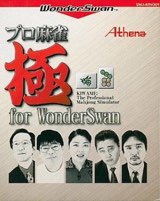
Athena's four-player mahjong against real professionals on the WonderSwan, with a ten-level system that unlocks features, a built-in rules and hand list, and link play.
Screenshots
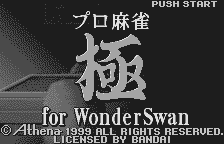
Title screen 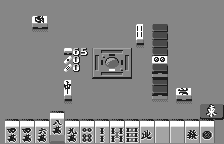
In play 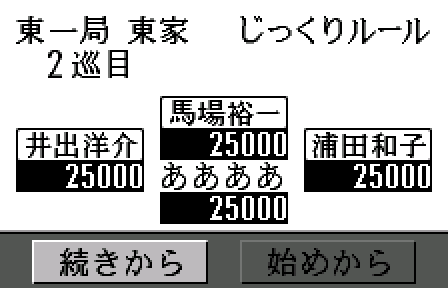
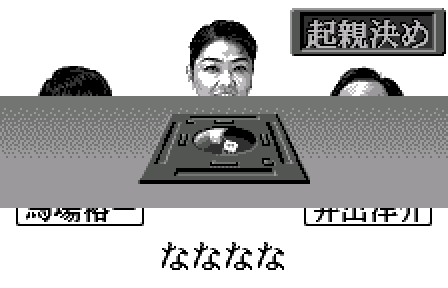
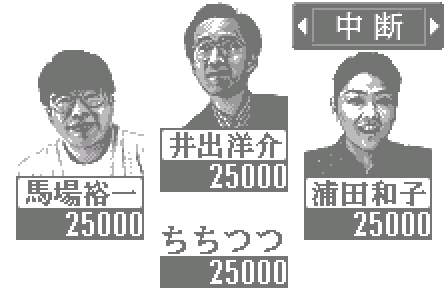
Pro Mahjong Kiwame for WonderSwan is the WonderSwan entry in Athena’s Pro Mahjong Kiwame series of four-player computer mahjong games. The series began on the Super Famicom in June 1993. The developer behind it, who also founded Athena, has said that it grew out of contact with the Japan Professional Mahjong League, which gave Athena access to professional players and led to the idea of a mahjong game built around them. Athena released the WonderSwan version in Japan on 7 October 1999, a busy year for the series that also brought a Game Boy entry and other new versions.
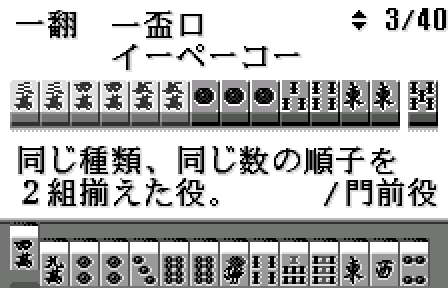
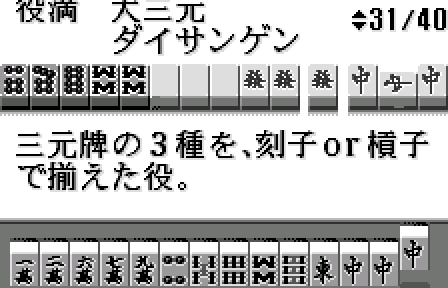
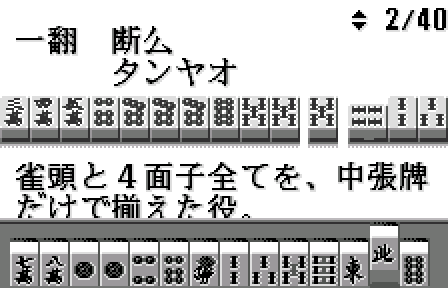
The game is four-player Japanese mahjong against three computer opponents modelled on real professional players. It was pitched at beginners and experienced players alike: the rules, a list of scoring hands and a set of help screens are built in so that the manual is not needed, and a ten-step level system opens up the rest of the game as the player improves. Progress is saved automatically.
The cartridge was made for the original WonderSwan and does not use the colour of the later WonderSwan Color. Two consoles can be joined with the link cable.
The story
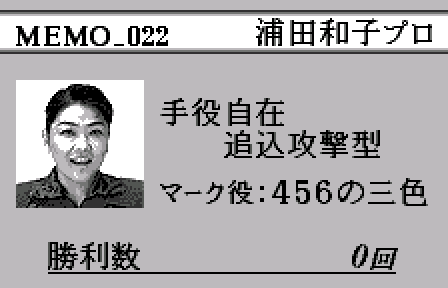
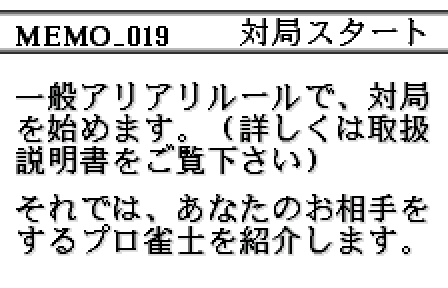
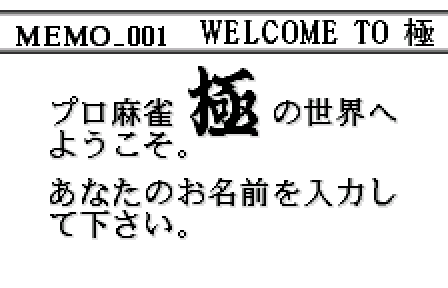
There is no story. The player enters a name and sits down at a table with three professionals, and the only thread running through the game is the climb from Level 1 to Level 10, which the manual sets as the goal. Before each step the game shows a numbered memo screen with the challenge to meet, such as finishing a half-game in third place or better, or beating Hirokazu Baba, and passing it is announced on another memo screen along with whatever has just been unlocked.
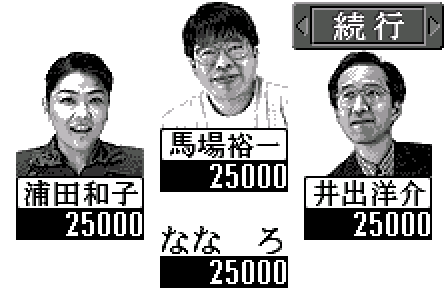
The opponents are the game’s characters, shown on screen with photographs of their faces. The manual introduces each one with a playing style and a favourite hand. Yosuke Ide plays for valuable hands but adapts freely, and likes the mixed triple sequence. Hirokazu Baba is a hand-builder of the all-out attacking kind whose mark is the concealed full flush. Kazuko Urata is a flexible attacker who chases hard and favours a triple sequence of 4-5-6. These three are the opening table.
More players join as the level rises. Yuko Ito, from Akita, a hand-builder who presses his attacks and likes the concealed half flush, arrives at Level 3, and Hiroshi Tachikawa, an all-rounder whose mark is the concealed self-drawn win, at Level 7. The last page of the line-up is a silhouette: a professional wrapped in mystery, rumoured to be a master of the style known as subspace killing, whose identity the manual leaves open. Counting the hidden ones, eight professionals can be played in all.
How it plays
The WonderSwan is held sideways. A confirms and discards the chosen tile, B cancels, and the X buttons move the cursor in menus and pick the tile to throw during a hand, while X3 opens the command menu used to call chi, pon, kan, ron and the rest. The Y buttons copy the main functions so that the whole game can be played with the left hand alone: Y1 opens the player window, Y2 cancels and Y3 discards. B or Y2 switches on a scroll mode that lets the X buttons move the view across the table, Start brings up the player window with everyone’s points, and the Sound button sets the volume in three steps. One habit to learn early is that the tile to discard has to be chosen before riichi is declared; choosing riichi first and then a tile throws a different tile and no riichi is made.
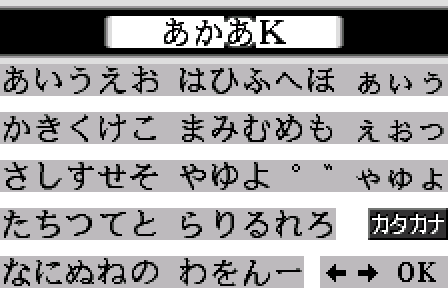
A new game asks for a name, typed in katakana, and then runs through help screens that explain the basics. At first the main menu offers only a match. The game saves automatically after every discard, so a session can be ended by switching the console off and picked up later where it stopped, and the player window has commands to carry on, move to the next hand, stop for now, end the half-game early or save the hand to the album. Holding X1 and pressing A on the title screen wipes the saved data.
The level system decides what the menu holds. Level 2 adds link play and the memo book, which keeps every help screen seen so far for reading again; Level 3 adds the choice of rules and of opponents, Level 4 starts keeping score records, and Level 5 opens the album and the replay feature. From Level 3 the player picks the three opponents from every professional unlocked so far. The conditions for later levels can be looked up in the memo book. The early steps are not hard to clear.
The rules are fixed and follow common Japanese practice. Each player starts with 25,000 points against a target of 30,000, open all-simples counts and tiles may be called before the hand has a sure yaku, and when two players could win on the same discard only the one nearest in turn order takes it. There are no double yakuman and no liability payments, 30 fu with 6 han or 60 fu with 5 han is rounded up to a mangan, and every dora, uradora, kandora and kan uradora is worth one han. Riichi costs 1,000 points and cannot be declared without a ready hand or taken back, a player who is not ready at an exhaustive draw pays 3,000 points in all, and four kinds of abortive draw are in force. The game recognises 39 scoring hands, and a full description of each can be called up mid-hand from the command menu.
From Level 3 two rule sets are on offer before each match. The leisurely set plays a full east-south half-game, keeps the dealer on a ready hand, does not end the game when someone drops below zero and does not let the leader call it off in the last hand. The quick set, meant for short sessions, plays the east round only, keeps the dealer only on a win, ends the game when a player goes below zero and lets a dealer who is in the lead stop at the last hand. The score records keep the best results in a growing list of categories. The album stores a whole hand from the deal to the scoring, with more slots as the level rises, and plays it back either as it happened or through the tarareba replay. That mode restarts the hand from the first draw with the same wall, so the player can try a different line, though a call changes the order of the draws that follow.
Link play needs two cartridges and two consoles, both players at Level 2 or higher. The two humans sit opposite each other with two computer professionals filling the other seats, the rules and opponent choices of whichever player has the higher level are used, nothing is saved automatically and the score records are not affected.
The opponents are strong but play a readable, consistent game that does not feel like cheating, and the tempo is brisk for a handheld mahjong game. The weakness is the screen: the discards are drawn so small that they are hard to make out, which makes it easy to miss a tile and fall into furiten.
Development and release
Athena both made and published the game; the copyright line names Athena alone, and the whole series was developed by Athena itself. The cartridge was sold as SWJ-ATN001 for 3,800 yen before tax and came out the same day as several other WonderSwan releases, among them Densha de Go! 2 and HarobotS.
Ports and other versions
Pro Mahjong Kiwame for WonderSwan is an entry of its own, made for the WonderSwan, and it was never ported to another system or re-released. Kiwame games appeared on most consoles of the 1990s, from the Super Famicom and Game Boy to the Saturn, PlayStation, Nintendo 64, Dreamcast and Windows, and in 1999 alone the series also gained Kiwame GBII for the Game Boy in March, which supports the Game Boy Color, and the PlayStation’s Tengen-sen edition three weeks after this cartridge. Unlike that Game Boy contemporary, the WonderSwan entry has no colour support, and the later WonderSwan Color received no Kiwame game of its own.