
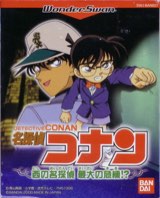
Bandai's second Detective Conan mystery adventure for the WonderSwan, in which clues found in investigations unlock logic puzzles and Heiji Hattori takes a leading role.
Screenshots
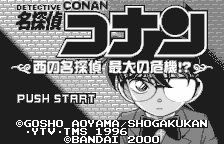
Title screen 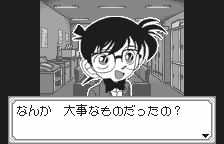
In play 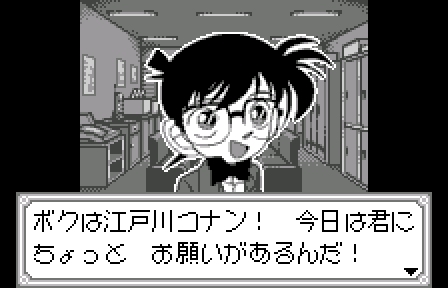
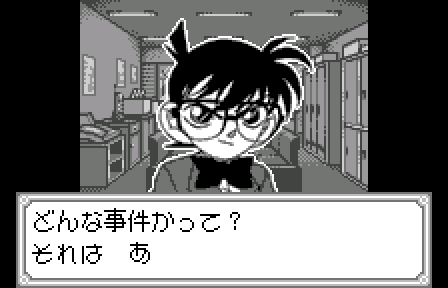
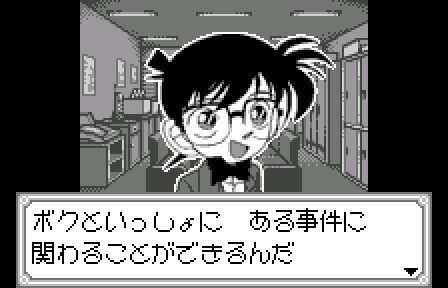
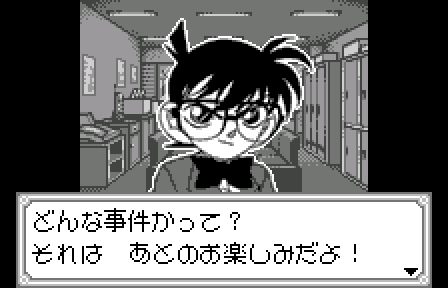
Meitantei Conan: Nishi no Meitantei Saidai no Kiki!? is a mystery adventure based on Detective Conan, the manga by Gosho Aoyama that was also adapted as an anime. Bandai released it on 27 July 2000 as its second Conan game for the original WonderSwan, following Majutsushi no Chousenjou! from 1999. The title points to Heiji Hattori, the detective from western Japan, who appears alongside Conan. It brings back characters from the first game and builds on its systems.
Play centres on investigation. Hints and key statements picked up from witnesses feed a logic grid that has to be worked through to reach the solution, and some scenes break up the deduction with a chase in which Conan follows a suspect through several areas.
At the start the game takes down details about the player and turns them into a character who appears in the story. Owners of the game can swap these characters with each other by joining two WonderSwans with the link cable. The game is for one player, and it was followed in 2001 by Yuugure no Oujo for the WonderSwan Color.
The story
The setup is the one the series is built on. Shinichi Kudo, a high-school detective, was made to swallow poison by men in black after seeing them at a shady deal and was left in the body of a child. Calling himself Conan Edogawa, he lives at the Mouri Detective Agency, where he hunts for the men while taking on difficult cases. The tagline sets the tone for the game as a whole: a sinister hand is closing in on Heiji Hattori, the great detective of the west, and the flames of revenge threaten to swallow Conan and Ran as well.
The cast is introduced as in the series. Ran is Kogoro’s gentle daughter, waiting for Shinichi to come home, and Kogoro is a former police detective whose fame as “Sleeping Kogoro” is really Conan’s doing. Ayumi, Genta and Mitsuhiko are Conan’s classmates in Teitan Elementary’s first-year class B and form the Detective Boys, Ai Haibara is a scientist once known as Sherry in the black Organization who shrank from the same poison, and Professor Agasa is the inventor next door who knows Conan’s secret and builds his gadgets. Sonoko is the daughter of the Suzuki conglomerate whom Conan sometimes puts to sleep with the stun gun so that she can play the detective. The police are represented by Inspector Megure and detectives Sato and Takagi, and Ran’s mother Eri Kisaki, a lawyer, also appears. Heiji is the son of Osaka’s police chief and a high-school detective on a level with Shinichi who knows Conan’s identity, and Kazuha Toyama is his childhood friend. Alongside them, original characters fill the roles of suspects, culprits and passers-by, and they can take the names the player has stored in the game.
There are five cases after a short tutorial. In the first, Mitsuhiko’s father arranges for the Detective Boys to watch adults at work, but Genta goes off to buy lunch and does not come back; the children split into two groups and search the town for him, and he turns out to be shut in somewhere unexpected. In the second, after the Detective Boys settle a request to find a parakeet, Conan comes across Sato and Takagi asking questions about a recent jewellery robbery. A gunshot follows, and the man found dead in a locked room is the owner of the robbed shop, holding the pistol that was used in the robbery.
Heiji arrives in the fourth case, when a letter reaching Kogoro announces a plan to murder him. Heiji visits the agency with Kazuha and insists it is only a prank, but Conan feels uneasy, and his fear comes true at the Beika Hotel where the two are staying. Heiji appears only in the last two cases. The scenarios do more than set puzzles: many of the hints have nothing to do with the crime itself and instead fill in the characters and the bonds between them.
How it plays
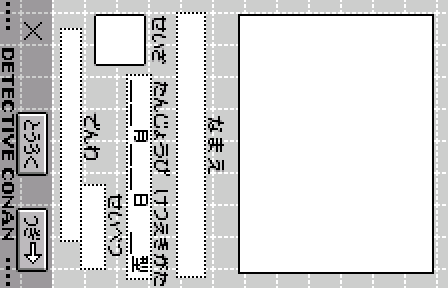
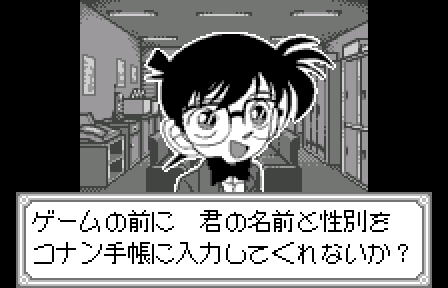
When the cartridge is first switched on, the player registers as a user, entering personal details and favourite things; only a name and sex are required, and the entry can be edited later. These details and the friends stored in Conan’s notebook are cast as the original characters in the cases. Holding A at power-on reruns the casting with other people’s data, but doing so wipes the record of cleared cases and restarts from the first one, and holding A and B at power-on offers to erase all saved data.
The title menu has four modes: the scenario mode, which is the game itself, Conan’s notebook, data exchange and extras. In the scenario mode only the short tutorial case, built around Ran, can be chosen at first, then one case at a time opens as each is cleared. Before a case starts the player chooses Easy or Normal. Easy makes the grids easier, but the rating can then be no better than C and part of the ending is not shown. The best rating for each case is shown on the selection screen.
Investigation and the town map are played with the console held sideways. The X buttons move the cursor, A confirms and advances text, and B cancels or speeds up messages, while the Sound button sets the volume in three steps. The investigation screen has up to four icons: the bow-tie voice changer for talking to people nearby, the turbo skateboard for moving to another place, the notebook, and a special icon that changes with the situation into the magnifying glass, the stun gun or the Detective Boys badge. Choosing the magnifying glass opens a free investigation in which a cursor is moved around the scene to examine it, and the scene cannot be left until all the needed information has been found. The map of Beika marks seventeen main places, among them the Mouri agency, Agasa’s house, the Beika Hotel, department store, station and library, the Tohto Art Museum, Teitan Elementary and Tropical Land, and some buildings have maps of their own.
Statements that hold a key to the deduction are recorded in the notebook as key statements. Hints are collected the same way, and the player can open the hint list in the notebook and press the right person about the right hints, as many at a time as the hint icon on screen shows; a well-chosen combination draws out new information or an important key statement, though some hints have no bearing on the case. At certain points the story offers a choice, such as whether to gather information with Haibara at the hotel or outside with Ayumi, and each branch leads the case along a different path.
Some scenes switch to a chase screen. Instead of moving freely, Conan reads the messages and choices to decide which marked section of the map to enter, and every move or choice uses up the remaining time, so the target has to be found as quickly as possible.
The grid, called the Marubatsu-ru, is played with the console turned upright. The Y buttons move a pencil cursor, X1 and X2 scroll through the key statements, X3 writes or erases a circle and X4 a cross, and B opens a menu for saving or returning to the investigation. Only squares where both items have been revealed by key statements can be filled, so blanks show that statements are still missing, but the grid can be opened and marked at any time. Every pairing is one to one, and the tutorial explains it with Ran trying to remember a cake recipe: four ingredients, flour, sugar, butter and eggs, matched to four weights of 165, 110, 80 and 20 grams from her four recollections. When every square is marked, the confirm button checks the answer, and solving the grid clears the stage.
The game saves itself after every stage, and saving from the map menu or the grid menu allows play to stop partway through a stage, to be picked up again from the title screen. Each case ends with a rating from A, the best, down to E, and the rating and the way the case was investigated decide which of three endings is shown, which gives a reason to replay a case for an A. The notebook is a separate mode played upright, holding up to 20 friends, a calendar of about three years with stamps and notes, a weekly school timetable, a fortune in which Conan draws a card for the day, and profiles of 20 characters. Data exchange swaps user data with a friend over the link cable and adds it to the notebook as a business-card page, and the extras mode gathers the pictures seen in the cases into a gallery to complete.
Development and release
Bandai introduced the game by recalling that the first Conan game had sold 100,000 copies the year before. It promised five scenarios again, the keyword trigger and the Marubatsu-ru logic grid from the first game in an improved form, and a new chase puzzle for scenes in which a culprit is pursued. It announced a 16-megabit cartridge with 256 kilobits of save memory, play with the console held either way, stereo sound, link-cable support and a provisional price of 3,800 yen before tax. The model number is SWJ-BAN027. Tomcat System developed the game, and Bandai and Caramel Mama are also credited.
Modes and features
Compared with the first game, the investigation adds the hint system, the grid no longer flags a mistake straight away, which makes the puzzles stricter, and some scenes add an examination of the screen or a car chase that follows the information gathered. Saves can now be made partway through a case. Grid keywords now use kanji and are enlarged when the cursor rests on them, and the console has to be turned upright only for the grid and the notebook. Bandai suggested carrying the notebook as a simple address book, so that a friend stored in it might turn up as a suspect or a victim.
Reception
It is generally judged an all-round improvement on the first game, praised for the smoother controls and menus, the new hint system and chase scenes, and scenarios that bring out the relationships between the characters well. Its faults are that the scenario title screens and the new effects for collecting statements cannot be skipped, the grids are all of the smaller size, and the bonus puzzle collection of the first game was dropped. Players often point out that Heiji, despite the title, appears only in the last two of the five scenarios. Players new to the series have found it absorbing and suitable for adults as well as children, with the logic grid making the player think instead of just clicking, though the lack of a backlight made the screen hard to read.
Ports and other versions
The game was made for the WonderSwan and was never ported or re-released. It belongs to Bandai’s trio of WonderSwan Conan games, built around the Marubatsu-ru logic grid, which stand apart from the series’ map-based detective adventures on the Game Boy and PlayStation. Two weeks after it came out, Bandai released 3 Nin no Meisuiri for the PlayStation, which also gives Heiji Hattori a scenario of his own; it is a separate game with its own cases, not a version of this one.
Later history
The game was followed in 2001 by Yuugure no Oujo for the WonderSwan Color, which can take over this game’s notebook data through the link cable, keeping the names that the player assigned to characters.