
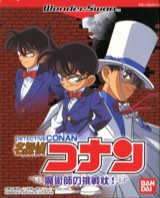
Bandai's first Detective Conan game for the WonderSwan, a set of separate mystery cases solved through choices and logic-grid puzzles, tied to the 1999 film.
Screenshots
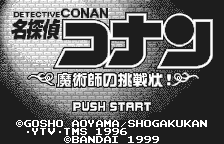
Title screen 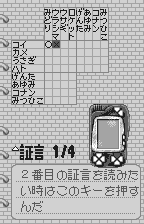
In play 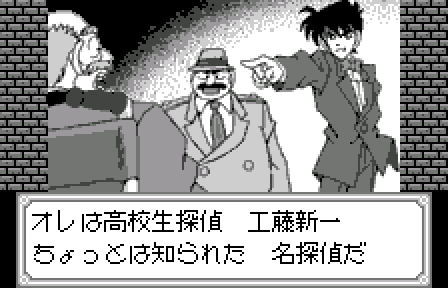
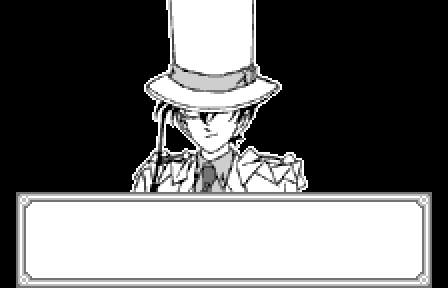
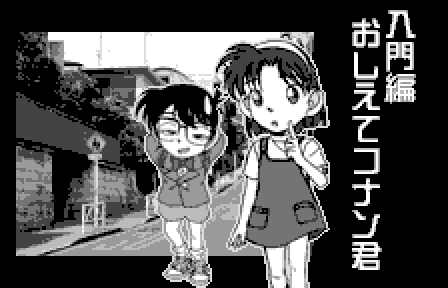
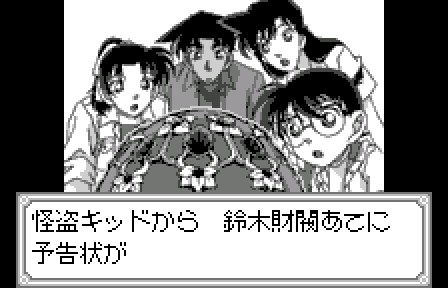
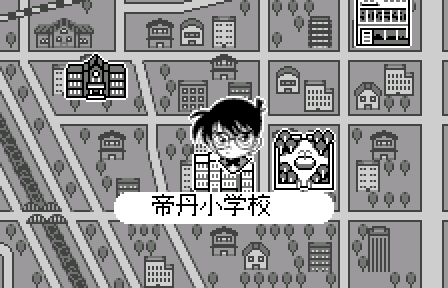
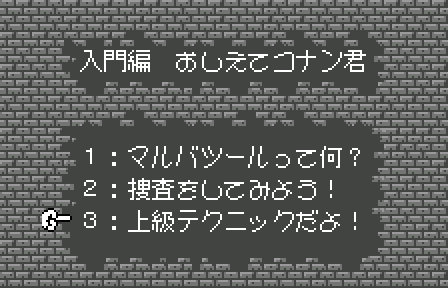
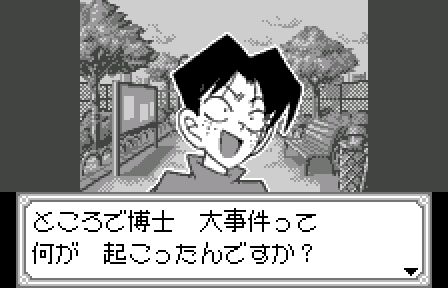
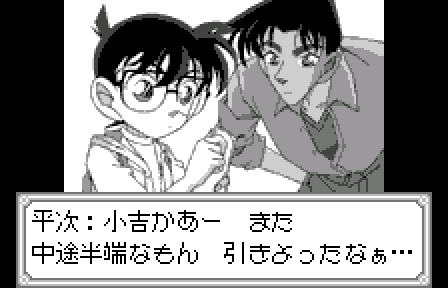
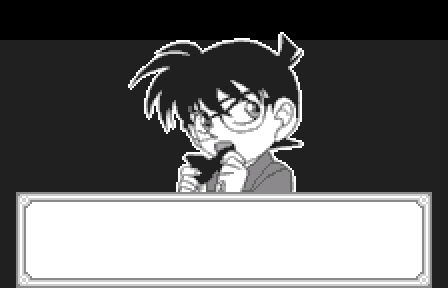
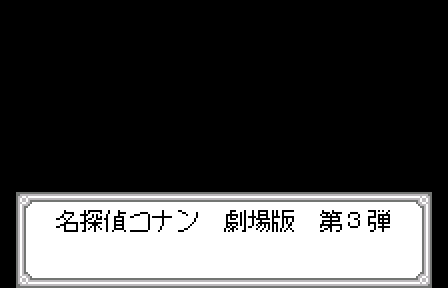
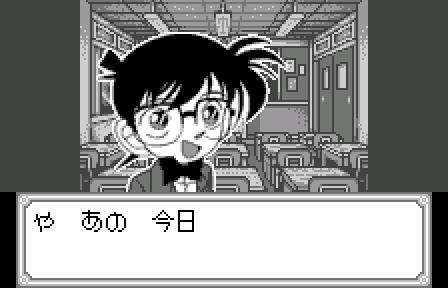
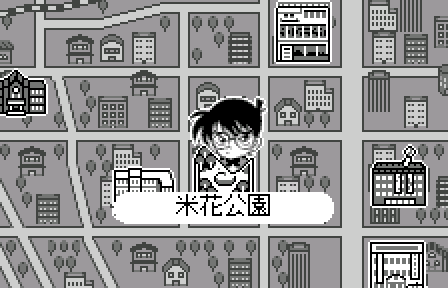
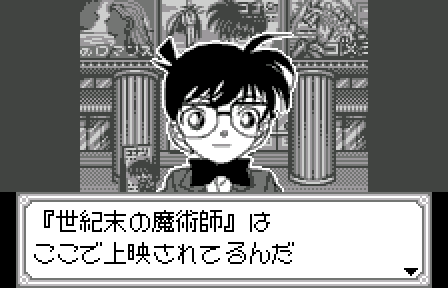
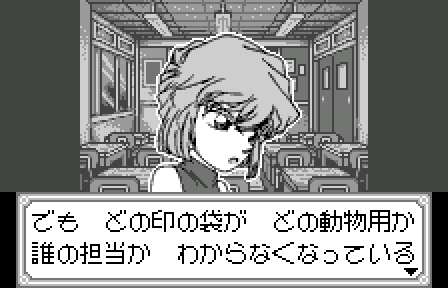
Meitantei Conan: Majutsushi no Chousenjou! is a mystery game based on Detective Conan, the manga and anime known in English as Case Closed. Bandai released it on 5 August 1999, five months after the WonderSwan went on sale, and it was the first Conan game on the system. Bandai holds the copyright, and the studio Tomcat System developed it.
Rather than one long story, the game collects a number of separate cases. Each investigation is followed on adventure-style screens, and every case is cracked by solving logic puzzles laid out as a grid of true and false marks. The cast is drawn from the series, from Conan and the Detective Boys to the Mouri family, the police, Heiji Hattori and the phantom thief Kaito Kid, with Beika town as the main setting.
The game was made to tie in with the third Conan film, The Last Wizard of the Century, released in Japan the same year, and one of its scenes, centred on a Fabergé egg, is taken from that film.
The story
Shinichi Kudo is a celebrated high-school detective until men in black force a poison on him and he wakes up in the body of a small child. Hiding his identity under the name Conan Edogawa, he lives at the Mouri Detective Agency with his childhood friend Ran and her father Kogoro, a private detective. The game opens on this setup, with Shinichi and the men in black Gin and Vodka in its introduction, and its tagline puts the player in the role of the one who has to solve the magician’s challenge.
The cast is introduced much as in the series. Kogoro is known as “Sleeping Kogoro” for cases that Conan in fact solves while he dozes, Heiji Hattori is an Osaka high-school detective and the police chief’s son who knows who Conan really is, and Kaito Kid is a gentleman thief and master of disguise. Conan’s classmates Ayumi, Genta and Mitsuhiko form the Detective Boys, Ai Haibara is a former member of the black-clad Organization, and Ran’s wealthy friend Sonoko sometimes takes the credit for Conan’s deductions. Inspector Megure leads the police, and more than twenty other people appear across the cases, among them Eri Kisaki, Shiratori, Kazuha, Yoko Okino, Eiichi Yamagishi, Ginzo Nakamori and Agasa.
The first real case begins when Keiko, a classmate of Ran’s, has been missing for three days. Her parents and the police assume that she has run away from home, as most missing high-school girls have, but she left behind her cash card and her clothes, so Conan goes with Ran to look for her. The trail leads around Beika, to people such as the priest of the local church, and the manual presents this disappearance as only the start of something larger.
After a tutorial with the Detective Boys, the game holds five cases: a string of kidnappings of high-school girls, a murder on the set of a suspense drama, killings modelled on Jack the Ripper, a mystery that starts with a thief’s warning letter and brings in Kaito Kid, and a treasure hunt at the end of the century that follows on from it. Only two of them are murders; the later cases lean towards treasure hunting and a lighter tone, with a rooftop chase after Kid at the Beika Art Museum. The last case ties back to an object seen in the earlier stories, and the Fabergé egg scene links it to the film.
How it plays
The title screen leads into the scenario mode. On a first play the tutorial must be finished before any other case can be picked, and it runs as three short lessons that explain what the logic grid is, how to investigate and a few advanced techniques. Progress is kept in the cartridge’s save memory: resuming carries on from the saved point, while picking a fresh scenario discards the old save, and holding A and B while switching the console on offers to erase all data.
Each case opens with drama scenes and is split into stages. Within a stage the player moves between three screens, the investigation screen, the map of Beika and Conan’s notebook, and solving the stage’s grid puzzle clears it and moves on to the next. When every stage is cleared the ending plays and a further case opens. Wrong choices never end the game, so a case can always be finished.
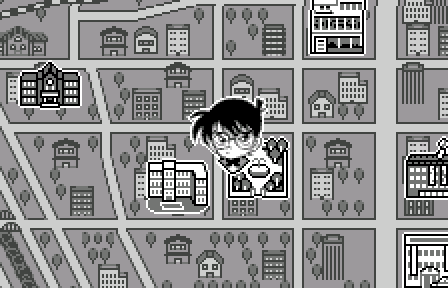
The investigation screen and the map are played with the console held sideways. The X buttons move the cursor or the map marker, A confirms and advances text and B cancels, while Y is not used. The town map shows buildings that can be entered, among them the art museum, the church, a cinema, a department store, a park, the police station, the Mouri agency, Teitan Elementary, Tohto Tower and Tropical Land, and some places open an enlarged map of their own. Pressing B on the town map brings up a menu for opening the notebook or suspending, and the game can only be saved by suspending from that map, not from an enlarged one.
Commands on the investigation screen are six icons, each one of Conan’s gadgets, and only those lit up can be used at that moment, with the set changing as the case goes on. The tracking glasses examine the surroundings and at times act as a tracker or bug detector, and the stun-gun wristwatch can put someone to sleep when the story calls for it. The bow-tie voice changer is used to talk to people nearby and sometimes to speak in another voice, and the Detective Boys badge calls up friends, mostly the Detective Boys. The turbo skateboard moves Conan around the town or the enlarged map, and the power-kick shoes are for kicking when a fight comes.
The notebook and the grid are played with the console turned upright. The Y buttons move the cursor, X1 and X2 page through statements, X3 writes a circle and X4 a cross, and B opens a menu for suspending, carrying on or reading a summary of the story. The notebook holds every statement collected so far, profiles of the people Conan has met and a log of his own actions, and from it the grid can be reached.
The grid opens for filling only after all the statements for a stage are in hand and Conan has his flash of inspiration. Each statement links keywords such as people, objects and places strictly one to one, so the player marks a circle where two keywords match and a cross where they cannot, and combining statements fills in the remaining squares. The tutorial shows this with Ayumi, Genta, Mitsuhiko and Conan, four bags of feed and four animals at school, a turtle, a rabbit, a carp and a pigeon, worked out from five of Ayumi’s remarks. Mistakes in the grid are flagged at once, and filling every square clears the stage.
Each case records the clear time and number of misses, and a record is only replaced when both are better. An overall rating appears after the fifth case. Clearing every case opens the puzzle mode, a set of 30 grid problems with their difficulty shown in stars and the best time kept for each; three misses end the attempt and the problem has to be done again, and the difficulty climbs towards the end of the set. The cases themselves are easy, and the bonus problems give the game most of its length. The official complete guide published by Shogakukan in September 1999 carried an extra scenario of its own, a challenge from Yusaku Kudo, which exists only in the book.
Development and release
Bandai presented the game as a scenario tie-in with The Last Wizard of the Century, which had opened in cinemas over the Golden Week holidays that spring, and promised five entirely new cases. It announced an 8-megabit cartridge with 256 kilobits of save memory, stereo sound, play with the console held either way, one player and a provisional price of 3,600 yen before tax, with link-cable support still undecided at the time. The model number is SWJ-BAN012. Bandai and Caramel Mama are also named alongside Tomcat System as developers, so Caramel Mama probably had a hand in the work, though its role is unknown. When Bandai announced the sequel a year later, it said this first game had sold 100,000 copies.
Modes and features
Counting the tutorial, there are six scenarios, chosen from the title menu. Only some are open at first and more appear as the player clears them. Small grids relate three groups of keywords, such as people, times and actions, and large ones four. In the bonus set of 30 grid puzzles a rank based on mistakes and time is given at the end, and finishing the set unlocks an extra epilogue. The tutorial case also includes a trailer for the film.
Reception
Fans regard it as a good puzzle game more than a true detective adventure. It is praised for its attractive artwork, its many event pictures and how well it captures the mood of the series, and the logic grids are thought cleverly written, with clues phrased in ways that make the player think and a difficulty that rises steadily through the bonus puzzles. Because wrong choices never end the game and mistakes in a grid are pointed out at once, the cases themselves are easy. Players dislike having to return to the map and turn the console round every time they want the notebook, the fact that the game can only be suspended from there, the lack of any reason to replay a case, and a bonus epilogue that is felt to ignore a central premise of the manga. The grid system is generally found distinctive and fairly enjoyable.
Ports and other versions
The game was made for the WonderSwan and was never ported or re-released. Bandai’s earlier Conan adventures had come out on the Game Boy in 1996 and 1998 and on the PlayStation in 1998, games that advance the story by moving around a map. This one sets that aside for adventure screens and the Marubatsu-ru logic grid, and it is a mix of mystery and puzzle rather than a detective adventure. The Conan games Banpresto released for the Game Boy Color from 2000 are separate titles, not versions of this one.
Later history
The game began a run of three Conan titles on the WonderSwan. Nishi no Meitantei Saidai no Kiki!? followed in 2000 with a refined version of the same system, and Yuugure no Oujo concluded the series on the WonderSwan Color in 2001, where entering this game’s product code changes parts of the story.