

The first of three WonderSwan Color games retelling the original Mobile Suit Gundam, covering the first twelve episodes with screens modelled on the TV anime.
Screenshots
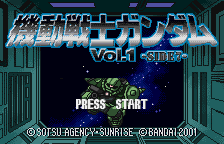
Title screen 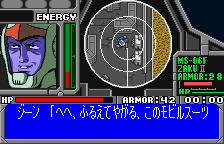
In play 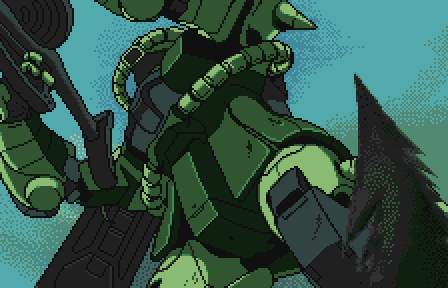
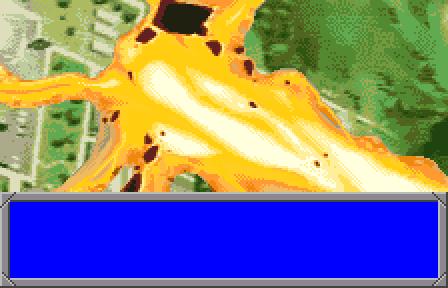
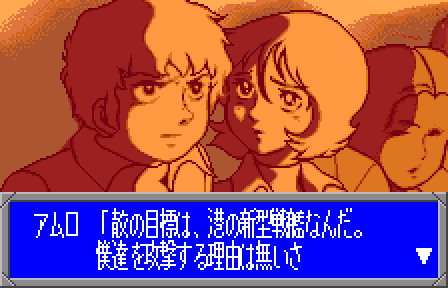
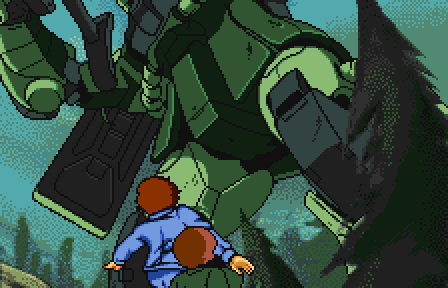
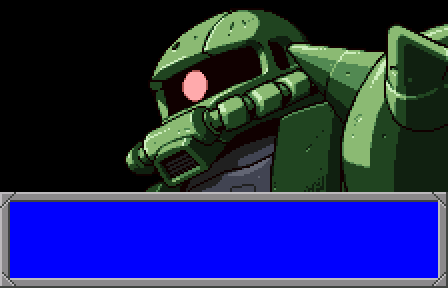
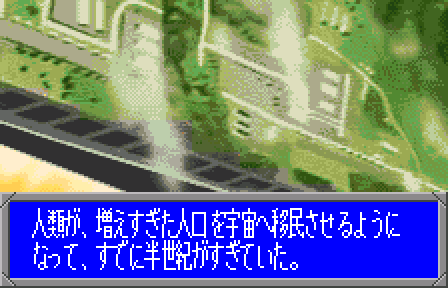
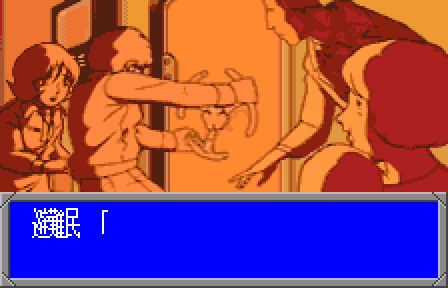
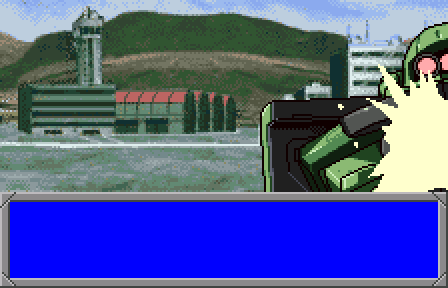
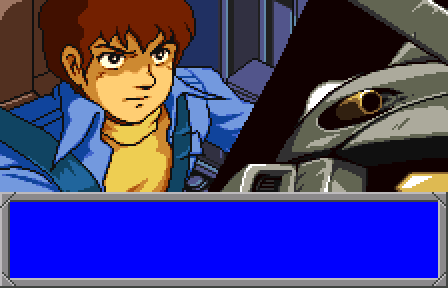
Kidou Senshi Gundam Vol. 1: Side 7 opens a trilogy of WonderSwan Color games that retell the first Mobile Suit Gundam television anime. Bandai planned the three cartridges to cover the whole story of the TV series and the films between them, and this first part runs from the first episode to the twelfth. It came out on 1 February 2001, less than two months after the WonderSwan Color went on sale, and Bandai described it as an adventure game with simulation elements.
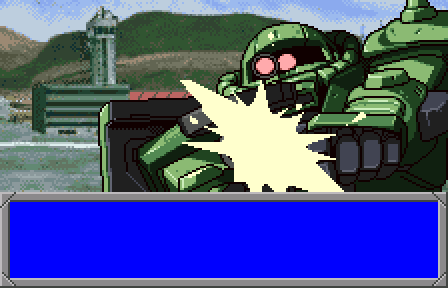
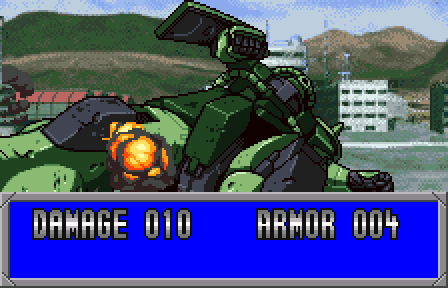
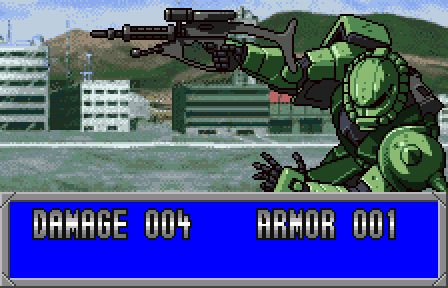
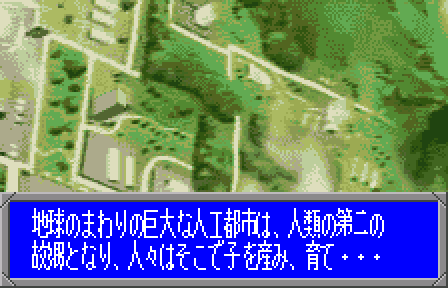
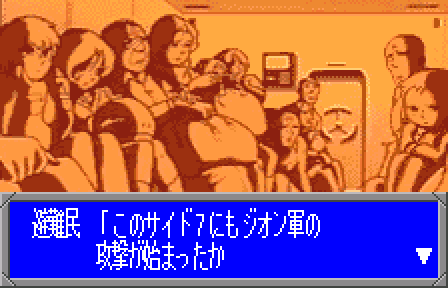
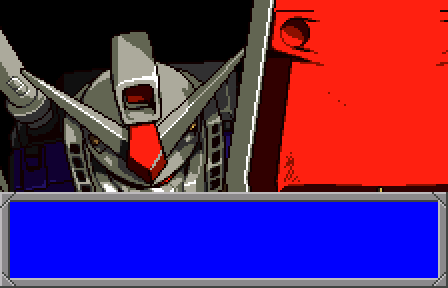
The game is built around reproducing the look of the television series on the small colour screen. Scenes are composed to match the anime closely, and the mobile suits are drawn in more detail than in the original cels, with animation during the battles. The cartridge is played with the console held sideways and is for one player; it does not use the link cable.
Vol. 1 also works with the WonderGate adapter, through which players could download strong weapon parts, so the game could be played on after the story mode was finished. It is made for the Color and does not run on the original black-and-white WonderSwan. The story continues in Vol. 2: Jaburo and Vol. 3: A Baoa Qu.
The story
The game is set in the Universal Century of the anime. For more than half a century humanity has been moving its surplus population into space, and the huge colonies around the Earth have become a second home where people are born, raise families and die. In the year 0079 Side 3, the colony group farthest from Earth, renamed itself the Principality of Zeon and began a war of independence against the Earth Federation. In about a month of fighting the two sides killed half of the total population, and when the game begins the war has been locked in stalemate for some eight months.
The starting point is Side 7, a colony still being built, where the Federation runs the final tests of the mobile suits made under its V Project. Zeon’s Zaku made these piloted humanoid weapons the core of the war, and the Gundam is the Federation’s prototype answer to it: its cockpit section can separate and fly as a light fighter, and its backpack thrusters let it fly briefly inside the atmosphere. It is carried by White Base, a new multipurpose carrier whose horse-like outline gives it the Zeon code name of the wooden horse. Amuro Ray, whose father Tem Ray designed the Gundam, is drawn into the war through his father’s work and becomes the Gundam’s pilot on the ship.
Most of the people around him are civilians or cadets. Fraw Bow, Amuro’s kind childhood friend, handles communications and nursing. Bright Noa, an elite officer cadet acting as captain, has a strong sense of duty and is often hard on Amuro. Sayla Mass, a medical student with a complicated background and a determined manner, also works the communications desk. Mirai Yashima, the daughter of a former senior Federation official, steers the ship because she holds a space cruiser licence. Kai Shiden, the sour-tempered son of a Federation engineer, slowly matures through the fighting; Hayato Kobayashi, whose family was forced from its home by the military, resents the army but is pushed to become a real pilot by his rivalry with Amuro; and Ryu, the only pilot cadet on board, acts as an older brother to the others and flies the Core Fighter.
The twelve episodes follow White Base’s route. The first five take place in space, from Side 7 to the asteroid base Luna II and the descent into the atmosphere, the next six cross North America while Char and Garma of Zeon pursue the ship, and the twelfth heads out over the North Pacific. Everything is seen from Amuro’s side, with his unspoken thoughts shown in brackets, and the familiar lines and scenes of the broadcast are redrawn alongside hidden scenes that only appear under certain conditions. The tone follows Amuro as he is swept into the war and grows up while still unsure of himself.
How it plays
The console is held sideways. Each stage after the first runs through the same cycle: a map, a story scene, a battle, another story scene and a save screen. On the map the X buttons move the cursor and A picks the stage. In story scenes A advances the text and confirms choices, and START skips the conversation. Some scenes offer a choice of what Amuro says or does, and answers that stray from what happens in the anime lower the crew’s trust in him rather than changing the story.
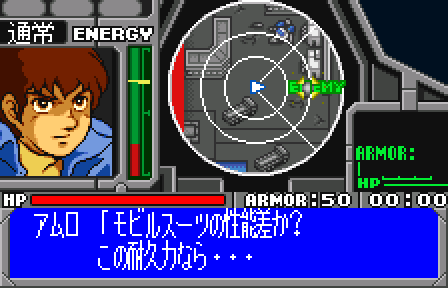
Battles start on a radar screen where the Gundam moves in real time like a radio-controlled model: X1 moves forward, X3 backs away, and X2 and X4 turn it on the spot, so going sideways means turning first and then advancing. The radar shows a fan-shaped field of fire and rings for short, medium and long range. Enemies appear as points of light, white if they have not noticed Amuro, red if they have and yellow if they are after an ally, and a flashing red enemy will strike first if left alone. Once an enemy is inside the field of fire, B switches between targets and A opens the action screen. An enemy attacking from outside the field of fire cannot be answered at all, so keeping enemies in front of the Gundam is the first rule.
On the action screen Amuro chooses to shoot or fight in melee when he attacks, and to dodge or block with the shield when he is attacked. Shooting covers the Vulcan, the beam rifle, the bazooka and the Bull’s-eye aimed shot, which only works at long range; melee covers the tackle, the beam saber and a jump attack, which only works at medium range. Shooting suits far targets and melee near ones, and the right choice for the distance helps the Gundam act first. Enemy suits carry armour that cuts the damage they take, so the usual plan is to strip it with the saber or a tackle and then finish with accurate weapons. The shield throw can wipe out armour in one go but often misses, the Hammer does heavy armour damage, the javelin has a high critical rate and deals half as much damage again, and the jump attack always lands. A failed dodge makes the hit hurt more.
Every action drains weapon energy. If the gauge reaches the red zone the Gundam overheats and cannot act until it recovers over time, and the Bull’s-eye costs more than other attacks. In the Bull’s-eye the A button has to be pressed the moment the sight lines up with the enemy and flashes, which raises accuracy and the chance of a critical hit. Amuro’s state of mind shifts between excited, normal and panicked and changes hit and dodge rates and the speed of the Bull’s-eye cursor; blocking calmly with the shield helps him settle and restores some energy. HP does not recover during a battle, and the game is over when it reaches zero. When the Core Fighter, Guncannon, Guntank or White Base is on the radar, the Y buttons call them for support, but allies may refuse if their trust in Amuro is low, and trust falls whether or not they help. Another Y button shows the stage goal.
After a win a report lists the shooting, melee and reaction proficiencies, the kill count, how many of the stage’s events were seen and the trust level. Proficiency grows from the damage dealt and taken, and higher values raise hit rates, first strikes and dodging, so the manual’s own advice for an enemy that cannot be beaten is to replay an earlier stage first. Gains are slow: a ten-minute run of the second stage adds about 400 points of proficiency, and the cap is 9,900, so it takes around 25 runs to fill one value.
Goals change from stage to stage. The descent through the atmosphere only asks Amuro to survive until a timer runs out, so pulling back is a valid tactic, while a later stage against Garma’s forces is about drawing the enemy into position. The fourth episode, the escape from Luna II, can take several attempts. A stage takes ten to twenty minutes and the whole game about four hours. There is one save slot, and Kikka appears only on the save screen. The music is taken from the television series. After the ending, saving writes the clear data and proficiency to the console and the title lettering turns red.
Development and release
Bandai named no developer. The game is credited to Arowana, with a director named Gotō, and Digitalware, though this has never been confirmed. Arowana made the official web pages for the later Vol. 2: Jaburo and Vol. 3: A Baoa Qu for Bandai, which ties the company to the trilogy. The three volumes came out over about a year and three months, and the way they divide the story roughly follows the three compilation films.
Modes and features
The only mode is the story, begun from the first episode with New Game or resumed with Continue. Cleared stages stay open on the route map, so any of them can be replayed to raise proficiency or to look for events that were missed. Once all twelve stages are cleared a WonderGate item appears on the menu, and the clear data written to the console carries into the two later volumes.
Secrets and extras
The Hammer and the javelin are unlocked by viewing particular story events, the javelin also needing a melee proficiency of 2,500, and the WonderGate download makes those conditions unnecessary. The full clear of the atmospheric descent stage, which requires destroying every enemy before time runs out, is the hardest goal in the game. Proficiency carries over to the next volume at a tenth of its value, and clearing this volume opens extra episodes in Vol. 2.
Reception
Fans praise the pixel-art versions of scenes from the anime, the detailed mobile suit sprites, the narration and the music and sound effects taken from the television series, and see the trilogy as made with real care for the original. Some players find the radio-control style movement awkward at first and the proficiency grind slow, and the battles have a reputation for being dull, though many play mainly for the story scenes. Some also find the WonderSwan Color’s dark screen hard on the eyes.
Ports and other versions
Side 7 was made for the WonderSwan Color and, like the two volumes that follow it, was never ported, remade or re-released on another system. The three volumes are not versions of one another but consecutive parts of one retelling, each covering a different stretch of the television series. What sets the trilogy apart from the many other games drawn from the first Gundam is its aim of following the anime episode by episode, with scenes laid out to match the broadcast.