
Kidou Senshi Gundam: Giren no Yabou Tokubetsu Hen: Aoki Hoshi no Hasha
機動戦士ガンダム ギレンの野望 特別編 蒼き星の覇者
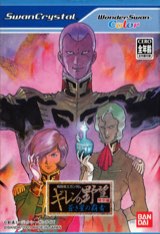
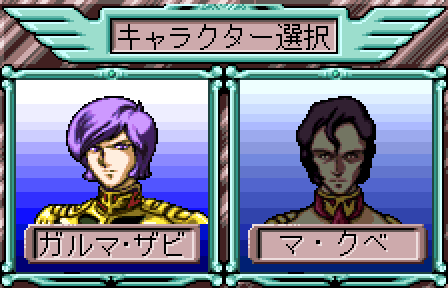
A WonderSwan Color spin-off of the Giren no Yabou war games in which Garma Zabi or M'Quve must win votes at a council of Zeon commanders to direct the invasion of Earth.
Screenshots
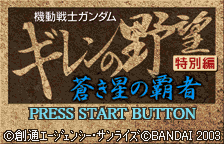
Title screen 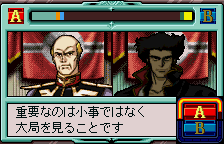
In play 
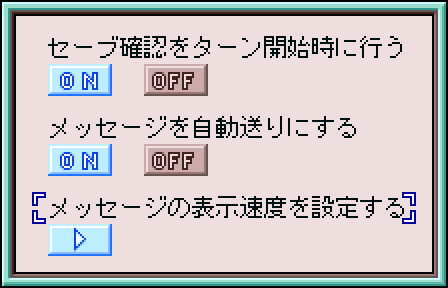
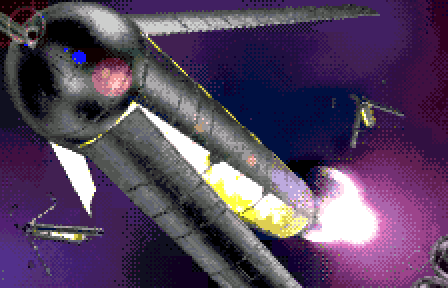
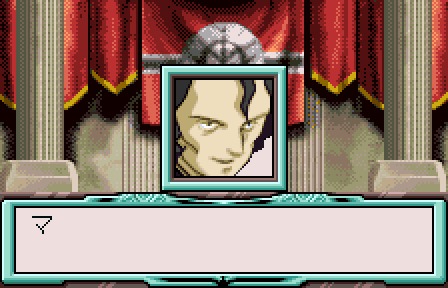
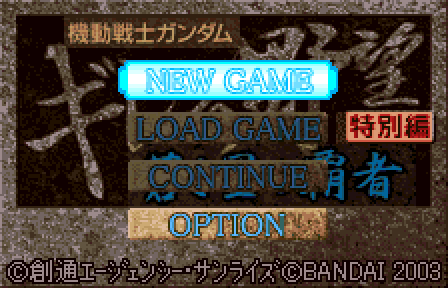
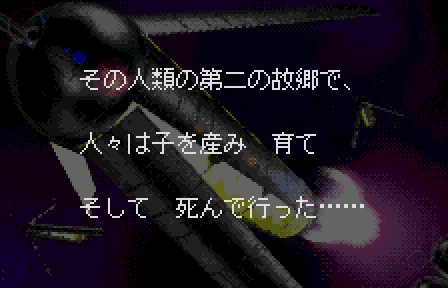
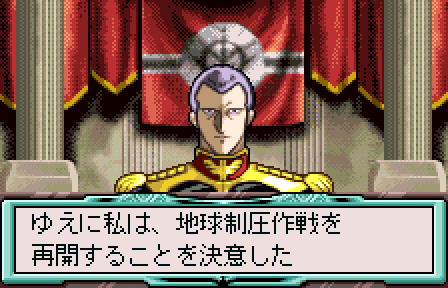
Aoki Hoshi no Hasha, “the ruler of the blue planet”, is a special edition of Giren no Yabou, Bandai’s series of strategy games set in the One Year War of the first Mobile Suit Gundam, which began on the Sega Saturn in 1998. Where the main games put the player in charge of a whole side, this one narrows the view to a single front: Zeon’s campaign on Earth. It was made by Vanguard for the WonderSwan Color only, with rules simplified for handheld play, and came out on 2 May 2003, late in the system’s life.
The player takes the role of Garma Zabi or M’Quve, each commanding an army group in the invasion. The other is still in the game as a rival, along with three more Zeon commanders, and all five compete for control of the campaign while fighting the Earth Federation.
What sets the game apart from the rest of the series is that the player cannot simply choose the next target, the weapons to develop or the officers to appoint. Each plan has to be put to a meeting of the five commanders and carried by a majority, so the game is as much about winning over rivals as about beating the Federation.
The story
The setting is the One Year War between the Principality of Zeon and the Earth Federation, seen entirely from Zeon’s forces on Earth. Giren Zabi has ordered the ground invasion to go ahead again, and the Earth forces are run by a handful of commanders who cooperate and quarrel in equal measure. Giren is not the player’s character here. The player is one of two colonels, Garma Zabi or M’Quve, and the aim the title points to is to become the ruler of the blue planet, the Earth itself.
The two leaders are set up as opposites. Garma, of the ruling Zabi family, is the leader of charisma; M’Quve is the leader of scheming. Around the council table sit the other four commanders: whichever of the two was not chosen, Neuen Bitter from Gundam 0083, Yuri Kellerne from The 08th MS Team, and Walter Curtis. Each leader has followers of his own, Ramba Ral’s unit on Garma’s side and the Black Tri-Stars and Flanagan on M’Quve’s, and characters and mobile suits from side stories such as 0080, 0083, The 08th MS Team and the Sega Saturn’s Gundam Gaiden join the cast. On the other side the Federation’s ace, Amuro, is the threat the player has to prepare for.
Because only Zeon can be played, the story is a what-if in which Zeon is able to win the war. Both leaders are alive and in command, Zeon does not pull back into space, and the Earth stays the main battlefield to the end, so pilots who would otherwise be busy in space come down to fight on the ground. The first part, 37 stages long, follows the invasion region by region in a set order: North America and Eurasia, the Pacific and East Asia, Oceania, the defence of Odessa, Europe and Southeast Asia, the defence of Torrington, and finally South America. A shorter second part of eight stages follows once the Earth has been taken, and it opens a new conflict.
The story is carried by some 600 events, and choices made in them change which battles come up and which special units arrive. The two leaders’ campaigns share most of their story but each has scenes of its own. The tone is the series’ usual alternative history of the anime’s war, here centred on politics among Zeon’s own officers, and the game is much enjoyed as a character piece for fans of Garma. The music includes arrangements of pieces from the anime, among them the songs Ai Senshi and Meguriai, by Ryo Kawanishi of Two Five, who had earlier scored Vanguard’s SD Gundam G Generation Gather Beat; the council meetings have their own tense theme.
How it plays
The campaign moves forward one turn at a time, and a turn usually takes one region, so the war moves at a quick pace. Between battles the commanders meet in council, and the council is the centre of the game. Every important matter goes before it: the target of the next invasion, which development plans to adopt, promotions, transfers and other appointments. Items come from the player and from the other commanders, and each is debated and then put to a vote.
In the meeting the player speaks through commands: assert, refute, rally, criticise and persuade. What is said moves a gauge of approval up and down, and a proposal passes when more than half are in favour. Before a meeting the player can ask the others for cooperation on a request, such as a transfer or a promotion, and can buy support with bribes. How each commander votes depends on his friendship with the player, but the answers also have a large random element. Voting against a commander lowers his friendship and makes him harder to persuade later, and any commander whose friendship is below 60 when the second part begins leaves for the other side.
The game’s one currency is AP, which stands in for the funds and resources of the main series. It pays for promotions, transfer requests, bribes and replacing lost units. A few characters, among them Norris and the Sahalin siblings, can be recruited by paying AP rather than through a vote.
The army is made of squads of three mobile suits. The number of squads in the main force grows over the campaign to seven, with up to three more in reserve that can be brought in from the third turn of a battle; large mobile armours such as the Apsaras take up two places. A squad that loses machines is refilled for free on the next turn as long as one of its three survives, and only a squad wiped out entirely has to be replaced with AP. Ships do not fight, but an officer of field rank can captain one, and a captain with high charisma raises his squad’s defence, so giving every squad a captain is the first priority. Pilots are rated for shooting, melee and reaction, and a pilot with fast reactions does best in a nimble machine.
Battles are turn based and fought on a map that fits on a single screen. A battle can be won by taking every base, but destroying the enemy is usually the practical way, and most fights end in two or three turns. Striking first is a strong advantage, and a common tactic is to spend the first turn moving out of the enemy’s reach and wait for it to close in. Conversations between characters play out during battle, and the battle scenes, built from polygon data, show up to nine machines on each side.
New machines come from the development plans the council adopts. Upgrading a type raises its basic stats by only about five per cent and does nothing for its weapons, and models are replaced quickly, so spending heavily on production or upgrades early on is wasted. Some special units depend on choices in events: keeping a mobile armour project funded brings the Apsaras III, and lending men to the effort to capture the Gundam and then sending help brings the Zeon-coloured Gundam. Because some characters end up on opposite sides in the second part, it pays to plan scouting and promotions with that in mind.
There are 45 stages in all, 37 in the first part and 8 in the second, with three save slots and a suspend save. There is no choice of difficulty, and the game is easy by the standards of the series. Saving before a council and reloading until a vote goes the player’s way makes it easier still, and is so common that saving at the start of each turn is standard advice. The exception is the hidden battle on Garma’s side in which Iserina fights, which is much harder than the rest. The ending is graded by the number of turns the campaign took: 59 or fewer earns an A, 60 or more a B, 90 or more a D and 200 or more an E. A first run takes about nineteen hours and a second about fourteen.
Development and release
Vanguard handled the whole production of the game for Bandai, for both the WonderSwan Color and the SwanCrystal. It was one of several Gundam strategy games Vanguard made for Bandai’s handheld, after SD Gundam G Generation Gather Beat and its sequel and SD Gundam G Generation Mono-Eye Gundams. The studio had a history with the series too, having handled the main programming, graphics and game design of Giren no Yabou: Kōryaku Shireisho, a PlayStation companion to the original game. This was the first Giren no Yabou game on a handheld, and it limits the war to Zeon’s side and to the fighting on the ground.
Modes and features
Two mobile suits were made for this game, a brown Gelgoog for Garma and a Gundam in Zeon colours with a Gelgoog shield, and the original units are little more than repaints. The cartridge does not use the link cable, and it also plays on the SwanCrystal.
Secrets and extras
The two leaders’ campaigns share most of their story but each has scenes of its own, among them a hidden battle in Texas on M’Quve’s side and an extra battle tied to Iserina on Garma’s. There is no gallery or other unlockable collection.
Reception
Japanese players are divided on the game. Fans of the setting enjoy seeing the One Year War go differently and find the game easy to get into, and its quick battles and its music are often praised. The main complaint is the council: players find that the commanders’ votes swing on luck rather than personality, that meetings come round too often with little variety in what is said, and that saving before a meeting and reloading until the vote goes the player’s way becomes routine. Some find the battles a chore for anyone not already fond of simulation games while still judging the battle scenes solid for a handheld. A first run takes about nineteen hours.
Ports and other versions
Aoki Hoshi no Hasha was made for the WonderSwan Color alone and was never ported, remade or re-released. It is not a cut-down conversion of one of the console games but a separate story built around the council of commanders. The series next appeared on a handheld in 2005, when Giren no Yabou: Zeon no Keifu came to the PSP, followed there by Axis no Kyoui, Axis no Kyoui V and Shin Giren no Yabou; these are other entries in the series, not versions of this game.