
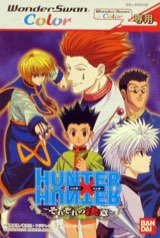
Bandai's second Hunter × Hunter game for the WonderSwan, an adventure told through four separate stories set around the hidden Hunter Exam.
Screenshots
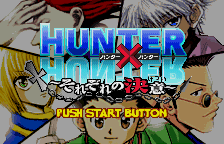
Title screen 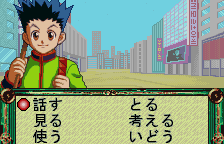
In play 
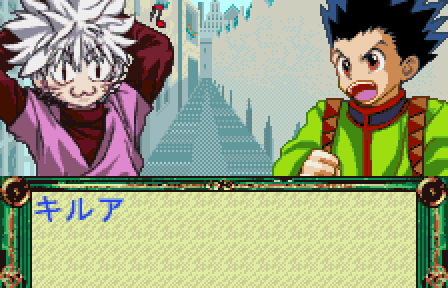
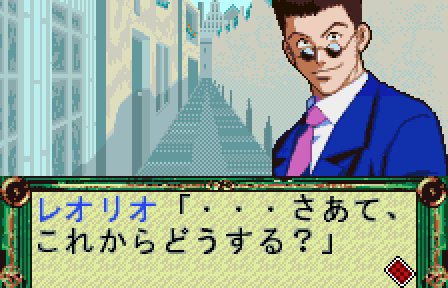
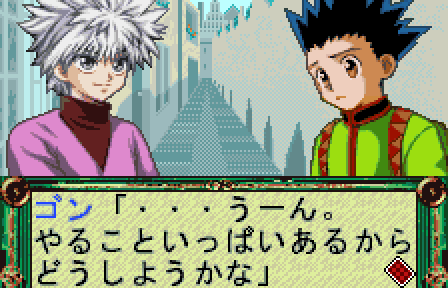
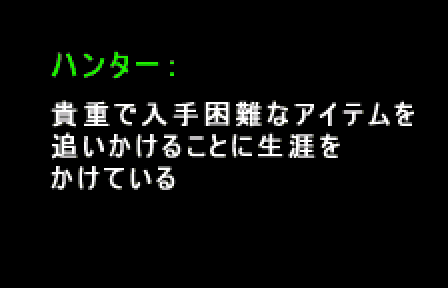
Hunter × Hunter: Sorezore no Ketsui is an adventure game based on the manga Hunter × Hunter, published by Bandai for the WonderSwan Color on 26 April 2001. It was Bandai’s second game from the series on the system, following Ishi o Tsugu Mono, a role-playing game released for the original WonderSwan in June 2000. Two more followed on the Color: Michibikareshi Mono in August 2001 and Greed Island in 2003.
Instead of one long quest, the game is split into four stories, each seen through different eyes: Gon and Killua together, Kurapika, Leorio and Hisoka. All of them take place around the hidden Hunter Exam, many of the episodes are not in the manga, and fights are settled with Nen abilities taken from the original work.
The Dennou Mobile, an in-game information device from the previous game, comes back and fills up with the series’ terms as the story goes on. The cartridge is made for the Color and does not run on the original black-and-white WonderSwan.
The story
In the manga, passing the Hunter Exam is not quite the end of it. There is also a hidden Hunter Exam, a secret test in which the new Hunters must learn Nen, the manga’s system of special powers. Gon and Killua meet it in the manga’s Heavens Arena arc, where they find a teacher and learn the basics. Sorezore no Ketsui is set in this period, after the main exam, and follows four of the exam’s characters separately. The title means “each one’s resolve”.
Gon and Killua share a story. It follows the manga for a while and then, from about its fourth chapter, takes the pair back to Whale Island in a turn of events written for the game. Kurapika’s story is the most original of the four. Without Nen he cannot even take work through the job agency he finds on the network, and while trying to get by he is taken for a food thief and runs into Clario, a sheltered princess who looks very like him. She has heard of someone who owns a pair of scarlet eyes, the eyes of Kurapika’s lost clan, and that lead draws him into her world, including a party where he has to stand in for her.
Leorio’s story takes him to places such as the Numere Wetlands. Hisoka gets a story of his own, which is rare in Hunter × Hunter games, and his route is the most combat-heavy of the four. Each story is divided into chapters, and the player chooses which one to play.
How it plays
The game is a menu-driven adventure. The player picks one of the four stories and works through it chapter by chapter, reading the scenes, asking people for information and choosing commands. Use and take are the two commands needed most, since many scenes turn on using the right item at the right place, and Kurapika in particular spends a long time going around town asking people, reading posters and trying things. The puzzles themselves are easy, but a wrong input or a wrong choice in many scenes ends the game at once, which gives it the feel of a Japanese novel game.
Fights are visual battles built on the Nen techniques of the manga, such as Ten, Ren and Hatsu, and the core of each fight is deciding where and when to spend Nen. The characters bring their manga abilities with them: Kurapika has his Chain Jail and Hisoka his Bungee Gum. The characters gain levels, and mini-games between fights strengthen their Nen. Once the player understands how a battle works, losses are rare, though there are hard points, such as the last enemy of the Gon and Killua story’s sixth chapter.
The four stories feel different to play. Gon and Killua’s runs to six chapters. Kurapika’s is long on text, and reading it properly takes about a day. Leorio’s is hardest in its fifth and sixth chapters: in the Numere Wetlands there is no map, only a choice of north, south, east or west across an area of about four squares by four, with options to rest, have tea or shop along the way. Done cleanly it takes about fifteen minutes, but getting lost there can cost one to two hours. Hisoka’s route has around thirty more battles than the others, among them a run of about ten fights in a row against the same opponent, Majitani; none of them are strong once the pattern is learned.
The Dennou Mobile now records keywords automatically as they come up, so that by the end it works as a personal Hunter × Hunter dictionary. After a story is cleared, a second playthrough keeps the level reached. Clearing also opens extras: a mini-game, a Visual Battle mode in which a favourite character fights four or five opponents in a row and can level up there without the levels carrying into the story, and a gallery of the pictures seen so far.
Development and release
The game was developed by Access, which also made the other three Hunter × Hunter titles for Bandai on the WonderSwan. The first production run came with an original B2-size poster as a bonus. Bandai made a point of announcing that this entry was made for the WonderSwan Color only, where the first game had been for the black-and-white machine.
Modes and features
With this game Bandai’s line switched from role-playing to adventure. The Dennou Mobile’s automatic keyword registration replaced the earlier game’s reliance on the player looking terms up. The game is for one player and has no link-cable features.
Reception
The game drew little attention. Players who remember it enjoyed the Nen battles and welcomed the rare chance to play scenarios centred on Leorio and Hisoka, and some rank it among the better games on the WonderSwan Color.
Ports and other versions
Sorezore no Ketsui was made for the WonderSwan Color and was never ported, remade or re-released. Konami was making Hunter × Hunter games for the Game Boy Color, PlayStation and PlayStation 2 at the same time, but those are separate games with their own designs. Among Bandai’s four WonderSwan entries by Access, this is the one that turned the line from role-playing into a chaptered adventure and the one set around the Hunter Exam.
Later history
Four months later Bandai followed it with Michibikareshi Mono, an adventure in the same style set in the Yorknew City arc. Bandai promised a hidden scenario and changed scenes in the sequel for players who had already played Sorezore no Ketsui, and accepted this game’s package tag in a mail-in offer for a Phantom Troupe coin.