
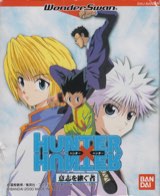
The first of Bandai's Hunter × Hunter games for the WonderSwan, an RPG in which Gon looks for his father by collecting keywords and looking them up on a handheld device.
Screenshots

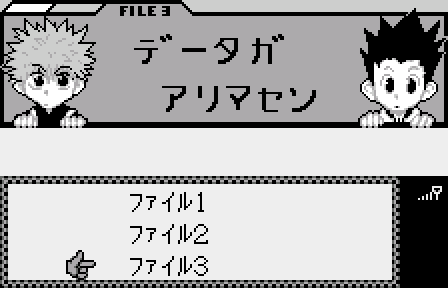
Title screen 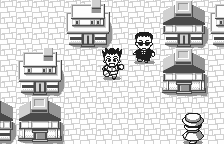
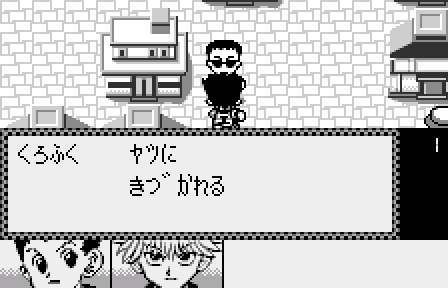
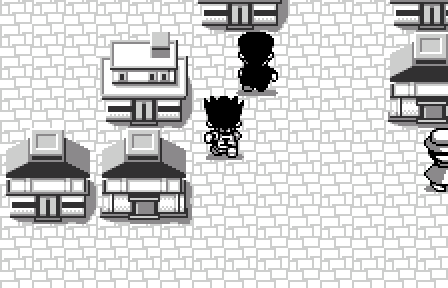
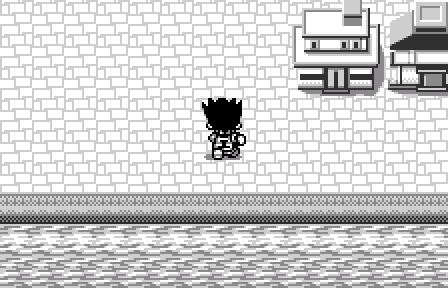
In play 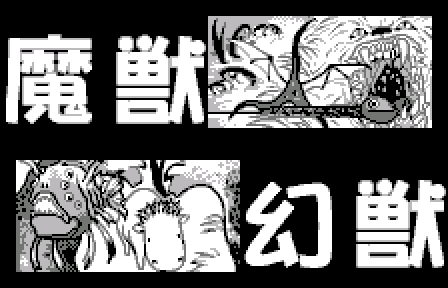
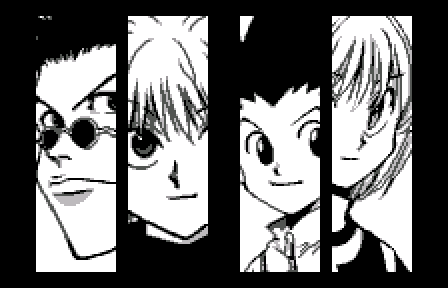
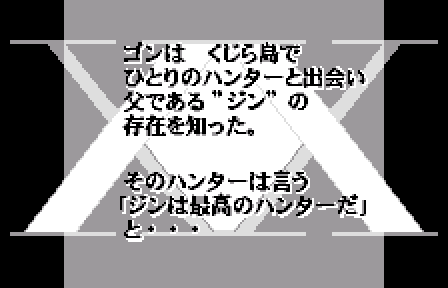
Hunter × Hunter: Ishi o Tsugu Mono, roughly “Those Who Inherit the Will”, is a role-playing game for the WonderSwan based on Yoshihiro Togashi’s Weekly Shonen Jump manga Hunter × Hunter and its television anime. Bandai released it on 1 June 2000. It was the first of four Hunter × Hunter games Bandai brought to the WonderSwan; the three that followed were made for the WonderSwan Color.
The story takes place after the manga’s Heavens Arena arc and follows Gon as he and his friends search for his father, Ging. Progress depends on information rather than on simply moving from place to place: keywords picked up in conversation are typed into Gon’s Dennou Mobile, a portable computer that works like a search engine, and following these leads one after another is how the hunt for Ging moves forward.
Access developed the game, as it did all four of Bandai’s Hunter × Hunter games on the system. It is a game for the original black-and-white WonderSwan, released in the console’s second year. The Dennou Mobile came back as a secondary feature in the next two games.
The story
The game is set in the manga’s world, where hunters chase rare beasts, hidden treasure and unexplored lands. A hunter’s licence is the reward for passing a punishing exam that only about one applicant in a hundred thousand gets through, and it opens almost every border and grants great privileges. Gon Freecss, a boy from Whale Island who dreamed of becoming a hunter like his father, has passed the 287th exam and is now a professional. His father Ging is a top-class hunter with a long list of achievements, and he is somewhere in the world. Finding him is the aim of the adventure.
Gon travels with Killua Zoldyck, his close friend and a son of a famous family of assassins, who is looking for something he actually wants to do. Both use Nen, the art of controlling the aura that flows from the body: Gon is an Enhancer and Killua a Transmuter. Others from the manga appear as well, among them Kurapika, the last survivor of the Kurta clan, who is hunting the Phantom Troupe that wiped out his people; Leorio, who acts flippant but wants to become a doctor; Hanzo, heir of a secret clan and a fellow graduate of the 287th exam, who is after a legendary book; and Hisoka, the magician who failed the previous exam by half killing an examiner.
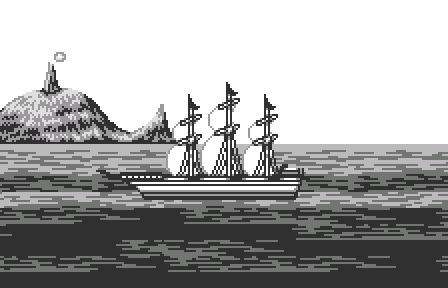
The adventure opens as the two boys arrive in Dore, a trading port where large ships call and merchants and travellers come from all over the world. They have come to meet someone with a lead on Ging, and they track down Kana, a self-styled clever and beautiful information broker. Her information does not come cheap, but she offers it free if they do a job for her first: catch Majitani, an escaped convict hiding in disguise somewhere on the waterfront.
Once that job is done, Kana hands Gon a Dennou Mobile that runs on Nen waves, and from then on the story is driven by what he looks up on it. There are no fixed chapters. Each name of a person, place, monster or treasure leads to new people and new towns, and the world opens up as Gon follows the trail across land and sea, with a limited number of days in which to find his father.
How it plays
The WonderSwan is held two ways. Turned sideways, it shows the field, where the X buttons walk Gon around, A talks, examines and advances text, B cancels, and holding B with an X button makes him dash. The Y buttons are shortcuts to the phone, the link page, a small menu and the search page. Turned upright, the console becomes the Dennou Mobile itself: the Y buttons move a cursor, the X buttons scroll, confirm and cancel, A switches between the phone and the computer pages, and B goes back to the field.
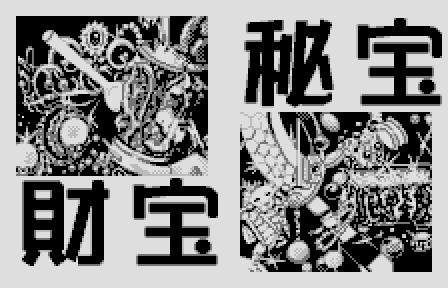
The core loop is talk, search and travel. Words shown in brackets in a conversation are keywords. On the search page the player spells a keyword of up to twelve characters on an on-screen grid of kana, or copies one of the last four new words from a short list. A hit opens an information page: a person’s profile, a monster or treasure with a picture, or a place, which then becomes a destination. Bounty heads can be caught for prize money. Every keyword found is filed on the link page under eight headings, which cover people and hunters, bounties, places and ruins, monsters and phantom beasts, treasures, food and computer terms, techniques and occupations, and everything else. Information pages can contain new keywords of their own. The device only works where there is a signal, shown as bars on the conversation screen.
Travel between towns is booked on the movement page. Every town has a guide who leads the way to its docks, and from there the player can buy a ticket by ship, train or airship. Ships are cheap but slow, airships fast but expensive, and every trip costs both money and days. Only Gon travels, so the party breaks up on departure. Friends are called back with the phone: once a friend’s home code has been found and entered, the player can mail them a meeting place and they come if they are free. Up to three characters travel together. News mail arrives every five to seven days as more places are discovered, and a hidden friendship value, which rises and falls as Gon adventures with his companions, changes the ending.
Ruins and forests are explored as dungeons. They can be mazes with traps, but they also hold treasure chests, money and items, and strong enemies. At a chest the player can open it, leave it or examine it, and examining starts a trap-disarming test in which a moving cursor has to be stopped on success before a time bar runs out. Traps can cost money or put the party to sleep so that days pass. At a door the player can open it, turn back or ask a companion for advice.
Battles are simple and turn-based. Characters have no statistics, and luck decides most of the outcome. The three commands are an ordinary attack, which seldom misses, a Nen attack, which misses more often but hits much harder, and running away, which does not always work. After an attack is chosen a cursor moves at random over the possible results, such as a miss, a hit or a critical, and the player presses A to stop it; if the time bar empties first, the enemy attacks. Each hit that lands allows another attack in the same turn.
Days pass as Gon travels and takes part in events. When 200 or more have gone by, returning to Dore brings the ending, so the search for Ging has to fit within that span. The game is over if time runs out, if a wrong choice is made at certain points, or if the whole party falls in battle, and play then resumes from the last save. There are three save files, each showing the current place, the days elapsed and the money in hand, and the player should always save at the docks before leaving a town. Money comes mainly from bounties, but a man on Whale Island pays for fish caught with a timing-based fishing game that costs 10,000 in bait, and the Dungeon Park north of Sunaka is a beginner’s dungeon with a 20,000 entry fee whose chests can be looted again on every visit. Searching first for Gon’s own home code and for Majitani is the quickest way to early information on Ging and the first bounty.
Development and release
Ishi o Tsugu Mono was the first Hunter × Hunter video game of all. It reached shops on 1 June 2000, two weeks before Konami’s Game Boy Color game Hunter × Hunter: Hunter no Keifu. The licence was split between the two companies: Bandai handled the WonderSwan games, while Konami published the adaptations for the Game Boy Color, PlayStation, PlayStation 2 and Game Boy Advance. Access developed all four WonderSwan games; the studio’s other work includes the PlayStation version of Akumajou Dracula and PlayStation 2 versions of Ys III and Ys V.
Reception
The Dennou Mobile is the game’s most remarked-on feature. It was felt to capture the fun of surfing the web with a search engine, and the idea of typing in keywords to gather information has been called fairly original, perhaps simply too early for its time. Anyone who knows the manga will never run short of words to try, but the battles were thought an afterthought. Since characters do not grow in strength, the game is considered closer to an adventure than the role-playing game Bandai advertised.
Ports and other versions
Ishi o Tsugu Mono was made for the WonderSwan, and it was never ported or re-released on another system. The adaptations on other systems at the time were separate games from Konami, beginning two weeks later with Hunter no Keifu on the Game Boy Color, a tactics game set during the Hunter exam with a hero the player names. Bandai’s cartridge stands apart from those by following Gon himself and by moving the story forward through keyword searches on the Dennou Mobile.
Later history
Bandai and Access followed it with two adventure games for the WonderSwan Color in 2001, Sorezore no Ketsui in April, set during the manga’s underground Hunter exam and told from four viewpoints, and Michibikareshi Mono in August, built around the Phantom Troupe arc in York Shin City. Both kept the Dennou Mobile as a bonus feature. The fourth and last WonderSwan game, the card-collecting role-playing game Hunter × Hunter G.I., followed in April 2003.