
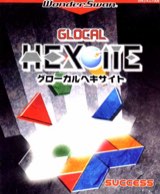
Success's WonderSwan version of Hexcite, a turn-based puzzle game in which two sides take turns placing geometric pieces on a board of hexagons to score points.
Screenshots
Title screen 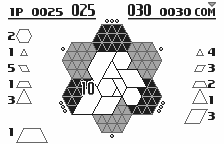
In play 
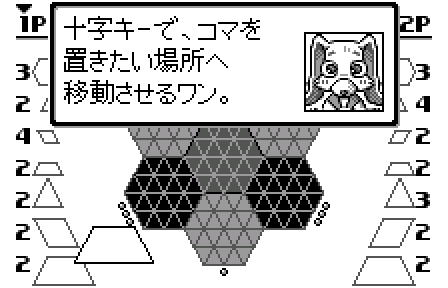
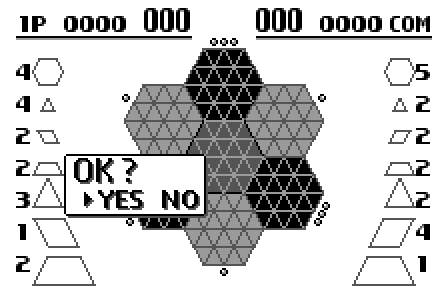
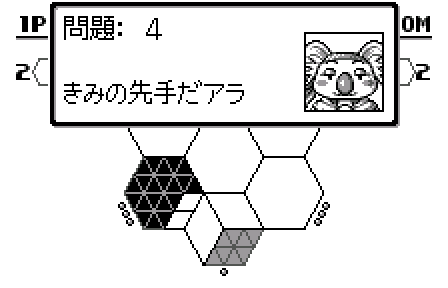
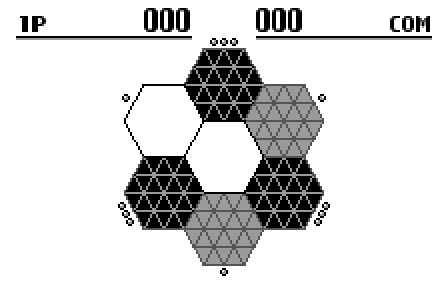
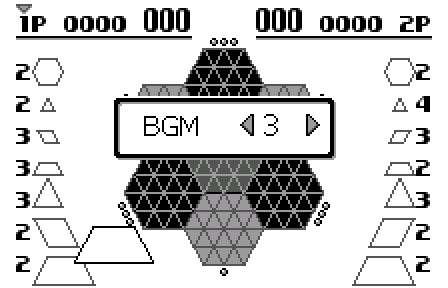
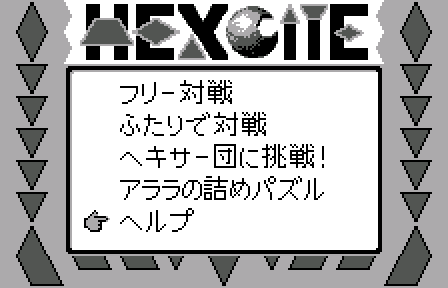
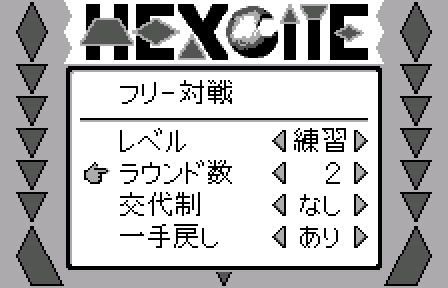
Glocal Hexcite is a puzzle game for the original WonderSwan, published by Success on 29 June 2000. It is a version of Hexcite, a game created by the small Japanese company Gu, which also programmed this cartridge. Hexcite came to Windows PCs first, and its first console release, in October 1998, was a Game Boy cartridge that also ran in colour on the Game Boy Color and was one of the titles available when that console launched in Japan; a PlayStation version followed.
The game is played on a board made of seven hexagons divided into small triangles. The two sides take turns laying down pieces dealt to them at random, such as triangles, diamonds and trapezoids, and score points for how the pieces fit against the ones already down. The higher score wins.
The story
Glocal Hexcite has no story. It is an abstract board game for two, with no setting, plot or hero, and the board, the coloured pieces and the running scores are all there is on screen.
The game grew out of a single night. In January 1996 its designer, who works as Gajin, sat down at a computer meaning to make a puzzle, and Hexcite existed by the next morning. Gu has described the aim behind it as a new and highly original game that people of any age could play, and could go on playing for a hundred or a thousand years.
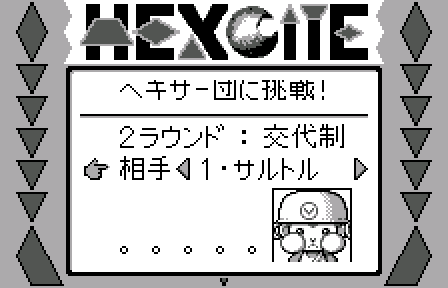
What the WonderSwan version adds to the bare board is a cast of opponents. The computer players are animal characters called Hexers, and the single-player game is a challenge against them. The screen is used in the horizontal position, and the sound is mono.
How it plays
The WonderSwan is held sideways, and the game is played entirely in turns, so nothing depends on reflexes. One player can face the computer, or two people can share one console and pass it back and forth after each move. There is no link-cable play on this cartridge, and the two-player game needs only the one machine.
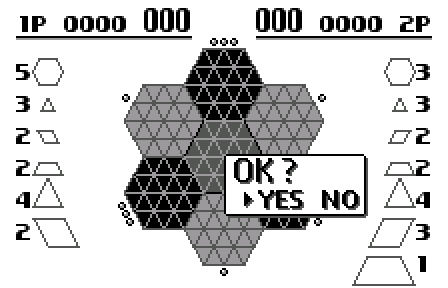
The board is a large hexagon in the centre surrounded by six more of the same size, all laid over a grid of small triangles. At the start each side is dealt a random hand of pieces of seven kinds, among them triangles, diamonds, trapezoids and hexagons, each made of a number of those triangles.
The placing rules are short. The very first piece must go inside the central hexagon, touching one of its edges. Every piece after that must touch a piece already on the board along at least one whole side, and none of its sides may stick out past the edges of the pieces it is placed against. The outer rim of the board counts as empty space, so a piece cannot be propped against it. A player who has no legal move must pass, and passing by choice is not allowed.
Points come from contact. Each side of a new piece that lies against a piece already down earns 5 points, and on the first move each side touching the edge of the central hexagon counts the same way. The six outer hexagons are bonus zones: the player who fills the last space in one of them takes a bonus on top of the normal points, 10 or 30 depending on the hexagon, as marked around the edge of the board. The round ends when both players have run out of pieces or of places to put them, and every piece still in hand then costs 5 points per side, so a leftover triangle loses 15 and a leftover hexagon 30.
That mix of bonuses and penalties means the lead can change hands right up to the last pieces. Working out the score by hand is fiddly, and having the cartridge count it is the main thing the video game version adds to the board game. The rules are learned in a game or two, but the play is deep, in the manner of Othello or chess.
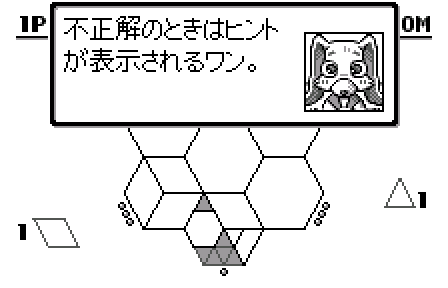
Beside the ordinary games there is a problem mode built on set positions, in the spirit of shogi problems, where the task is to win against the computer within a small number of moves. Working through them is the usual way to learn the standard patterns of good play.
Development and release
Gu, written ジー・ユー in Japanese, is a company in Tokorozawa, Saitama, whose representative goes by the name Gajin. It planned a board-game version of Hexcite in 1996, made the first computer version for Windows in 1997, moved to the Game Boy in 1998, and planned and developed the WonderSwan version in 2000. The cartridge was split three ways: Gu developed it, Success released it, and Kaga Tech handled sales, which is why the product code begins SWJ-KGT. The copyright line reads Gu Inc. and Gajin, from 1997 to 2000. The same year the WonderSwan game came out, Hexcite won a Good Toy award in Japan.
Modes and features
The WonderSwan version offers a single-player game against the Hexers, two-player games on one console, and the problem mode. It is for one or two players, with mono sound and no link-cable support. Bandai pitched the game as a simple puzzle in the line of Tetris and Gunpey, in which the player and the computer take turns laying seven kinds of panel inside a fixed area and score points for how they place them.
Reception
Hexcite is seen as a strategy game with the depth of Othello or chess, whose rules are quick to learn in play. Its scoring is fiddly to work out by hand, so letting the machine count the points is one of the video game’s advantages. The problem mode, modelled on shogi problems, is the way to learn the standard patterns.
Ports and other versions
Hexcite did not start on the WonderSwan. After the Windows version Gu developed in 1997, the first console release came on 21 October 1998 as Glocal Hexcite for the Game Boy, a cartridge that also ran in colour on the Game Boy Color and was published by NEC Interchannel; Ubi Soft released it in North America as Hexcite. Locus made and published a PlayStation version in December 1999, and the WonderSwan cartridge followed in June 2000. Later releases came on Windows, among them a downloadable Glocal Hexcite 2001 in 2001 and a budget series in 2002, and a mobile phone game for the au network called Hexcite ES. In 2001 Jorudan released Space Hexcite for the Game Boy Advance, made by the Hexcite staff around Gajin as an expanded version of the game, with a story mode featuring characters by Leiji Matsumoto, the Hexcite ES variant and 100 problems. The WonderSwan cartridge itself was never released on another system.
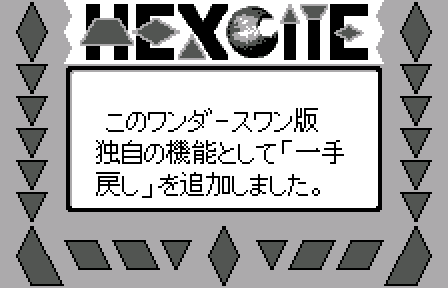
The Game Boy cartridge and the WonderSwan one share a single-player game against the computer, two-player play by passing one console back and forth, and a problem mode of set positions; the Game Boy version adds a computer opponent with fifteen levels of strength that reads up to ten moves ahead, and play over the link cable. The WonderSwan cartridge has no link play, and its computer opponents are presented as the animal Hexers. The PlayStation version adds a story mode of its own, an official rules mode and a tutorial, and Glocal Hexcite 2001 for Windows brings a new mode called Hexcite ES, network play for up to four people and the turn rules of official competitions.