Glocal Hexcite
グローカルヘキサイト
Download v1.0Glocal Hexcite (グローカルヘキサイト) is the 2000 WonderSwan (monochrome) version of Hexcite, the tile-placing board game by Gu Inc. / GAJIN, published by SUCCESS and released only in Japan. Two players take turns placing triangles, diamonds, trapezoids and hexagons on a board of seven hexagons: every edge your piece touches scores 5 points, filling the last space of an outer hexagon wins a 10- or 30-point bonus, and pieces you can't place cost you points at the end. This version adds a cast of animals: the Hexer Gang, five rivals you beat one by one, Arara the koala with 50 puzzle problems and titles to earn, and Powan the dog, who teaches the rules. This patch translates it into English.
Please read: this translation was made with AI (Claude), as a hobby project. A person (me) made every judgement call before release, but nobody on the project is a professional translator. I'm sharing it as it is for anyone who wants to play. Please don't upload it to romhacking sites (romhacking.net and the like). It may not be up to the standard of a real fan translation and it doesn't belong there.
Screens
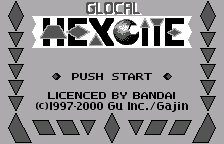
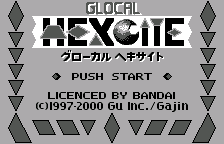
Title screen 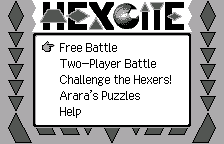
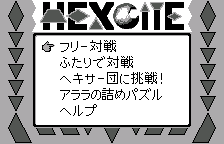
Main menu 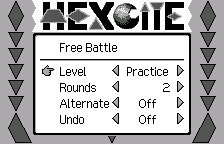
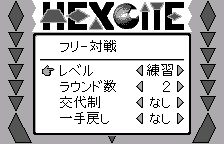
Free Battle settings 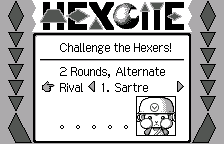
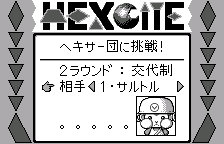
Challenge the Hexers 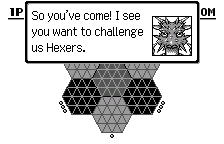
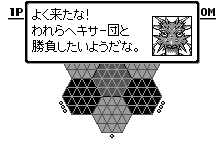
The gang's boss 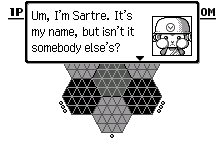
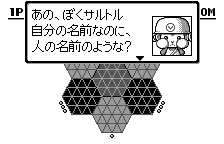
Sartre 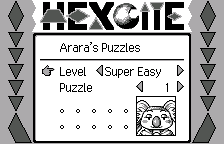
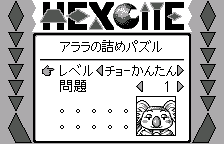
Arara's Puzzles 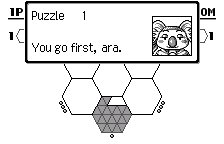
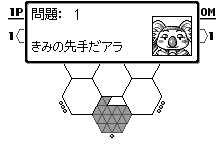
Starting a puzzle 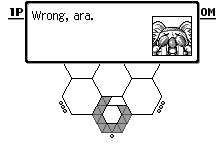
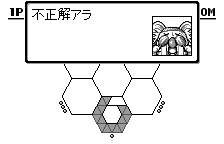
A wrong answer 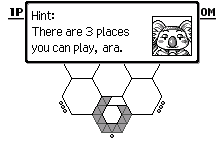
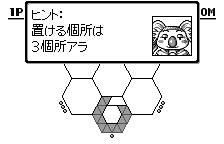
The hint 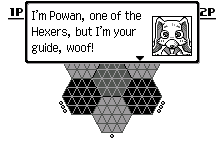
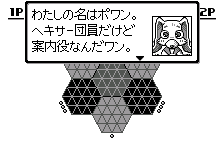
Powan's rules tutorial 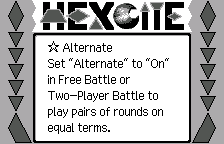
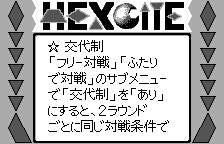
Other Tips 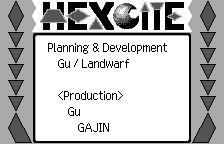
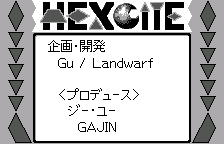
Staff credits 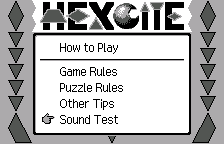
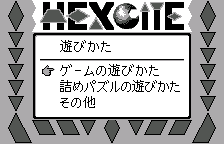
Sound Test edition: How to Play with Sound Test
What’s translated
- Everything the game writes in its font: the menus and their settings, the Hexer Gang’s dialogue (introductions, rematches, reactions after every round and match, their “thinking” chatter, and both endings), Arara’s puzzle mode (class introductions, the puzzle headers, ten “correct!” lines, all 50 hints and the titles), Powan’s two rules tutorials, the help pages, the developers’ messages and the staff credits.
- The title screen: the katakana reading under the logo (グローカル ヘキサイト) is removed, so the title shows only the logo.
- Already English in the original and unchanged: the logo, PUSH START and the in-game banners (Begin Play, Round, Total Score, You Win!!, Pass…). They come from the English Game Boy Color Hexcite: The Shapes of Victory, and the rules use its terms.
Names: the gang is the Hexer Gang (the Hexers): Sartre the shy monkey (his name is the philosopher’s, and he jokes about it), Tonpei the brash pig, Bearnga the self-styled bear of justice, Misha the cat and Pascowl, the owl elder (Pascal + owl). Arara the koala sets the puzzles and Powan the dog is the guide. Their verbal tics stay where the Japanese has them: Powan’s “woof”, Arara’s “ara”, Tonpei’s “oink” and “snort”, Bearnga’s “nnga” and Pascowl’s “Hoo-hoo!”. The cast is new to this version, so there are no official English names.
The Sound Test edition
The developers left a sound test in the cartridge that nothing in the original can open. The Sound Test edition (glocal-hexcite-en-special-1.0.bps) adds it to a menu:
- Opening it: Help > How to Play now lists Game Rules, Puzzle Rules, Other Tips and Sound Test. Choose Sound Test.
- Using it: four lines, SOUND1 to SOUND4, each with a number. UP/DOWN pick a line, LEFT/RIGHT change its number and A plays it. START leaves.
- Limits: it’s the developers’ bare tool: the numbers aren’t labelled, and START goes back to the title screen rather than to the menu. Everything else is the standard patch.
How it was made: AI translation, independent checks, human decisions
- Claude translated everything directly from the Japanese in the ROM and did all the hacking. The text uses a Latin font that was already in the cartridge, unused (left over from the English Game Boy Color release), so a box holds about a third more than with the Japanese font’s own letters.
- A Claude reviewer checked every line against the Japanese, a naturalness pass was verified line by line, and a separate, independent Claude reviewer then checked the whole game, text, screenshots and documents; its findings were verified and fixed.
- On screen: every message drawn by the game in its own box (all 50 hints in the real hint box), the whole Hexer campaign with both endings and all 50 puzzles played through in the emulator with every character logged (no Japanese left), random play from seven points across the game, the title left alone for 15 minutes (no demo), and 21 menus and boxes compared side by side with the original for alignment.
- The judgement calls were listed with the Japanese, a literal reading and the options, and I decided all 13 by hand over two rounds: names, the title screen, a forced abbreviation, the puns and the Sound Test edition.
Changelog
- v1.0: first release.
Sources consulted
- Japanese text: the WonderSwan ROM itself.
- Rules terms: the English banners in this ROM, shared with Hexcite: The Shapes of Victory (Game Boy Color, Ubi Soft, 1998/1999).
How to patch
Apply one of the BPS files to the Japanese ROM “Glocal Hexcite (Japan)” (CRC32 8FCD6D2C) with Floating IPS, beat or ROM Patcher JS:
- Standard:
glocal-hexcite-en-1.0.bps, the result should be CRC32 F0738013. - Sound Test edition:
glocal-hexcite-en-special-1.0.bps, the result should be CRC32 887AD11F.
The ROM stays 512 KB. It’s a WonderSwan (mono) game, so keep the .ws extension.
You must provide your own copy of the original Japanese game to apply it.
Download: glocal-hexcite-en-1.0.bps, glocal-hexcite-en-special-1.0.bps on the release page.
Known issues
- It hasn’t been played start to finish by a person. If you find leftover Japanese, cut text or a crash, please tell me where it happened.
- The “Draw” banner (a drawn match) never came up in testing; it’s an English picture in the original anyway.
- One menu value is abbreviated to fit: the Free Battle level “Intermed.” (Intermediate).
- The A+B+X1-X4 reset goes to the title screen, which the help page (like the Japanese) calls the menu screen.
Technical notes (for the curious)
- Text is 16-bit glyph codes drawn by a variable-width 16x16 font routine. The cartridge also holds two Latin-1 fonts that the Japanese game never selects; one immediate in the font-select routine switches all text to the first of them.
- All 272 strings live in one bank behind near-pointer tables; the English is written to the free end of that bank and every pointer is rewritten, so nothing else moves.
- The settings menus are built from small item records (position, width, letter spacing) and stored tilemaps for the arrows; those were widened so the English values fit, keeping the original’s centring and right alignment.
- For testing, a RAM flag makes player 1 a computer player, so whole campaigns play themselves; it isn’t in the patch.
Feedback on this translation
Found a line that reads wrong, leftover Japanese, cut-off text, or a crash? Tell us where. We go through feedback every day with the help of Claude, and a person decides on any change. Fixes go into the next version.