
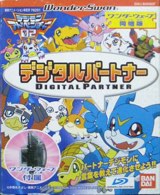
A Digimon Adventure 02 tie-in for the WonderSwan in which the player talks with Digimon and teaches them words that they then use in battle.
Screenshots
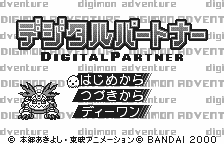
Title screen 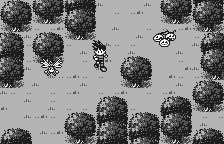
In play 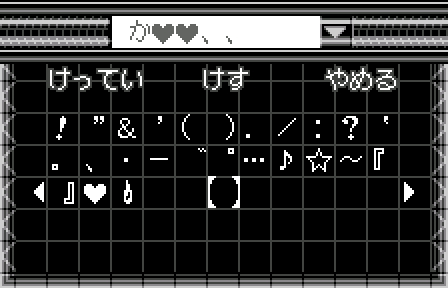
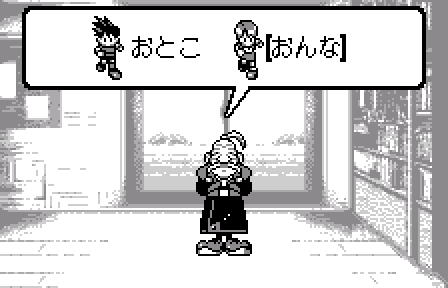
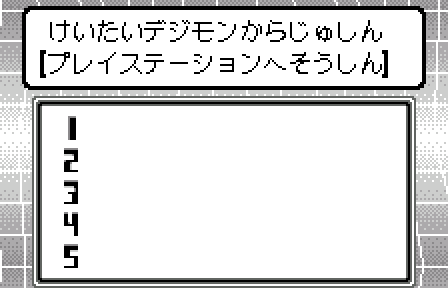
Digital Partner is a Digimon game that Bandai released for the WonderSwan in Japan on 25 May 2000. It is tied to Digimon Adventure 02, the second Digimon anime series, and is sometimes listed under the longer name Digimon Adventure 02: Digital Partner. Its cast of 60 Digimon mixes 49 from the first series, Digimon Adventure, with 11 that were due to appear in the new one.
Instead of raising monsters through feeding and training, the game is built around conversation. The player talks with the partner Digimon of the anime on File Island and teaches them words, and the words a Digimon has learned are what it draws on in battle, so a larger vocabulary makes it stronger.
Most of Digital Partner’s connections lead to other Bandai products: the PlayStation game Pocket Digimon World by way of the WonderWave and a PocketStation, and the Digimon virtual-pet toys through the adapter that came with Digital Monster Ver. WonderSwan. The game is also for one or two players, with link support.
The story
The game opens with Gennai greeting the player as one of the Chosen Children. He explains the task: on File Island, Digimon grow stronger and can evolve by learning words, and the player is to teach words to the partner Digimon living there. There is a deadline. The player can stay on the island only until an eclipse ends, and when it does, the door back to the player’s own world will close, so the time until then is to be spent getting to know the Digimon.
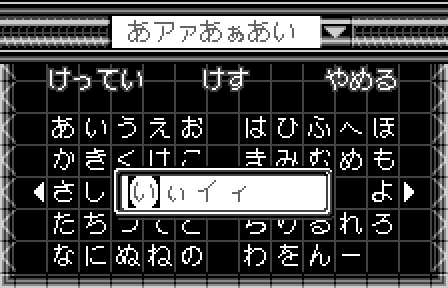
The player character carries a name the player chooses, but the cast is the Digimon. The partners are the partner Digimon of both series, such as Agumon, Gabumon, Piyomon, Tentomon and Patamon from the first series and Veemon, Armadimon and Hawkmon from the second, met at five stages from In-Training up to the Armor and Ultimate forms. Around them live other Digimon of the first series, among them Leomon, Monzaemon, Wizarmon, Etemon and Vamdemon, who are the island’s residents and the player’s opponents.
There are no chapters or set missions. File Island is divided into eleven places, from the Forest of No Getting Lost to Misty Trees, including Toy Town, Freeze Land, the Great Canyon, Gear Savanna and the Tropical Jungle, and each has its own Digimon to talk to. Bandai named the game’s theme as affection. The game is about spending time with the Digimon rather than a quest, and it has been compared to Seaman; the stakes are only how close the player and the partners can become before the eclipse is over.
How it plays
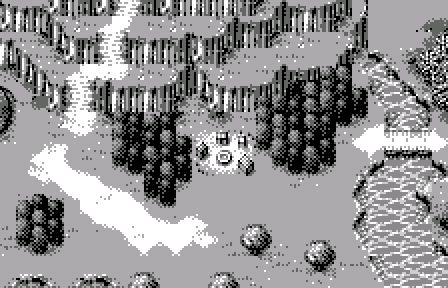
The WonderSwan is held sideways. The game starts with exploring the map of File Island and talking with the Digimon found in each place, and among them the player finds a partner Digimon. Which Digimon turn up where is fixed: Toy Town, for example, has Pagumon, Numemon, Sukamon and Monzaemon, and Freeze Land has Bakemon, Monzaemon and Piccolomon. A partner can then be taken along on outings, or brought back to the player’s home, where it can be taught words and given items.
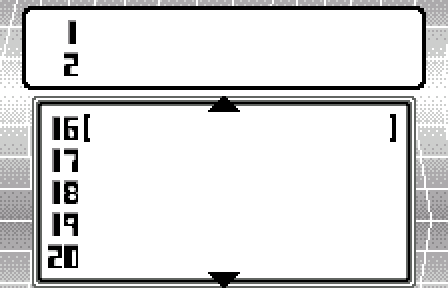
Conversation is the core of the game. The player can talk with two Digimon at once, and the two also talk with each other, which widens what can be said. Words are taught within a set time, and the game keeps track of affection as a row of hearts, which tops out at seven. A Digimon can hold at most 170 words; beyond that, each new word pushes out one taught earlier. A Digimon gets angry if the player tries to teach it the player’s own name.
Learning words is what makes a partner evolve. An In-Training Digimon needs to have spent ten minutes with the player before it can become a Rookie, and from there it can grow into a Champion or an Armor form and on to an Ultimate. The partners cover 38 forms in all: six In-Training, nine Rookie, seven Champion, eight Armor and eight Ultimate. A Digimon that reaches the Ultimate level drops back to In-Training, but it keeps the words it has learned and the items it holds, so a vocabulary built up over one round of growth carries into the next.
Battles are fought with words. The two sides exchange words in the manner of shiritori, the Japanese word-chain game in which each word begins with the sound that ended the last, or line up words of the same length, and words that work like a shiritori link are strong. A Digimon that knows more words therefore has more to play with, and what decides a fight is the vocabulary the player has built rather than numbers raised through training. The opponents are nineteen Digimon of the first series, from Koromon and Pagumon to Devimon, Etemon and Vamdemon.
The island’s Digimon can also give the player items. Floppies, Recovery Words and Surprise Mushrooms come from many of them, and the eight Digimentals of the second series come from particular Digimon: Elecmon gives the Digimental of Courage and Wizarmon that of Light, while Devimon, Piccolomon and Etemon can give every Digimental and Vamdemon every item. Each item can be held only up to a maximum count, and collecting all of them to the limit is a considerable feat.
The game has no flashy presentation and moves at a slow pace, and it gives little direction; some players at the time could not tell what they were meant to be doing. What it offers instead is a partner whose speech and battles grow out of the words the player chose to teach it.
Development and release
Tom Create, the studio that later made Digital Monster Card Game Ver. WonderSwan Color, developed Digital Partner. Bandai’s own title for the game is simply Digital Partner. Besides the standard cartridge, Bandai sold a limited edition packed with the WonderSwan’s WonderWave infrared adapter, under the product code SWJ-BAN02F at 4,700 yen, against 3,200 yen for the game alone. When the game came out, both Pocket Digimon World and the WonderWave itself were still due for release in June. The game sold about 67,000 copies, tenth among releases for the original WonderSwan.
Modes and features
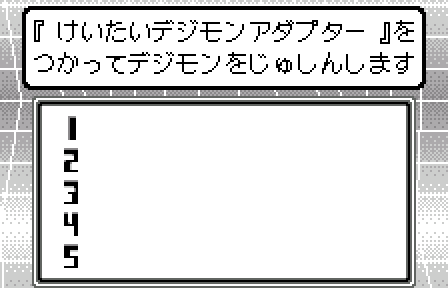
Besides the main game on File Island, Digital Partner has a D-1 Grand Prix mode. Using the adapter for the virtual-pet toys that came with Digital Monster Ver. WonderSwan, monster data from the Digital Monster, Digimon Pendulum and Digivice toys can be saved into the game and entered in the D-1 Grand Prix, where there are more than 70 opponents. With the WonderWave infrared adapter and a PocketStation, Digimon raised here can be sent to Pocket Digimon World on the PlayStation and fight there in full 3D.
Secrets and extras
Six In-Training Digimon appear only once a condition is met. Koromon turns up after three hours of play, Pyokomon once Tailmon has learned thirty words, Mochimon once Veemon, Armadimon and Hawkmon have learned twenty each, and Pukamon after twenty visits to Freeze Land; another needs a particular item used ten times in a row in battle. A Digimon gets angry if the player tries to teach it the player’s own name.
Ports and other versions
Digital Partner was made for the WonderSwan, and it was never ported, remade or re-released on another system. Its tie to the PlayStation is a data link rather than a second version: Pocket Digimon World is a separate PlayStation game that receives Digimon raised here by way of the WonderWave and a PocketStation. Among the Digimon games of its day, Digital Partner stands out for building its play around teaching words instead of the feeding and training of the virtual pets.