
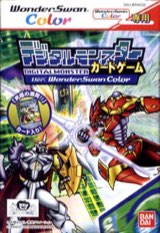
A WonderSwan Color version of Bandai's first Digimon trading card game, with a tutorial, a solo campaign and link-cable battles and card trading.
Screenshots
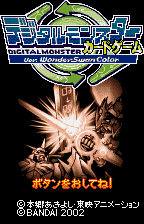
Title screen 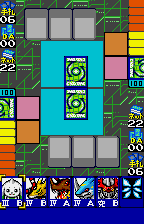
In play 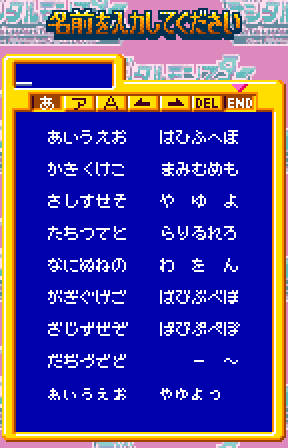
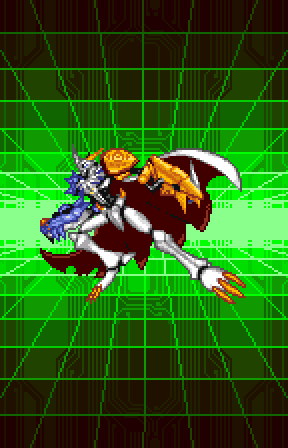
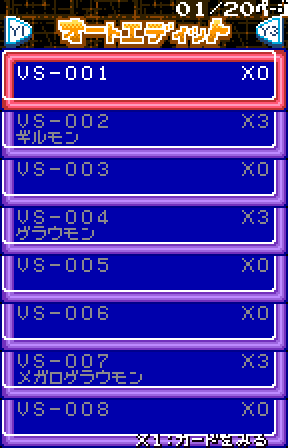
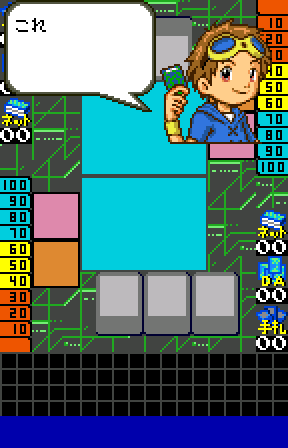
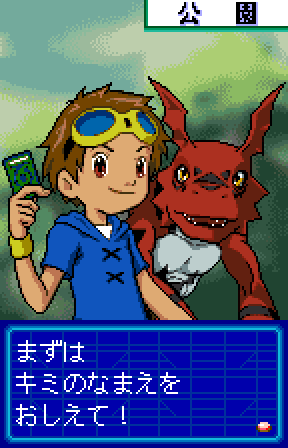
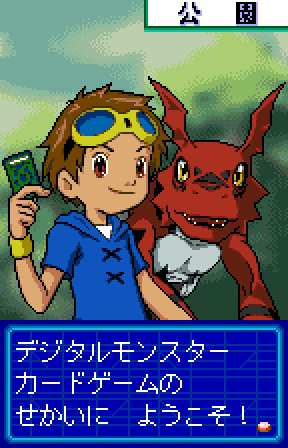
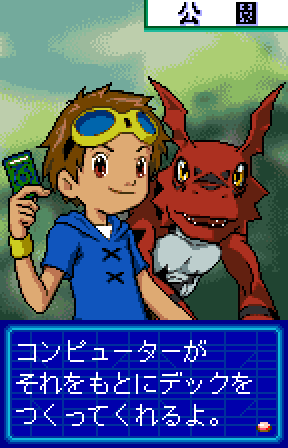
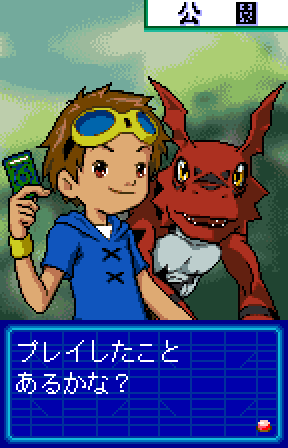
Digital Monster Card Game Ver. WonderSwan Color brings the Digital Monster Card Game, the first Digimon trading card game, which Bandai sold from 1999, to the WonderSwan Color. Bandai published it in Japan on 16 March 2002. In the card game each player builds a deck of 30 cards and starts with 100 points; Digimon fight each other, the loser’s owner gives up points, and a player whose points run out loses.
The cartridge follows the official rules closely, with a few changes made for the video game, and adds around 70 visual effects for battles. It is built for newcomers as much as for regular players: characters from the anime teach the rules, and a solo campaign moves through a run of opponents from the Digimon Adventure and Digimon Tamers casts, with cards won along the way and more cards added from the player’s own paper collection by password.
Two players can battle and trade cards with the link cable, and linked battles make rare cards more likely to turn up. The cartridge needs a WonderSwan Color or SwanCrystal and does not run on the original black-and-white WonderSwan.
The story
The game has no plot of its own beyond the order in which its opponents appear; its framing comes from the anime. The card game it reproduces is the one the children in Digimon Tamers use in their battles, and the cast is drawn from that series and from Digimon Adventure and its sequel. The solo campaign begins with Takato explaining the rules to the player, a lesson that can be skipped, and from then on the player meets the children one after another across the table.
From Digimon Tamers come Takato with Guilmon, Ruki with Renamon, Jianliang with Terriermon, Shaochung with Lopmon, Juri with Leomon and Ryo with Cyberdramon, and Impmon turns up on his own. From the earlier series come Taichi with Agumon, Yamato with Gabumon, Takeru with Patamon, Hikari with Tailmon, and Daisuke and Ken, who play as a pair. Every opponent plays a deck built around their own partner, so each duel feels like a match against that character’s Digimon.
The campaign is divided into chapters, each set in one place. It opens in a park, where the Tamers children challenge the player in turn, and moves to an internet café, where three opponents called VDS play decks built around Apocalymon, Diablomon and Belial Vamdemon. In Odaiba the opponents are the Digimon Adventure children, and in the Digital World the Tamers return with stronger decks. The story closes with a tournament back at the café, and winning it brings the ending.
How it plays
The WonderSwan is held upright for this game. A duel follows the paper game’s rules apart from a few card effects. Each player has a 30-card deck and 100 points, and starts with a Level III Digimon in play. Every turn runs through the same phases: preparing the hand and setting option cards, evolving, battling and counting points. A Digimon evolves step by step from Level III to Level IV, Perfect and Ultimate, paying for the higher steps with cards such as the Winning Percentage programs at 40, 60 and 80 per cent.
In battle each Digimon has three attacks, marked A, B and C, and the attack it has to use is decided by the battle type printed on the opposing card, so the same Digimon hits hard against one opponent and weakly against another. The stronger attack wins, and the losing side gives up the points shown on its own card for the level of the Digimon that beat it. Other cards change the sums: option cards such as attack plug-ins and chargers, program cards that ban items or turn an attack back, and field cards such as Metal Empire and Mugen Mountain. The video game adds a support rule of its own, and 19 of its Digimon cards have a support ability.
The card pool has 211 cards. 156 of them are Digimon: 26 at Level III, 42 at Level IV, 38 Perfect and 50 Ultimate. The rest are 26 option cards, 21 program cards and 8 field cards. Cards are won in battle, and 66 of the Digimon cards, along with a number of the others, can also be entered by password from the paper cards.
After the tutorial the player picks a single card and the game builds a starter deck around it. In each chapter, beating one opponent makes the next appear, and many duels pay a card the first time they are won: Takato’s gives an attack plug-in, and Juri’s gives the Mugen Mountain field card and opens the café. Some opponents only arrive after repeated wins. In Odaiba, Takeru’s defeat brings out Yamato and Hikari’s brings out Taichi, and two wins each over Taichi and Yamato bring Daisuke and Ken, whose deck centres on Imperialdramon and whose defeat gives Imperialdramon Paladin Mode. In the Digital World two wins each over Jianliang, Ruki and Takato bring Ryo.
The game helps beginners along. Decks can be built automatically, battles can run semi-automatically, and characters sometimes step in during a duel to explain a rule. Since cards keep coming from repeat wins, from milestones and even from losses, the collection grows simply by playing on.
Two traps are worth knowing. A card password works only while the player owns no copy of that card, so passwords are best entered before the card is won in battle. Winning five times against Juri stops the story from advancing, so it is safest not to keep replaying her.
Development and release
Tom Create developed the game; the studio had already made Digital Partner for Bandai. The cartridge is a WonderSwan Color exclusive with stereo sound, on a 32-megabit ROM with 16 kilobits of EEPROM for saves, and carries copyright lines for Akiyoshi Hongo, Toei Animation and Bandai dated 2002. The cast mixes the children and partner Digimon of Digimon Adventure and its sequel with those of Digimon Tamers, the series then on television. The package came with a card made only for this release, showing Dukemon Crimson Mode clashing with Omegamon, and its password can also be entered in the game.
Modes and features
Beside the solo story there are link battles and card trades with a second player, and a password screen. Card passwords pair a hiragana character with a number, and the character is typed in the Digimon alphabet.
Secrets and extras
Impmon can cut into any battle as an uninvited challenger, and three unnamed opponents show up once the player owns 250, 275 and 300 cards; after the ending all of them can be challenged in the Digital World. Taichi and Yamato appear as a pair after seven link battles or eighty battles against the computer. Many cards are milestone rewards: five, ten and fifteen wins against each of the three Tamers in the Digital World each earn a card, as do twelve, twenty-four and thirty-six wins against the computer, and even losing four, eight and twelve times pays out, the last of these with Dukemon Crimson Mode.
Ports and other versions
The cartridge was made for the WonderSwan Color, and its source is the paper card game rather than an earlier video game; it was never ported or re-released. The PlayStation had Digimon card games of its own, such as Digimon World: Digital Card Arena from December 2000, which is also tied to the trading card game, but they are separate titles, not versions of this one. What sets the WonderSwan game apart is its direct link to the paper cards, whose passwords bring a player’s own collection into the cartridge.
Notes
The game is buggy. Among its faults, winning five times against Juri stops the story from advancing, an effect that should double an attack does not work properly, and Takato’s Guilmon plays the program card Is It True You Can’t Fly?, which a Level III Digimon should not be able to use. The card pool is fairly small, since it is drawn from the early sets of the paper game: it has 211 kinds of card, and players wished for several times as many.